
When team members are not online at the same time, a decision record should do more than capture the final choice. It should let someone signing in hours later understand the context, options considered, who can approve the decision, and when it will be checked again. Keeping those details together reduces repeated questions and shows implementers what is settled and what still needs confirmation.
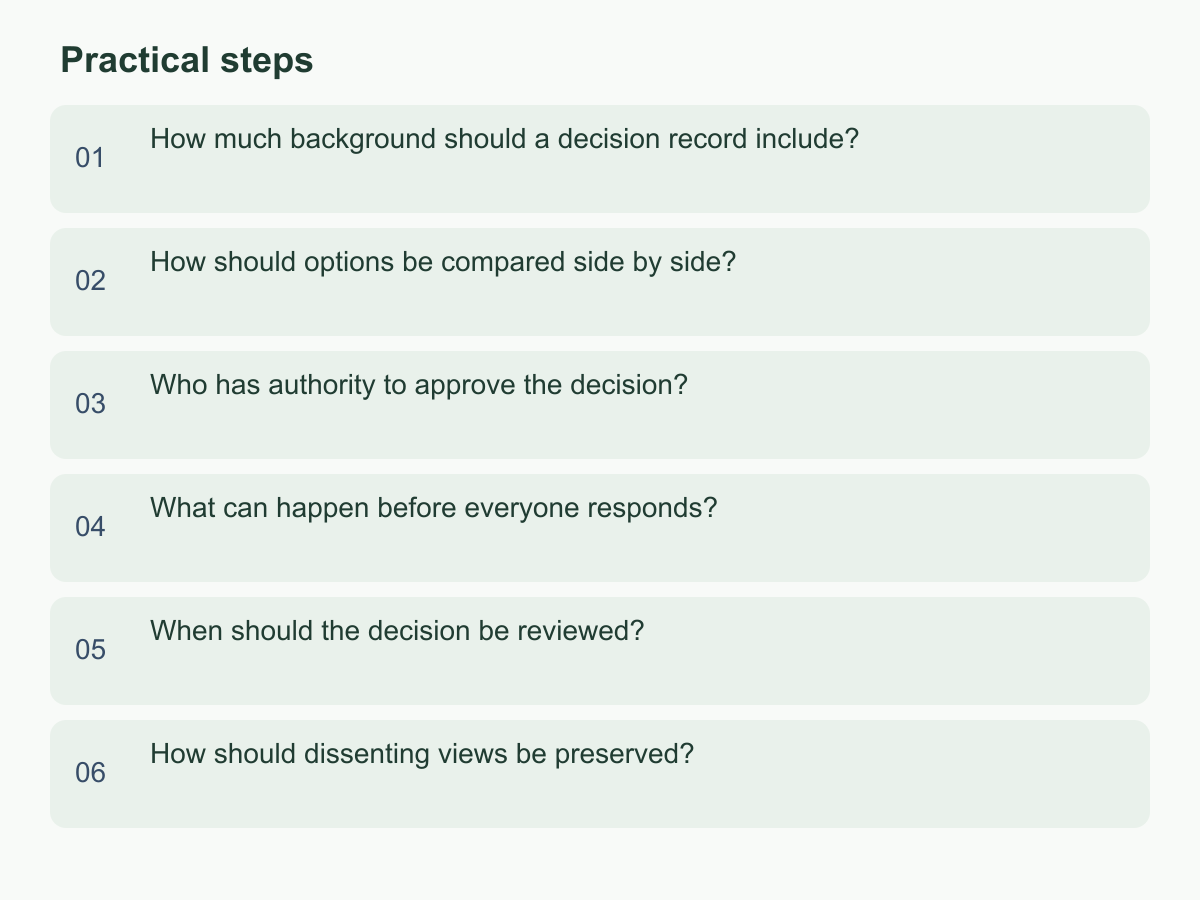
How much background should a decision record include?
Frame the issue as an answerable question and explain why now: current practice, what changed, and what work is blocked without a decision. “Should Singapore and Taipei share a weekly handover log?” identifies a choice and scope; “improve collaboration” does not say what completion means.
Separate facts, assumptions, and open questions. Link facts to sources, name who proposed assumptions, and assign each open question an owner and target date. “The process feels slow” does not show whether repeated handoffs revealed a pattern or one person made an observation. Keep the context brief and traceable.
Define the boundary: teams or workflow covered, start date, what stays unchanged, and constraints such as dependencies, deadlines, or staffing. Label unconfirmed details as open instead of promises; otherwise, a small pilot may look like a rule for everyone.
For the handover example, note scattered messages and the later shift waiting for updates. State that only internal handover is in scope, customer notices stay unchanged, and both locations still need to confirm they can update fields before shift change. Record creator, date, status, and source. Keep the problem separate from the decision and add dated versions as facts change.
How should options be compared side by side?
List at least two workable options, including the status quo or a delay. Compare each with the same fields: expected improvement, effort, dependencies, main risks, and trade-offs. Mark missing information as open and name its owner; a blank should not imply there is no risk.
The table shows a hypothetical internal handover scenario, not actual results.
| Option | Possible benefit | Cost or dependency | Best fit |
|---|---|---|---|
| Keep message-based handovers | No habit change | Information stays scattered | The issue is uncommon |
| Use a shared form | Fields stay together | Someone must maintain it | Handover content is stable |
| Run a small pilot | Gaps surface early | A pilot owner is needed | A key condition is open |
Choose two or three criteria that matter, such as continuity of information, who maintains the process, and reversibility. Avoid precise-looking scores without agreed weights. State the priority directly: here, traceable handovers come before reducing form-filling time.
Connect each option to evidence or an explicit assumption. Refer to a process document, handover example, or owner's explanation. If evidence is missing, state the gap and its effect on the choice. Keep reasons for rejecting options, such as another team's fields being unavailable or no maintainer; changed conditions may make an option viable later.
Close with why the selected option meets priorities, what cost the team accepts, and what new information could change the ranking. If no choice is possible yet, decide what to learn, who will gather it, and by when.
Who has authority to approve the decision?
Name one accountable decision owner, their name or recognizable role, responsibility scope, and approval method. The proposer may not be the approver, and the implementer may not be authorized to accept the consequences. “Management approved” or “everyone agrees” leaves readers unsure who can answer questions, handle exceptions, or make the final call. If the approver is unknown, list it as an open task.
Record who provides information, recommends an option, decides, executes, and needs the result. One person may fill several roles, but listing them separately exposes gaps: a proposal may lack an implementer, or the form maintainer may not have been consulted about its fields. Named responsibilities are clearer than a long recipient list.
Match approval to impact. A routine, reversible internal adjustment may sit with the process owner. Changes involving resources across teams, external commitments, or hard-to-reverse steps may need named approvals. State each person's scope; do not infer organization-wide authority from a title. If someone represents another company or partner team, confirm who may respond for that group.
For example: proposal—Taipei operations; information—Singapore operations; approval—joint process owners for both locations; execution—this week's on-duty owner. Mark if someone can advise but not approve, or if both approvers must reply explicitly.
Name a delegate or escalation point if the decision owner is unavailable, and define the delegate's limits. After approval, record who replied, when, which version they reviewed, and any conditions. Approval for a pilot does not authorize full adoption.
What can happen before everyone responds?
Silence is not consent. State what can proceed, what must pause, and the default if the deadline passes without a reply. Separate preparation, a pilot, and a formal commitment. Organizing information or drafting fields is usually reversible; external publication, customer-process changes, resource commitments, and hard-to-reverse steps should wait for explicit approval.
Give a date, time, and time zone, and say whether you need approval, objections, or missing information. “Reply soon” makes people guess. Allow time to read and respond around weekends, leave, and required contributors. If the deadline moves earlier, explain why and provide another response route.
Make the default specific: “If no one replies, keep the current process” is clearer than “continue as appropriate.” If preparation may continue, define its stopping point. Limit it to internal use, one workflow, or a named checkpoint so it cannot be mistaken for an approved launch.
A hypothetical record for a form change needing both locations' approval could say: “Please approve or object by Wednesday at 17:00 Taipei time. If no reply arrives, keep the old form and have the proposer arrange another check-in. Candidate fields may be prepared, but the live link must not be replaced.” The time is illustrative; use the actual deadline and relevant time zones.
If delay has a cost, explain it and offer options such as extending the deadline, narrowing the pilot, or escalating to another named owner. “Do it first and sort it out later” is not a default. The proposer identifies safe preparation; the approver marks commitments that must wait. When a reply arrives, update status, decision time, and next step so late readers can distinguish a pending draft from an effective decision.
When should the decision be reviewed?
Record a review date and triggers for an earlier check. The date brings the team back; a trigger responds to change, such as a dependency no longer being maintained, an owner changing, or the workflow expanding. Review checks whether the original rationale still holds; it does not predict failure. “We will look at it later” names no owner, time, or evidence.
Specify the review owner, timing, information to examine, and question to answer. Evidence might include handover records, unfinished tasks, or implementer feedback. Point to its source and ask actionable questions: “Is someone maintaining the fields?” or “Can the later shift find the current version?” If information is not yet collected, assign the setup and a completion date.
Treat temporary and ongoing decisions differently. Give a temporary arrangement an end date and decide before then whether to renew, adjust, or stop it. If continuing, record the approver and review result; silence should not extend it automatically. A stable process need not be reopened daily. Set review frequency according to how quickly conditions change and how consequential the decision is, with triggers for earlier review.
For a pilot of a shared form on one internal handover workflow, the team might ask the implementer to review it after two weeks: were fields left blank, could the next shift find the latest version, and was maintenance manageable? These are discussion prompts, not proven thresholds. Review sooner if scope expands or the owner cannot maintain the form; otherwise, use the planned date.
Record the outcome even if the decision stays the same: information checked, conditions changed or unchanged, owner changes, and next review date. If the decision changes, create a version with its effective date and notify affected implementers. Keep the earlier version so colleagues can understand why the decision moved and avoid using a stopped approach.
How should dissenting views be preserved?
Record the substance of disagreement, not only “someone objected.” Preserve the reason, supporting information, expected impact, and any condition or alternative proposed. If the person should not be widely identified, follow the team's access practices; decision makers still need to know which work role raised the concern and what risk it describes.
Track each point as addressed, still to be confirmed, or accepted but not adopted. Give open questions an owner and deadline. A decision owner may reject a suggestion, but should explain why another option was chosen, what trade-off was accepted, and what new information could change the judgment. This helps prevent repeated concerns and shows how they were handled.
Append comments without overwriting the original record. Add a dated response or link to the source discussion. If the decision is already made, do not edit the record to imply the concern was considered earlier. Where useful, turn it into a checkable claim—for example, “the night shift cannot access the current link”—and connect it to evidence or an open question. This distinguishes verifiable issues from preferences and unresolved assumptions.
Suppose a colleague supports testing a shared form but worries it is difficult to update by phone. The record could capture the situation, evidence, suggestion, and why the approver keeps the old link available while arranging a review. If later observations show phone access leads to missing fields, the team can revisit the concern; otherwise, the record still explains why the link stayed available. This is an illustrative scenario, not a reported case.
Dissent does not automatically invalidate a decision and should not be hidden as if everyone agreed. Keep the approval result, conditions, and unresolved questions visible to those who must act. To use this approach, choose a pending decision and fill in its background, options, approver, and review deadline. To learn more about Chan & Chung, visit the brand website.