
When a bank reconciliation contains unmatched items, treat them as information to investigate rather than rushing to record them as income or expense. Start with the transaction list, bank records, and internal documents. The steps below help you create a follow-up list that can be handed over, tracked, and supported by evidence.
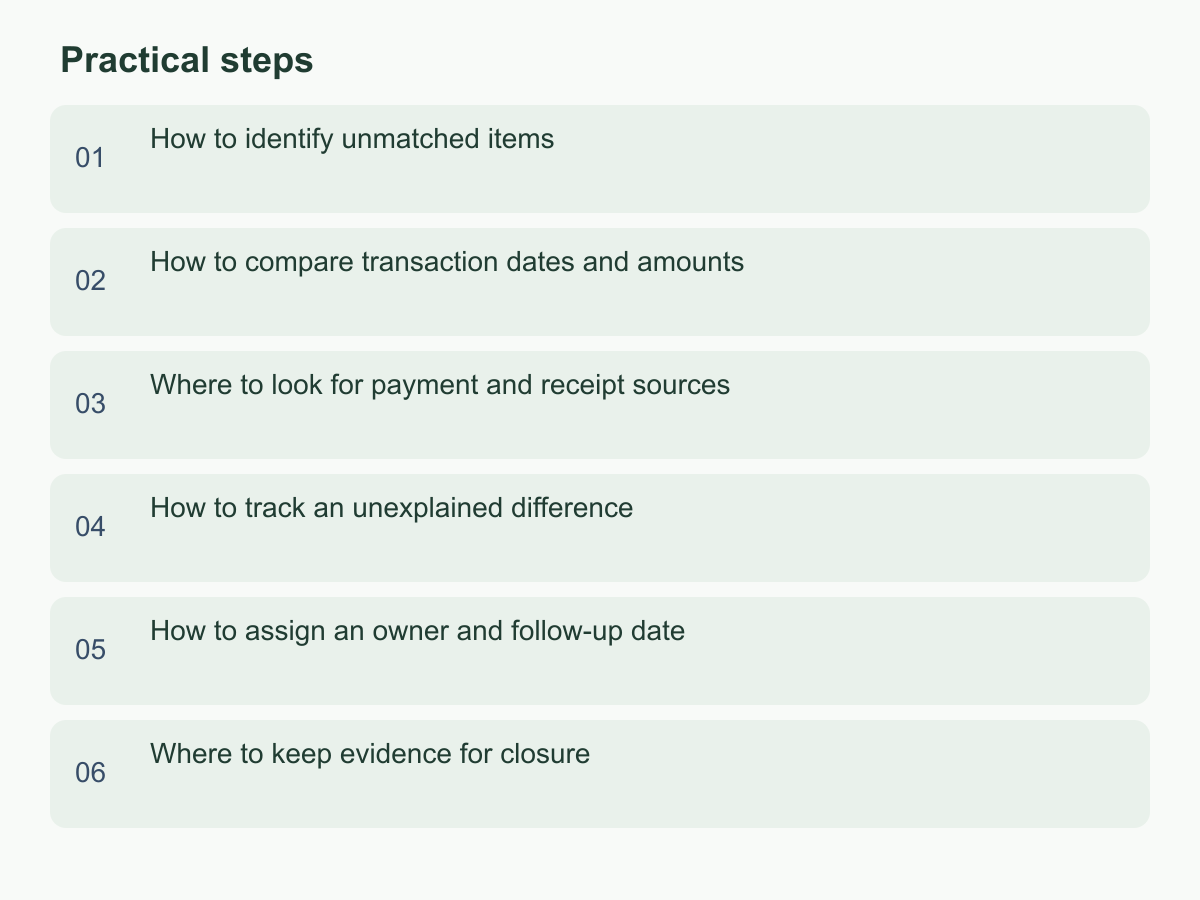
How to identify unmatched items
Place the bank statement or transaction export for the period beside the internal cash ledger and payment records. First confirm that the account, currency, start and end dates, and opening balance agree. Mark items that can be matched one to one. If bank data spans multiple months or internal records were exported in batches, sort by the bank posting date. Do not rely only on the document creation date or a colleague’s recollection, which can make timing differences look like missing entries.
Keep every remaining row, then check for duplicate imports, transactions split across several rows, refunds, reversals, and batch payments or receipts. Use date ranges, absolute amounts, and counterparty keywords to find candidates, then group them by direction, such as receipts, payments, refunds, or transfers. The same date and amount do not prove two records are the same transaction. Retain identifiers such as the transaction reference, account details, and document index.
For each row, record the bank date and description, amount credited or debited, possible internal match, status, records checked, and next action. Use preliminary labels such as “matched,” “possible match,” or “no lead yet.” A similar abbreviated name may suggest a payment record, but keep it as a possible match until supporting evidence is found; a similar amount alone is not enough. Triage larger, recurring, balance-affecting, or inter-account items first. Keep a count of unresolved rows and record what was checked, even for small amounts. Priority sets the investigation order, not the conclusion.
How to compare transaction dates and amounts
First check whether the dates use the same basis. A bank reconciliation usually follows the date money was posted or withdrawn, while internal documents may show the payment instruction, invoice, or export date. Treat date differences as possible timing items and inspect bank activity around period-end before deciding whether a transaction falls across periods. For overseas accounts or time-zone differences, retain both the source date and the date used for reconciliation; do not overwrite the original.
Before comparing amounts, align the currency and direction: receipts with receipts, payments with payments. Check decimal places, rounding, split batch payments, combined receipts, and separately listed fees. Keep the bank amount, ledger amount, currency, difference formula, and preliminary assessment in separate fields. For a currency conversion, find the exchange rate or settlement record used for that transaction. Do not subtract amounts in different currencies and treat the result as a confirmed difference.
| Illustrative case | Bank receipt (TWD) | Internal receipt (TWD) | Difference to check | Next step |
|---|---|---|---|---|
| Receipt on the same day | 12,300 | 12,000 | +300 | Check bank details and receipt documents |
This example shows that 12,300 minus 12,000 equals 300. It does not establish whether the 300 is additional income, a fee, or something else. Check whether the bank detail includes multiple receipts, then compare notices, orders, or internal collection records. If no supporting document is available, leave the item open and record the confirmed dates and amounts separately from what remains unknown.
Use the mismatch to choose the next check: same date but different amount suggests checking splits or combined transactions; same amount but different date suggests checking for posting delays; matching date and amount with an unclear counterparty calls for transaction identifiers and source documents. These are investigation directions, not automatic matching rules. A reviewer should be able to recalculate the difference from the original figures and see the evidence for each conclusion.
Where to look for payment and receipt sources
Start with the bank’s transaction detail, payment reference, remittance note, or payee information. Confirm whether the name shown belongs to the payer, recipient, collection agent, or an intermediary. Statement descriptions may be shortened, so a name fragment alone may not identify the counterparty. When detailed data is available, retain the date, amount, and reference needed to return to the original record rather than copying only the abbreviated description.
Next, search internal records according to transaction direction. For receipts, check collection notices, orders or contracts, invoices, accounts receivable records, and handoff notes from the colleague responsible. For payments, trace the requester, approval record, payment application, recipient, and receipt. Record the name and location of each source checked and what the comparison showed, so the trail does not depend on a verbal explanation.
If the business uses an external collection platform, payment service, or settlement tool, its reports may show order amounts, deductions, refunds, or bundled payouts. Check whether the report’s settlement period aligns with the bank posting date, then reconcile both the total and its detail. Do not assume a platform’s net payout equals one order. These are possible external information sources; whether they are used and how their records can be exported depend on the actual account and tool.
If the bank description is an unfamiliar abbreviation, use the date and amount to identify candidate transactions, then ask a colleague with access to the relevant order or payment records to confirm the counterparty and purpose. Share only the information needed for the inquiry, and use the company’s established secure channel for full account numbers or sensitive documents. If the item remains unidentified, record the bank detail and internal records checked, who was contacted, and what information is still needed.
How to track an unexplained difference
Keep an unexplained item on a follow-up list. Give each transaction a unique identifier, such as a combination of account, bank date, amount, and reference number. Record the counterparty, currency, direction, possible internal match, current owner, and last updated time. Add fields for the reason it remains unresolved and the next action, such as a missing payment document, unclear counterparty, or platform detail not yet received. This makes the open gap visible.
Use clear statuses such as “initial check,” “waiting for internal records,” “waiting for external response,” “pending review,” and “closed,” and define what must happen before a status changes. For example, a possible order match is not confirmed if the bank reference or collection notice is still missing, even when the order amount is identical. Each update should name new evidence, the result, and the next step. If the assessment changes, retain the earlier view and explain why it changed.
If closing work requires attention to an unresolved item, follow the organization’s existing accounting policy for a pending or temporary treatment and refer the recording decision to the person responsible for the accounts. Until the difference is explained, do not record it directly as income or expense, and do not alter the original bank amount to force a match. If the policy does not cover the situation, give the appropriate accounting owner the question and the available evidence.
For example, if a receipt is known to have reached the company account but the customer is unclear, note the bank date and amount, the receivables records checked, the missing identifying detail, and who will follow up internally. If no new information arrives, update why the item remains open and when it will be checked again instead of copying forward a blank status. That gives the next reviewer a clear history of how the difference was handled.
How to assign an owner and follow-up date
Assign one owner to each open item, preferably someone who can obtain the needed information. The account administrator may retrieve bank details; sales or the collections contact may confirm an order; and the requester or approver may help locate a payment application. Specify the expected output, such as finding the original document, confirming the counterparty, or reporting what information is missing. Naming only a department can leave the task with no individual responsible.
Also assign a reviewer to check the matching evidence, difference calculation, and status. Where staffing is limited, one person can investigate first and a manager can review during close or a periodic check; record the actual division of work. Give priority and more frequent updates to high-value, recurring, period-end balance-affecting, or potentially misdirected payments. For smaller items, still record why they were closed or deferred.
Set dates around the internal close schedule and the time needed to obtain documents. Include an initial response date and a later follow-up date. For example, if the list is exported on Monday, an initial check-in could be set for Wednesday and a manager review for Thursday. This is an internal scheduling example, not a statutory deadline. If information is pending from a bank or counterparty, update the status when the date arrives, including when they were contacted and when a response is expected. Do not let overdue items sit silently in the spreadsheet.
Plan a substitute when the owner is absent, lacks access, or cannot reach the usual contact. Include completed steps and missing information in the handoff, and record its date, the new owner, and the next action. If the cause is still unclear, identify who needs to make a decision. This allows a manager to distinguish unfinished investigation from unavailable records or a need to change the approach.
Where to keep evidence for closure
At closure, every bank transaction on the list should link back to the original bank record and the relevant internal records. If one bank receipt covers several transactions, keep the allocation detail and show how the amounts add up. Store evidence in a company-approved location and record the document name or index, storage location, investigator, reviewer, and completion date. Use consistent file names and period labels so the evidence can be found during the next reconciliation.
Record how the unmatched item was resolved, such as finding an omitted receipt document, confirming a posting date difference, or explaining a bundled payout through its detailed breakdown. If the difference is still unresolved, do not mark it closed. Keep it open and state what evidence is missing, who will follow up, and when it will be reviewed again. Closure evidence must show an amount relationship that can be recalculated; “confirmed” or “a colleague said it was this payment” is not enough.
For example, if one bank detail is matched to two internal receipt records, retain both document references, their combined total, and whether that total agrees with the bank amount. If one document is still missing, save what has been found and identify the gap rather than treating partial evidence as a complete closure. Follow company access rules for account information, and avoid placing full bank documents in an unsuitable shared folder.
Before the next reconciliation period, sample items closed in the previous period. Check that their links still open, the documents remain identifiable, and later information has not changed the conclusion. You can start by exporting the latest statement for one account, creating a follow-up list with the fields above, and assigning an investigator and initial response date. For public information about Chan & Chung, visit the Chan & Chung website.