
When checking statements across multiple accounts, start with one register that defines which accounts, periods, and document types are in scope. Then check each row against the files received. This guide checks whether monthly statements are complete; it does not match foreign-currency transactions. The workflow centers on a register that is ready for handover.
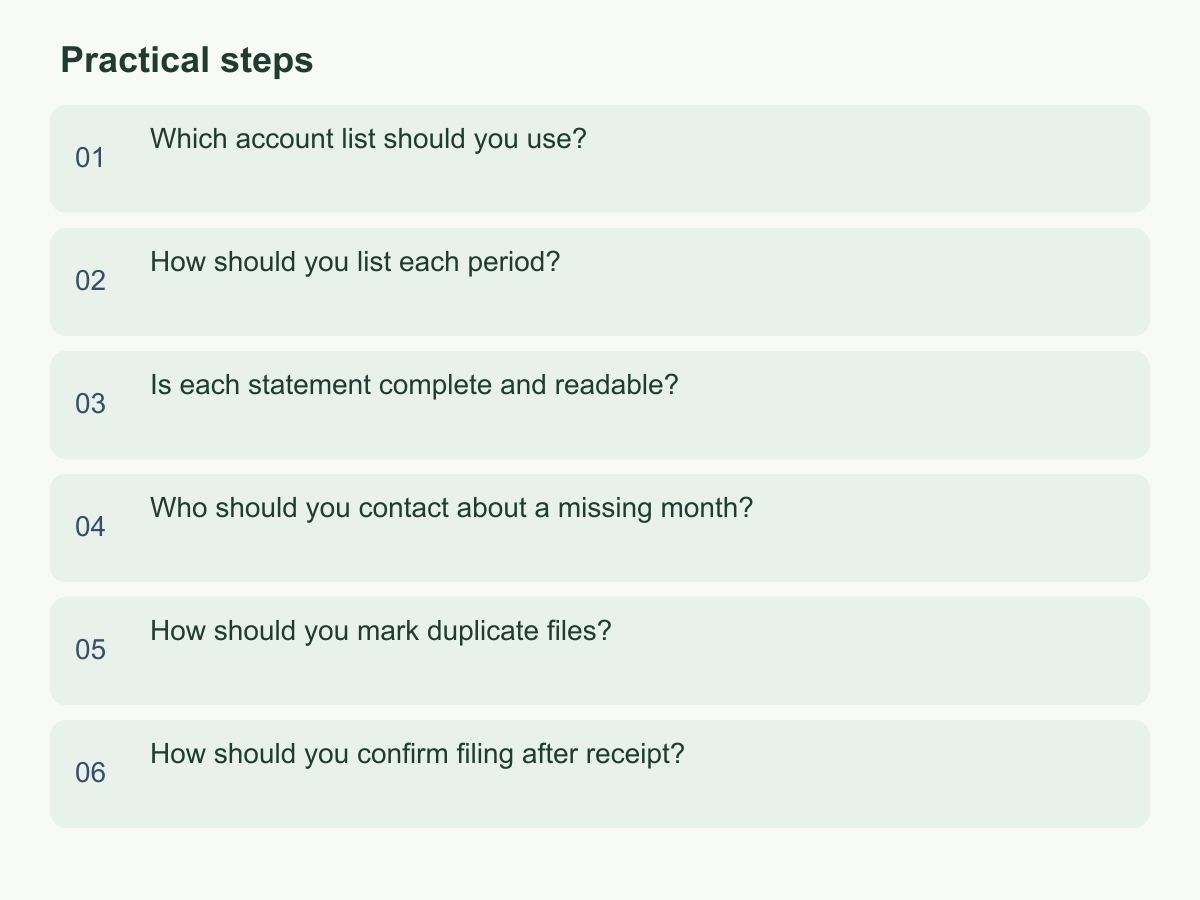
Which account list should you use?
Create the master account list first; files already on hand do not define the scope. Cross-check current online banking, bank notices, prior handover registers, payment authorization records, and old statement filenames. Give each account a row for its bank or platform, last four digits or masked identifier, currency, purpose, status, owner, source, and confirmation date. When the last four digits identify an account, keep the full number out of the general tracker and retain sensitive originals in a controlled location. Use masked identifiers rather than ambiguous aliases such as “operations account.” Keep old and replacement accounts in separate rows with their effective or closure dates.
Ask a person familiar with payment operations which accounts still need statements and whether closed, frozen, or renamed accounts need historical periods; do not infer this from the files found. Mark uncertainty “To confirm,” naming whom to ask and a response date. Add an entity column when several companies or overseas operations are involved, so similarly named accounts stay separate. Date the list and name its preparer. If source records are missing, mark them pending. For example, Company A’s operating account ending 4821 and Company B’s reserve account ending 0736 stay in separate rows, even when one colleague manages both.
How should you list each period?
First decide whether the register tracks calendar months or each account’s statement cycle. Write explicit start and end dates and use one rule throughout; some statements cross month boundaries. Use one row per account and review period, and judge coverage from the dates printed inside the document, not its filename. Include the account identifier, review month, expected document type, status, actual coverage, file location, owner, and notes. Keep status options fixed, such as “To obtain,” “Received—check pending,” “Complete,” or “Follow up.” If coverage is discontinuous, use separate rows; if one file supports multiple review months, link those rows to the same file.
Where statements do not match calendar months, retain both “review month” and “document coverage.” A July review may map to a June 26–July 25 statement; record those actual dates, not July 1–31. If a period is still open, mark it “Period not ended,” not missing. Example:
| Account ending | Review month | Document coverage | Status |
|---|---|---|---|
| 4821 | July | July 1–31 | Check pending |
| 4821 | August | August 1–31 | Received |
| 0736 | July–August | July 15–August 14 | Check dates |
Account 0736’s document does not by itself establish complete coverage for either month. Link it to each applicable row, note its exact dates, and mark those rows for period review rather than treating its month label as proof.
Is each statement complete and readable?
A file in the folder is not complete until its account, period, readability, and pages are checked. Open it and compare the masked account identifier or last four digits, document type, dates, and bank label with the register. Inspect pages for blanks, omissions, duplicates, truncation, or blur; if page numbers or a total are shown, confirm the sequence. Check that the intended handover recipient can open the electronic file. A filename or file size alone is not evidence of completeness.
Separate statements from transaction exports. An export may list transactions without the required period, account identifier, or full statement pages; do not substitute it without confirmation. Check low-activity or zero-transaction statements by period and format, not by page count. Keep any file password in an approved handover method, not in the tracker or filename.
Record three checks: correct account, matching period, and readable file with complete pages. Mark “Complete” only when all pass. If the account matches but dates do not, mark “Period to verify”; if unreadable or incomplete, mark “File to replace” and give the reason. A file named “4821_2026-08” that covers August 3–September 2 remains pending. Preserve it and ask the account owner whether another statement covers the calendar-month gap before changing its status.
Who should you contact about a missing month?
A blank month may mean a file is not yet obtained, the account is unconfirmed, or the document dates do not match. Identify the case before contacting anyone. Ask an authorized online-banking user to retrieve the named account and period through the company’s approval process. For access issues, contact the account administrator; do not share login credentials with the tracker owner. For handovers from former staff or external bookkeepers, ask the designated company contact whether the files remain in controlled storage.
If internal copies are unavailable, ask through the company’s established bank contact whether the statement can be retrieved, in what format, and by what process. Provide masked identifiers, exact dates, the requested document type, desired internal completion date, and reply contact. Never exchange one-time codes, passwords, or full login details by email or chat.
Log the contact date, recipient, status, and next step. Set an internal reminder for promised delivery; a verbal response is not receipt. If the bank cannot provide the statement, record why and mark the row “Pending decision” until the owner chooses another formal bank document or review method. A promise to check July history by Friday remains “Follow up” until the file arrives and passes review. If unanswered by the internal handover date, alert the account owner and project lead. Label that date internal, not a statutory or bank deadline.
How should you mark duplicate files?
Never decide two files are duplicates from filenames alone, and do not delete a copy just to tidy the folder. Compare account identifier, coverage dates, page count, and contents. A file hash can help, but confirm the documents themselves: identical names may hide different contents, while renamed downloads may match. Add a duplicate or version field to distinguish the source original, exact copy, partly overlapping periods, and reissued or corrected versions.
For exact copies, designate a primary file and mark the other “Duplicate—see primary,” noting its source, download date, and location. Keep it until the owner confirms disposal under the existing retention process. If files for the same account and month differ in pages or content, mark them “Version difference—verify”; do not overwrite the old file with the newest download. For date overlaps, record both the overlap and the uncovered interval: overlapping dates do not prove full coverage.
For example, if account 4821 has “final” and “final2” files for August, identical contents can point to one primary. If one covers through August 31 and the other through September 2, retain both and verify; later dates alone do not show replacement. A filename such as “entity_last4_start-end_version” can aid searching, but use only dates printed on the statement. When a correction is confirmed, record who confirmed it, when, and what it replaces, then link the primary to the superseded file or custody record. After deduplication, recheck month gaps so one file is not counted twice.
How should you confirm filing after receipt?
Archiving is complete when each row links to a retrievable primary file, not when its status turns green. Record the filename or controlled location, actual dates, reviewer, and completion date. Verify handover readers have access and that the file is in the agreed company location. If not, mark “Received—access pending”; a personal downloads folder is not a handover. Use the same account identifier in the tracker and statement.
Before handover, read every account and period. Confirm all expected rows exist, each required period has a reviewed primary file, pending items have owners, and duplicates point to their primary. Filter for non-complete rows and confirm the notes match. Keep open periods separate from missing files, and include closed-account history only within the confirmed scope.
Final arithmetic check: two accounts across three months require six rows. If four are complete, one period is under review, and one file is missing, report four complete and two pending. Ask another recipient to open a primary file and verify the account, dates, readability, and access. List unresolved account and date pairs, contact, next internal follow-up date, and decision owner for the handover.
Start by confirming the master account list and review periods for this handover. Then update each row as statements are received, checked, and filed. For more about Chan & Chung, visit Chan & Chung.