
Reviewing cross-border operations can be practical without a manual for every task. Check whether recurring work continues through handoffs, missing information, and exceptions by examining owners, records, backup coverage, and measurable improvements. Use the examples as hypothetical prompts, not benchmarks. Begin with a workflow that occurs regularly and can delay the next step or create rework; trace one recent case from start to finish.
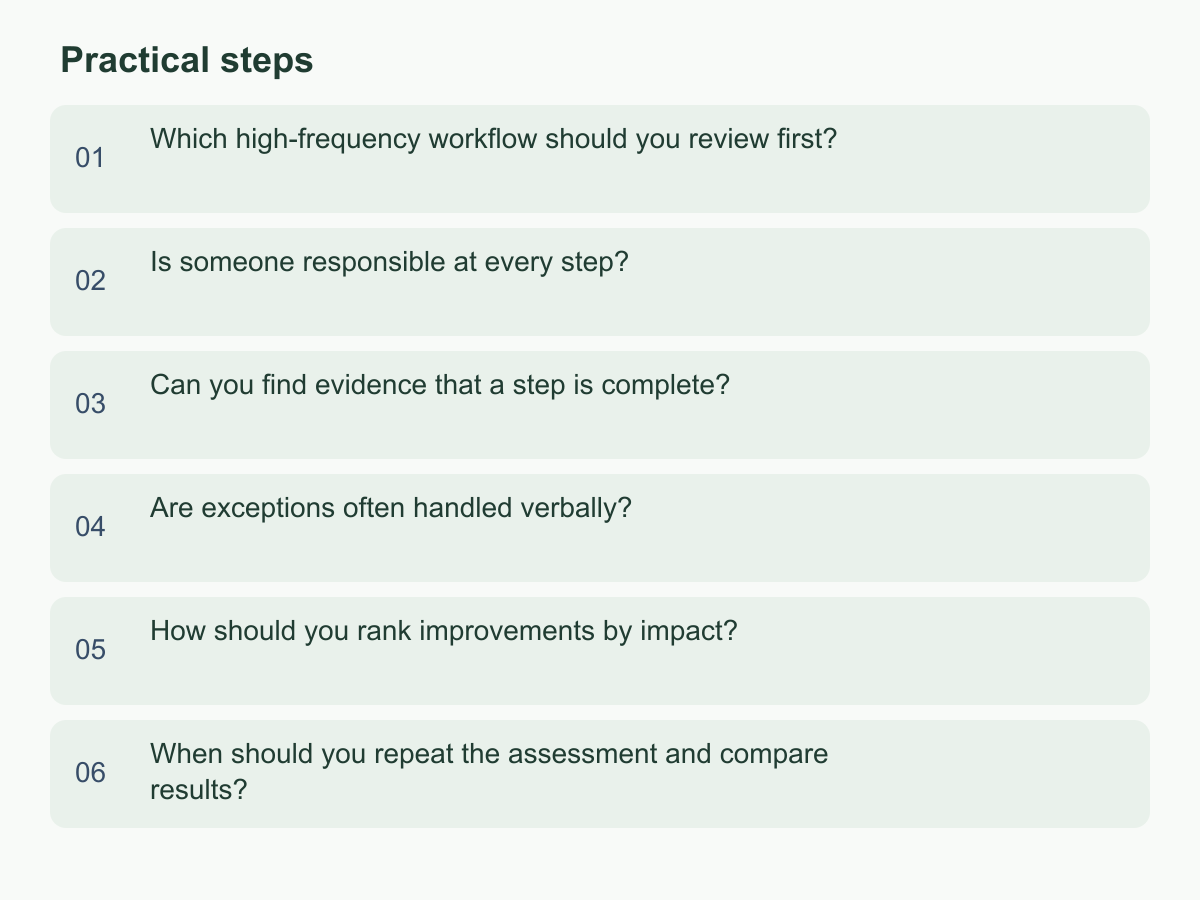
Which high-frequency workflow should you review first?
Start with recurring work that happens often, crosses handoffs, or affects customers and later steps. List activities such as checking overseas orders, reconciling payments, preparing delivery documents, or handing work to an external collaborator. Record each activity’s trigger, frequency, roles, inputs, and output. Investigate unclear starts or next owners.
Choose one end-to-end path, such as “order confirmation to delivery,” and define its start and finish. If work varies by market or product, select one scenario. Include upstream and downstream waiting, not just one department’s task.
Record items per week, roles, information exchanges, waiting, follow-up, and rework. Compare your own results over time; these are not industry benchmarks. If complete data is hard to collect, examine the five latest cases, note where each stalled and how the team recovered, and label it a small-sample observation. Keep the period and calculation method.
Prioritize frequent work with several handoffs or meaningful delays. For example, track a workflow producing 40 delivery packets weekly when staff often return to confirm the source, before an internal task performed once a year. Define the review in one sentence, such as “Find where information is most often interrupted,” to keep changes tied to an observed bottleneck.
Is someone responsible at every step?
Trace actual work, not job titles. For each step, name a primary owner to receive input, check it, decide whether it can proceed, and record completion. Specify the output passed downstream—“information checked,” “missing items listed,” or “an owner assigned to each open question.” “Followed up” alone does not establish completion.
Check backup coverage in practice. When the owner is away or overloaded, can a named backup find current status, essential files, outstanding work, and escalation conditions? Test an active case by asking the backup to explain the next step from existing records and noting what they must ask the original owner. A name without records or clear authority is not usable coverage.
Agree how the receiver confirms acceptance and where incomplete work is returned. “Sent” does not mean the next person can proceed. For example, in a hypothetical overseas order, sales could collect details, operations check required fields and the delivery list, and finance confirm the payment record matches the transaction. Record handoff conditions and backups. If an owner is unclear or the backup cannot proceed, assign an improvement and evidence of completion.
Can you find evidence that a step is complete?
Set minimum evidence for each important step: the checked document version, completion date and owner, delivery confirmation, discrepancy handling, or outstanding items. Each record should identify the work item and status, who did what and when, and the information used. When a document changes, distinguish the current version from its replacement so later work does not rely on an outdated file.
Keep records in a team-agreed location that authorized colleagues can access. Use consistent names or an index linking evidence to the work item, then confirm the next person can find it. If details sit in email, chat, or local folders, designate a primary record and link necessary support. Retain only personal or customer information needed for the handoff and decisions, with access set to work needs. Note the steps a spot check takes; repeated searching is friction to address.
Reverse-check a closed case by asking a colleague to find the input, review result, exception, and final delivery from records alone. A completed cross-border document delivery might show its recipient, version, time sent, and outstanding items rather than simply “sent.” Another authorized colleague should be able to find, understand, and use the evidence to continue.
Are exceptions often handled verbally?
Map normal and exception routes separately. Possible exceptions include incomplete information, a different document format, an unmatched payment reference, changed delivery time, or delayed partner response. Check your own cases. For each, record the trigger, decision-maker, temporary way forward, and when resolution will be checked. This makes verbal workarounds visible.
Group recent cases as occasional and clearly handled, recurring, or significant in impact. Recurrence may reveal a missing check, unclear input, or incomplete handoff conditions. A rare but serious issue may still need authority to pause work, a decision-maker, and a communication path. Avoid a permanent rule for every one-off event; record uncommon cases and set escalation thresholds, such as blocked later work, an affected external delivery, or unconfirmed important information.
If partner documents arrive in different formats and colleagues request missing details in messages, compare cases for repeated missing fields, source details, or file names. Add recurring requirements and completion conditions to a checklist, then assign someone to confirm the change works. If causes differ, retain case records and escalation contacts rather than forcing one fix. Compare exception types and waiting time next review.
How should you rank improvements by impact?
Describe each change observably, such as “check required fields before handoff.” Score impact, frequency, rework, and ease from one to five; define five as high impact, frequent, substantial rework, and easy to implement, respectively. Scores compare your own options, not an industry standard. A rare issue with serious consequences may still come first.
| Improvement | Hypothetical observation | Scores and decision |
|---|---|---|
| Complete required fields before handoff | Six follow-ups weekly × 12 minutes = 72 minutes | Impact 4, frequency 5, rework 4, ease 5; total 18, first |
| Add cross-time-zone backup guidance | Three handoffs weekly, with occasional waits | Impact 4, frequency 3, rework 3, ease 3; total 13, next |
| Standardize an infrequent file name | Monthly, with no clear delay so far | Impact 2, frequency 2, rework 1, ease 4; total 9, later |
Record a baseline such as follow-up requests, average waiting time, or first-time completion, with its source and period. Trial one or two high-priority steps at a time; name an owner, measure, review date, scope, and pause condition. Estimate the people and time needed. A checklist may be easier to validate than a full redesign. If the measure does not improve, investigate the cause instead of treating a new guide as proof.
When should you repeat the assessment and compare results?
Reassess when owners or backups change, a partner or market changes, workload rises substantially, tools or data paths change, or a similar exception recurs. For stable work, choose a suitable internal rhythm; monthly or quarterly are examples, not external requirements. Higher-frequency work with several parties may need closer observation.
Keep the same scope, definitions, and calculation method. Record case volume, waiting or rework, exception types, evidence accessibility, and whether owners and backups remain suitable. If volume changes, report it: total time can rise simply because there are more cases. Compare average waiting per case or the share needing follow-up too. Spot-check a completed case to see whether someone else can continue from the new records. If a metric is unchanged, check adoption before rejecting the measure.
Close with practices the records show are working, improvements with an owner and deadline, and unknown causes that need observation. After a change, compare the preselected metric. If it did not move, check whether the practice was adopted, the measure fits, or the original assumption was wrong. Do not mark an unconfirmed item complete merely to fill a table.
Choose a recurring workflow and bring two recent records for a first review of owners, evidence, backup, and one improvement measure. For Chan & Chung brand information, visit the official English homepage.