
When two partners claim the same client or opportunity, preserve each person’s account and its supporting timeline. Then follow the current written policy to identify the decision-maker and set a clear interim contact point. This process helps teams verify evidence, check the client’s current status, and document how a decision was reached without treating either claim as automatically stronger.
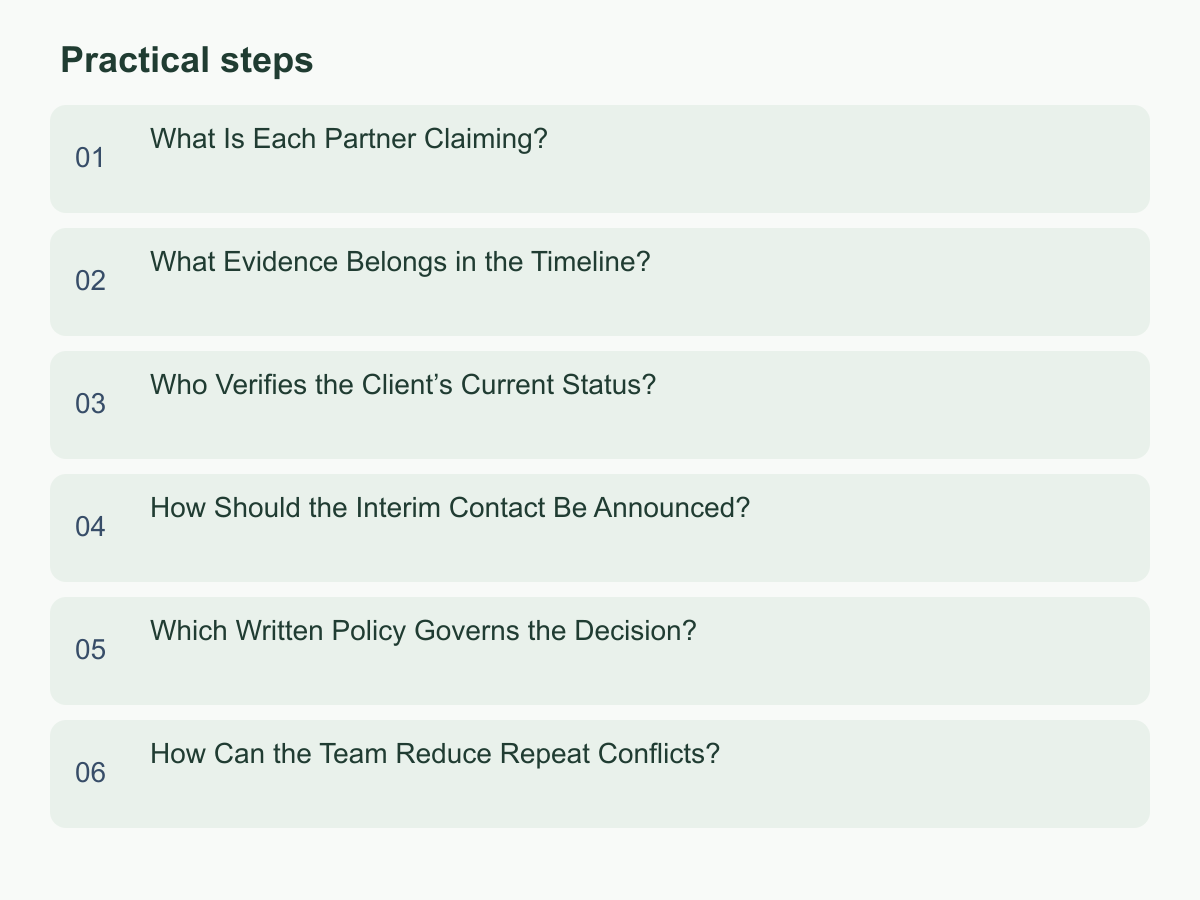
What Is Each Partner Claiming?
Separate what each partner says from who will ultimately handle the opportunity. Ask each person to record the client or business identity; discovery source and any introducer; first-contact time and method; interactions, commitments, pending actions; and locations of supporting evidence. Label each item as first-hand, relayed, or unverified, and flag conflicts. Confirm the client entity, brand, region, and contact to avoid merging similar names or departments.
Use the same form for both accounts. Preserve original wording and prior versions; date each correction and name the editor and reason instead of overwriting a record. Do not substitute familiarity, hours spent, or impressions for evidence. For example, one partner may cite an introduction by an existing collaborator while the other recalls exchanging details at a public event. Record both claims with the relevant message or follow-up note; meeting someone first does not establish attribution. Keep unsupported claims and mark “no evidence attached.” The initial summary should show overlap, disagreement, and missing items, not a decision. Clarify what each person means by “first contact” or “formal introduction” before the designated adjudicator applies the policy.
What Evidence Belongs in the Timeline?
Separate discovery, first contact, introductions, meetings, confirmed needs, proposals, and commitments. For each entry, record event and record-creation times, participants, what happened, the original source, and a checkable location. Preserve original timestamps when forwarding or editing changes them, noting the difference and time zone. For calls, record participants, summary, writer, and later confirmation; never present a retrospective note as real time.
The example is hypothetical. Its times show fields only; it describes no real client and sets no attribution rule.
| Event time (hypothetical) | Event | Evidence | Check status |
|---|---|---|---|
| Monday 10:00 | Partner B exchanges cards at an event | Same-day event note | Note visible; no client confirmation |
| Tuesday 09:00 | Partner A receives a referral email | Original headers and message | Original email checked |
Keep original emails, invitations, minutes, and follow-ups; note file location, creator, import time, and whether the source system was checked. A cropped screenshot is only an index. “Contacted” lacks context. Tuesday’s referral email and Monday’s event note show two contacts and their times, not who first created a qualifying opportunity. Label each source original checked, participant note only, or not obtained. Preserve conflicting displayed times and zones; do not normalize them. An uninvolved reviewer should be able to return to the source.
Who Verifies the Client’s Current Status?
Have someone check the latest client status against records both partners may access; neither disputed party’s account is sufficient. Review the latest actual interaction, current need, promised work, open questions, and planned external contact. Before asking the client, confirm who is authorized and whether one contact is required. Ask only about current needs and commitments, not who deserves credit; keep the internal dispute internal.
Distinguish original records, the client’s reply, and a colleague’s account. Record the source and date for any potentially stale status. List mismatched company names, aliases, regions, or contact roles with their evidence; merge records only when identity is supported. If a need is described as current but no client reply exists, mark it unconfirmed. When access is restricted, ask an authorized colleague to verify and summarize only what is needed, following existing retention rules. Send the same summary to the designated decision-maker and both partners; invite specific corrections or documents and mark unresolved facts. Record who prepared it and when. Fact-checking does not decide attribution.
How Should the Interim Contact Be Announced?
Check the written policy for an interim contact, decision-maker, and escalation route. Notify the specified people; a first message does not confer authority. Tell both partners what the temporary arrangement covers, which commitments remain unconfirmed, where updates belong, how urgent matters are escalated, and any policy-defined update point. The arrangement maintains continuity while a decision is pending; it does not decide attribution or dismiss the other partner’s contribution.
If the policy sets no time limit, say the arrangement continues until the decision-maker changes it; do not invent a deadline. For client updates, use a neutral message from an authorized contact. For example, acknowledge a request, say existing records will be checked, and log the request, response time, and owner without promising unconfirmed work.
Send the same notice to both partners and the decision-maker; preserve its text and recipients, and treat silence as no reply, not consent. Suggested wording: “For now, [contact] will handle [external matters]. At [policy/designated person]’s direction, this is an interim contact arrangement pending review, not an attribution decision. Send new facts to [record location].” Fill brackets with verified details only. Add new messages to the timeline and share updates through the same designated process if the contact changes.
Which Written Policy Governs the Decision?
Before comparing claims, identify the policy’s name, version, scope, covered parties, and provision for duplicate claims. The designated adjudicator should list the actual criteria, then mark each item of evidence accepted, excluded, or unresolved, with a reason. Explain how the criteria lead to the decision. “First contact,” final sale, effort, or client preference are context only unless the policy makes them criteria; a convenient practice is not a standing rule.
The decision record should cover its scope, client contact, each party’s next steps, unresolved facts, review or escalation route, policy version, and notification date. If the policy does not address the situation, refer the gap through existing governance to the policy owner; do not invent a split, priority, or retroactive effect. For multiple relevant documents, check issuer, scope, version, and any stated precedence. Record required consultation, recusal, or escalation where the policy provides for it. Separate verified facts, cited text, reasoning, decision, and unresolved points; include objections and responses. Cite relied-on provisions by version and location, send the outcome to specified recipients, and record delivery. Receipt is not agreement. State the existing correction or review route without extending the decision to commissions, qualifications, or future rights the policy does not cover.
How Can the Team Reduce Repeat Conflicts?
Review where the process created different expectations rather than replaying who deserved the opportunity. Check the record for confirmed gaps: searchable client identity, whether the source was logged after contact, an explicit referral, notes for key meetings, a clear update owner after handoff, and policy coverage for overlapping claims. Assign an owner to each confirmed gap; one case does not establish a general pattern.
A CRM, spreadsheet, or similar system may support duplicate searches or reminders, but these are external tool options, not a universal setup or Chan & Chung offering. Before changing fields, alerts, or access, the responsible owner should check feasibility and data permissions. Policy updates need version history, effective conditions, and notice records; never apply them retroactively. Compare similar future cases using the same fields and criteria before revising the process. Make each action verifiable: add a source field, change edit access, or publish guidance. Link actions to this case; record the change location, notice recipients, and effective date. Address only confirmed causes, retain necessary records under existing access and retention rules, and close with a “claim—time—source—open question” checklist that names the next owner.
Next, assemble a single case log with separate entries for each claim, timeline evidence, verified client status, policy basis, interim contact, and follow-up owner. Include evidence locations and version dates so another person can trace the record without rewriting either account. For official Chan & Chung information, visit the English homepage.