
Monthly company-card reconciliation is about linking each statement entry to its cardholder, purpose, supporting document, and any later refund. Keep source files, matching fields, status, and next owner in one tracker. Each entry should retain its source, decision, and next step; a balanced total alone does not prove complete records.
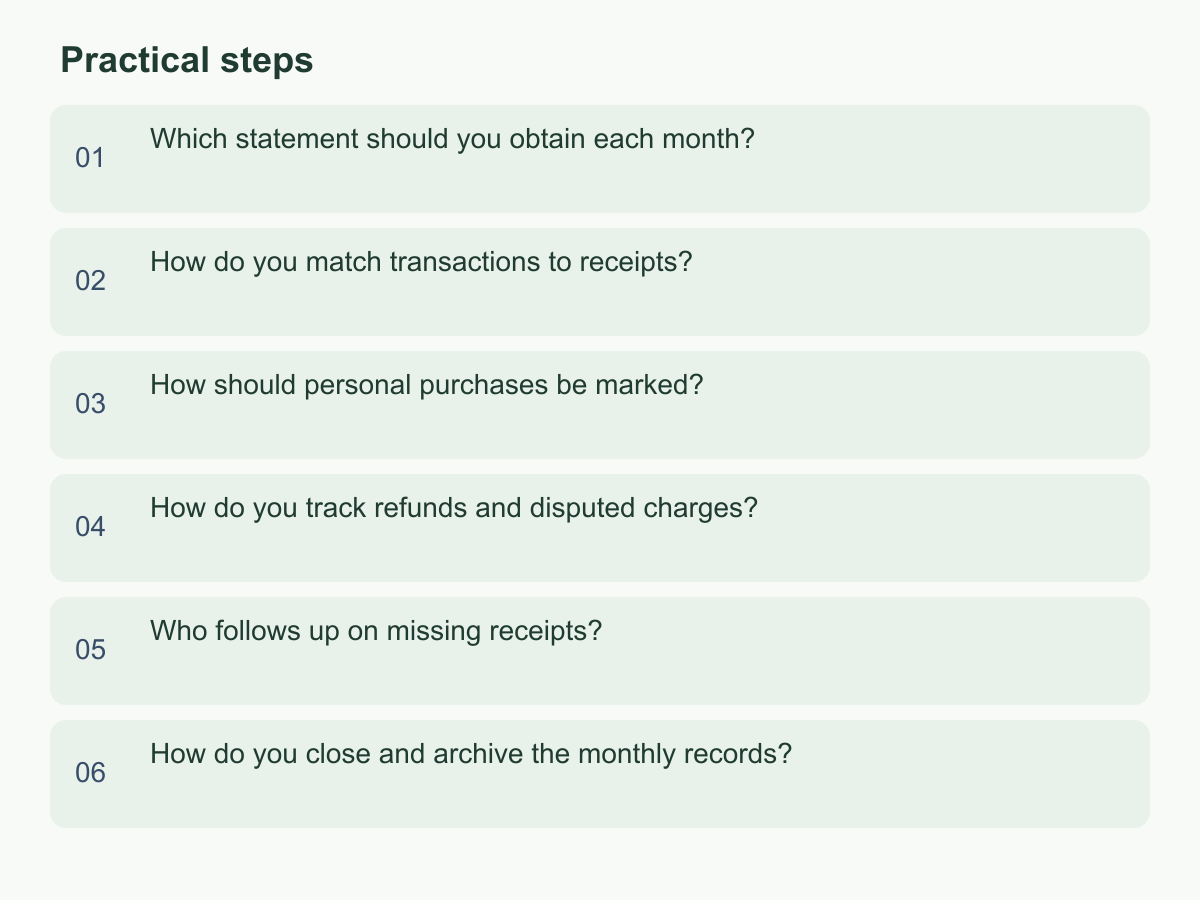
Which statement should you obtain each month?
Obtain the issuer’s formal statement for the full cycle, its transaction export, and any available cardholder or supplementary-card breakdown. Use the statement for the cycle total and closing date, and the export for matching. Alerts and screenshots can flag issues but do not replace complete records. Label each file with the cycle, currency, card’s last four digits, and retrieval date.
Define scope by posting date; retain the purchase date separately for identification. Record the source and version of any late supplementary-card file or corrected export to avoid duplicates. List pending entries separately from the formal statement total.
With multiple cards, register each holder’s name, department, last four digits, active status, and administrator; check that all cards are included. On handoff, note the effective date and owner; do not reassign earlier transactions. Compare the statement’s first and last pages, page count, total, and transaction count with the export, retaining zero-dollar, cancelled, and adjustment rows. Use posting dates as shown, including weekends and time zones. If the statement shows 18,400 and the export 18,000, preserve both and locate the 400 difference by posting date, amount, and last four digits. Check for a missing supplementary card, a refund on another page, or a different export period. Keep the difference open until explained; do not plug it with an adjustment.
How do you match transactions to receipts?
Match by posting date, amount, merchant descriptor, currency, and last four digits; confirm the purpose with the cardholder and link a receipt or electronic document. Descriptors may be platforms or abbreviations, so check for same-day orders, branches, or group payments. Keep one row per transaction with statement and transaction IDs, cardholder, purpose, document link, status, and discrepancy. Name files date_merchant_amount_last-four.
Check that the merchant, date, and amount are legible on a receipt or screenshot. If an electronic receipt shows only an order total, add payment or item detail identifying the relevant items. For a different branch code or platform, record the merchant alias and order number. For mismatches, check for discounts, tips, deposits, or balance payments; if the cause is unclear, note the missing evidence and preserve both amounts.
The following are assumed examples in the same currency:
| Assumed transaction | Statement amount | Supporting record | Status |
|---|---|---|---|
| Office supplies | 2,400 | Receipt 2,400; cardholder confirmation | Matched |
| Transport | 480 | Receipt 450; trip record | 30 difference under review |
| Personal purchase | 900 | Cardholder marked personal | Separate personal handling |
| Refund on original purchase | -300 | Refund record linked to original transaction | Matched |
The four entries total 3,480. Excluding the 900 personal purchase leaves a business portion of 2,580. Documents support 2,400 + 450 - 300 = 2,550, leaving 30 to investigate. Assign an owner; do not round away the difference or invent an offset. If one receipt covers several charges, record the split and allocation so each statement line points to its source without duplicating the receipt.
How should personal purchases be marked?
Do not infer a personal purchase from merchant type: restaurants, transport platforms, and online shops may include work and personal spending. Mark it “awaiting cardholder confirmation” and let the cardholder privately provide the purpose and supporting document through a limited-access channel. Once confirmed, separate it from business expenses and record the amount, posting date, confirmation date, and treatment under internal rules. Keep it in the tracker because it remains part of the statement total.
For mixed purchases, request item details or an itemized receipt that supports the split. If only part is confirmed, list that amount and the unconfirmed balance separately, preserve the source, and refer the question to the manager or internal owner. Do not guess from the merchant, a round amount, or a short description. Avoid company-wide requests for personal details; a card administrator can collect them privately, with only a necessary summary and file location in the discrepancy log. Use distinct labels for “personal confirmed,” “mixed purchase to split,” and “purpose unconfirmed.”
For example, an assumed 3,600 order with 2,700 of work supplies and 900 of personal items can be split only if order details support those amounts; otherwise, keep the full charge unconfirmed. Set an internal response date as a work arrangement, not a statutory deadline. Record how the personal amount was settled and keep evidence; review the card guidance if the pattern repeats.
How do you track refunds and disputed charges?
Trace each refund or disputed charge to its original transaction. Record the original date and amount, merchant, refund or dispute amount, request date, status, and next-check owner. Link a cancellation notice, refund confirmation, or issuer case number to the same row. Use distinct statuses such as “refund posted,” “requested, not posted,” “dispute in progress,” and “closed,” based on available records.
When a refund appears, verify whether it is full or partial and which original item it relates to. Link split refunds to that purchase and flag cumulative refunds above the refundable amount. A merchant notice does not mean funds reached the account. Until posting, keep the original expense and expected refund separate; do not subtract an expected refund from expenses. Record a later refund in its actual posting month and note the purchase month instead of changing an archived month.
Review unposted refunds weekly, noting the statement date checked, amount promised, and outstanding balance. For example, if an assumed 2,000 purchase has a 500 refund on this month’s statement, record 500 as posted and 1,500 as still to reconcile. A promised additional 1,500 is not complete until posted. For disputes, retain communication dates, submitted evidence, and the issuer’s reply; follow its channel and timeline without promising an outcome. Close a row only when the refund posts, the charge is confirmed valid, or the responsible person decides the next step. Keep open items visible.
Who follows up on missing receipts?
Assign one next-step owner and an internal response date to each missing item. The card user can supply the receipt, an administrator can maintain status, and a manager can decide the purpose under internal authority. Show who acts next, what they must provide, and by when. Filter for unmatched charges, receipt differences, unconfirmed purposes, and unposted refunds. Each notice should identify the transaction date, amount, merchant summary, and missing information.
Use short statuses such as “to assign,” “notified,” “documents received,” “review needed,” and “closed.” Record the date, updater, result, and next action at each change. When a receipt arrives, repeat the transaction and amount match; if they differ, return it for review with the reason. If it cannot be found, keep the item unresolved and ask the manager whether to request an order record, payment confirmation, or internal approval. Escalate overdue items internally; silence is not approval or reimbursement. Set an internal due date, send one reminder before it, and confirm what arrived or remains missing.
For example, assume three month-end items: A lacks a receipt, B has a 30 difference, and C’s refund has not posted. Assign A’s cardholder the original document, B’s cardholder an explanation and a reviewer to check the split, and C’s cardholder refund evidence for the next statement check. Keep tasks distinct, sort by owner, and prioritize items affecting close or recurring. If documents are repeatedly late, discuss the entries and whether the upload method is inconvenient; follow-up should clarify evidence and responsibility without public blame.
How do you close and archive the monthly records?
Lock the statement version for the period. Confirm its total, posted entries, supplementary cards, and refunds are represented. Review matched items, missing documents, personal items, pending refunds, and disputes. Sum open amounts and list each reason, owner, next step, and planned check date. Let a reviewer trace each difference to a transaction; do not bury it under “other” or add an unsupported adjustment.
Archive the original statement and export, receipt copies or links, discrepancy tracker, cardholder confirmations, and refund correspondence summary. Label files with month, version, retrieval date, and updater. Append a version or supplement note for late documents and retain the earlier record. Limit folder access to people who need it, check files before sharing, and hide unrelated identity or payment details. General trackers should show only the card’s last four digits, never the full number or security code.
A handoff summary should include the statement total, matched amount, unmatched count and amount, personal-item status, posted and pending refunds, dispute status, and an owner and next step for each open item. Record the reviewer and date; confirm each open item has an owner. This documents the handoff, not resolution of every external payment or dispute. Keep totals separate from transaction details so discrepancy IDs lead back to source files. Have a card administrator try the matching process and follow-up list on the latest statement. To learn more about Chan & Chung, visit the website.