
Taking over a contract that is still active can fail through small gaps: the current version, promises made in conversation, the right client contacts, and the next response date may sit in separate places. A shared handover record lets both owners verify what has been agreed, what remains open, and who will act next. The aim is continuity, not a fresh interpretation of the contract.
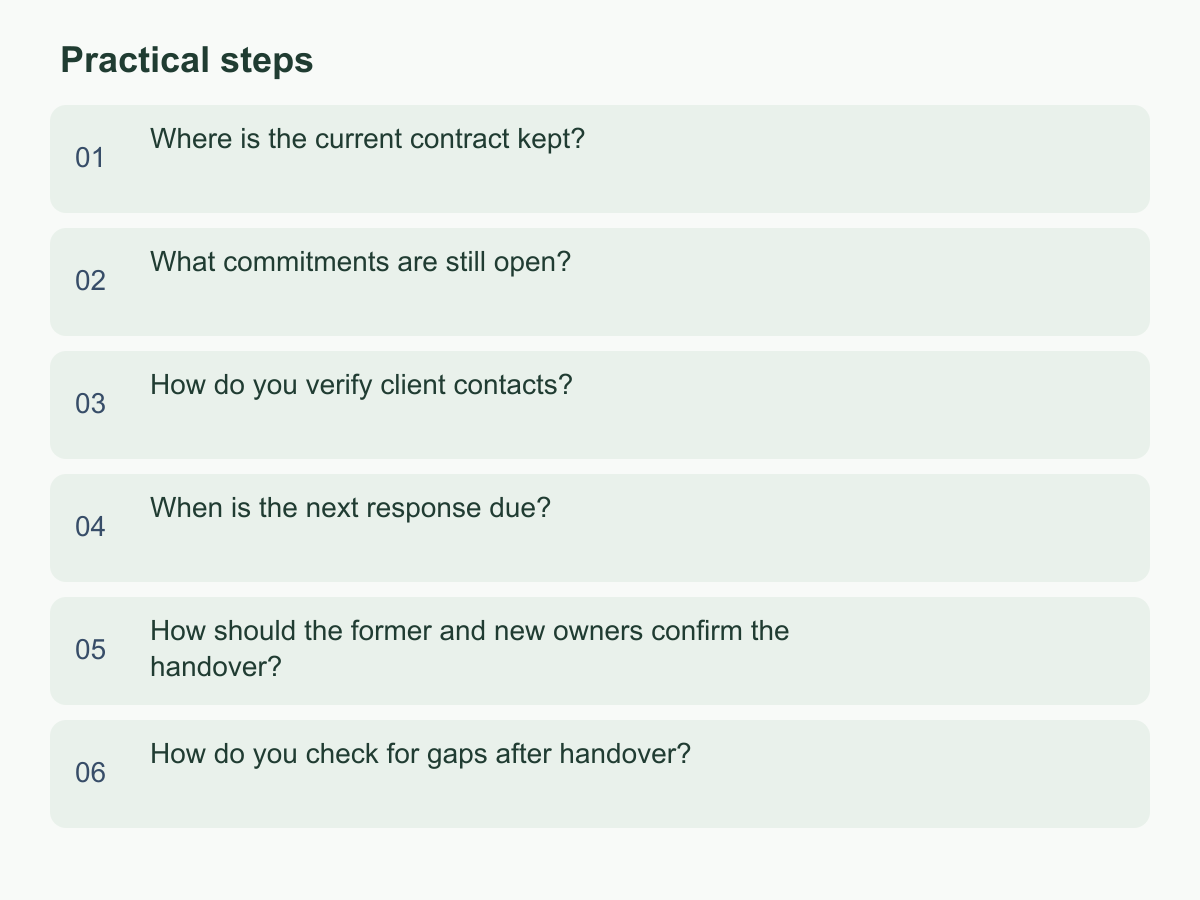
Where is the current contract kept?
Treat “current” as the signed text the parties are using, not the file with the newest modified date. Create one index for the main agreement, signed amendments, statements of work or attachments, and renewals. For each, list its name, parties, signature status, version or date, storage location, and checker. Separate drafts, unsigned copies, reference quotes, and replaced agreements; preserve unclear versions and mark them for confirmation. If the governing text is uncertain, ask the designated contract contact or an appropriate professional rather than selecting the newest file.
Have the new owner open each record from an authorized company location. Check that pages and attachments are readable, access works, and recent correspondence contains no unfiled agreed changes. If there is one main contract and two amendments, list all three and state which text is followed and why; if that is unclear, mark “to confirm.” Note who holds any paper original, where electronic copies are stored, and whom to ask about a missing attachment. Clause or page references help navigation but do not replace the source text. Use individual accounts and necessary read access; a link that only works under the former owner's login is insufficient. If copies differ, retain the source and date of the client-facing copy.
What commitments are still open?
Turn every commitment into an observable action, not “follow up” or “waiting for the client.” Record who agreed, when and through which channel, recipient, completion criteria, status, dependencies, and next action date. Mark verbal discussions as awaiting written confirmation. Give each open item one internal owner, with collaborators listed separately, and close it with evidence such as a sent file or client acknowledgment.
Hypothetical example only: an agreement calls for a monthly report, two training sessions, and one data-import checklist. Assume one report is delivered, one session is complete, and the checklist still needs client fields:
| Item | Status | Next step | | Monthly report | One delivered | New owner checks receipt | | Training | One of two complete; one remains | Confirm a time both sides can attend | | Data-import checklist | Waiting for client to complete fields | List missing fields and agree a reply date |
Include payment, change, or third-party tasks only if they remain active contract work; this is not a collections log. Link each item to an email, meeting note, or signed attachment; if evidence is missing, mark “to verify.” Prioritize by due date, impact, and external dependency. For multi-step work, record each completion check and next owner, and identify the person and date of each update.
How do you verify client contacts?
Treat contacts as roles, not one name field. Distinguish day-to-day contact, person who confirms signatures or changes, delivery acceptor, billing contact, and backup. A person may fill several roles, but verify.
Check the current agreement and recent formal messages for company name, title, company email, and stated role. Use a trusted existing channel to confirm the owner change, who takes each communication, and what still needs approval from the former contact or someone else. Being copied on email does not show authority to approve changes or make commitments for the company. For a proposed new contact, confirm their name, title, contact details, and responsibilities; ask for an introduction or authorized confirmation when needed.
For example, the email thread names A, but B described delivery needs at the latest meeting. Record A as “contract contact, confirmation pending” and B as “requirements contact,” then ask who approves delivery and receives routine updates. Do not turn an inference into a master-record fact. Save confirmation date and source, limit personal data access, and keep using the verified contact until a reply arrives. An unread message or automatic reply is not consent. Confirm specific responsibilities rather than asking only whether the contact changed. Verify a new email address through the established channel before updating it.
When is the next response due?
Make reminders actionable: who contacts whom, through which channel, by when, about what, and what if information is missing. Separate client deadlines from earlier internal checkpoints; never call an internal date client-agreed. Include the year, local time, and time zone for work across locations. State when a period starts, such as upon receipt of complete materials, rather than writing “as soon as possible.” This is record keeping, not an explanation of statutory periods. For unclear wording or requirements, follow company procedure and consult an appropriate professional.
Example: a revised draft is due Friday, but one input is missing. Record: “Owner sorts received materials by Wednesday; send the client missing items Wednesday afternoon and ask when they can supply them. If nothing arrives by Thursday noon, the former and new owners decide whether to send the ready portion and when to update the client.” This adds no contract obligation. If a date passes, log the contact, result, and next step. If delivery may be late, escalate early and inform the client accurately; update reminders after each contact. Set reminders before deadlines; separate input requests from final delivery and name the owner. If the reply date is unknown, schedule the next inquiry instead of inventing a date; record who confirmed any change.
How should the former and new owners confirm the handover?
In an internal review, the former owner explains each open item's history, client wording, evidence, risks, and next step; the new owner restates the commitment, owner, and date. Mark reviewed when understanding matches or uncertainty has a verifier. For oral or unconfirmed context, record source and confidence; do not present interpretation as a company promise.
Record the switch date and confirm access to email, files, meetings, and task boards. Do not share passwords; transfer access under company procedures. Send the client a short note with the date, contact, progress, and next agreed action; invite corrections. For example: “From [date], [name] will handle day-to-day contact. The open item is [task], and we expect to update you by [date confirmed by both sides]. Please correct us if your contact or understanding of delivery differs.” Use verified details only; silence is not agreement.
This notice changes contacts only. Changes to terms, scope, or commitments need the applicable process and both sides' confirmation. Label items “complete with evidence,” “in progress with next step,” or “to confirm” with a named verifier. If the former owner cannot join, note why and use a manager or source record to fill gaps. Check recipients and attachments, and assign unresolved questions an owner and due date.
How do you check for gaps after handover?
List agreements that remain active or have open deliveries or confirmations. Start with items due soon, with greater client impact, or lacking written support. Compare each with the agreement and amendments, recent messages, internal task record, and client confirmation. Check date, owner, executable next step, completion criteria, and link access. Open attachments and source messages; completed fields alone cannot reveal omitted conditions or later changes.
Mark each check “consistent, continue,” “difference, verify,” or “evidence missing, locate.” Name who will resolve each difference and by when; do not guess. Example: the log says a training date is confirmed, but the email shows the parties are still coordinating. Return it to “to confirm,” have the owner check with the contact, and update the date and source instead of preserving the old green status.
Share results with both owners and the designated manager. Correct the index, roles, or reminders and recheck changes against sources. If several agreements are in scope, review by risk and say which were checked; a passing sample does not prove all records are complete. Keep reviewer, date, source, and finding. Preserve earlier entries so the team can distinguish a missed note, different understanding, or delayed information. The new owner carries forward and reports the nearest next action. Prioritize unresolved findings for follow-up.
Start with one active agreement: fill in its version, open commitments, client roles, and next response date, then review each item with both owners. For more about Chan & Chung, visit the English homepage.