Published · Updated

An alert about a cross-border payment dispute does not confirm that a formal chargeback has been opened. Identify the event type, reason, and deadline shown by the payment provider, then gather records that answer the claim and show what happened from order to delivery or refund. The example below is a hypothetical cross-border physical-goods order, not a customer case or a prediction of the result. Record missing information and where you looked rather than filling gaps with assumptions.
Refunds, inquiries, fraud warnings, and chargebacks are different events
A refund is a merchant-initiated return of funds. A chargeback usually starts when a cardholder disputes a transaction with the card issuer and the payment flow notifies the merchant. Some network processes include an inquiry, a preliminary request for transaction information that may be resolved before a formal chargeback but can escalate if unanswered. Stripe distinguishes inquiries from formal chargebacks in its dispute lifecycle.
An early fraud warning signals suspected fraud; it is not a final bank finding. Stripe says these warnings do not require a response, while inquiries and formal disputes may require action shown on the case page. Labels and steps vary by provider, network, and payment method, so do not infer the stage from an email subject.
Record the event type, case and payment IDs, notification time, current status, and owner. Keep refund, warning, inquiry, and formal-case records distinct; check whether funds were refunded or debited and note the next action. Do not assume a voluntary refund replaces a formal response. For Stripe, a refund cannot be issued outside the dispute process while a formal dispute is open. If an inquiry escalates, recheck the status, deadline, and evidence requirements.
Confirm the reason and deadline with the payment provider first
Open the actual provider or acquirer’s case page. Confirm the transaction and case IDs, dispute reason, cardholder’s claim, amount and currency, notification time, response deadline, required fields, and accepted file formats. If the order system and payment dashboard use different IDs, reconcile them with the payment reference, order date, and amount.
Stripe and Shopify describe common response windows of about 7 to 21 days, depending on the network and process. This is a general range, not your case deadline. Use the exact due date on the notice or dashboard and confirm its time zone. If only a countdown appears, ask the provider or acquirer to clarify and record the answer. If an inquiry becomes a formal chargeback, check the new case for a new deadline and evidence request. See Stripe’s response guidance and Shopify’s chargeback and inquiry process.
For handoff, record the status, reason, exact deadline and time zone, evidence found or missing, owner, and submission status. Assign people to locate order, shipping, customer-service, and payment records. If the notice has no clear deadline or the page will not accept a response, contact the provider or acquirer promptly and preserve the reply.
Organize transaction and delivery evidence by dispute type
Evidence should answer the claim, not follow one generic checklist. For “product not received,” check the order, checkout address, dispatch date, carrier, tracking number and status, and delivery notices. For an unauthorized-transaction claim, use only existing records linked to that payment, such as provider verification, device or IP details, order history, and customer messages. Do not present unrecorded details as facts.
For a refund-not-processed claim, collect the refund ID, time, currency, amount, status, applicable terms, and customer notice. For a duplicate charge, compare each payment with its order. For “not as described,” preserve the product page, specifications, images seen at purchase, and relevant support or return messages. For a missing digital product or service, use requested activation, login, download, usage, or completion records. Shopify also lists evidence examples by dispute type.
Use an index such as “claim → supporting record → file name → source.” In the hypothetical parcel case, match the checkout address to shipping records, then check tracking and delivery notices. If the record proves dispatch but not delivery or signature, say so; do not claim the parcel was received. State which claim each file addresses, flag gaps, and retain its date and source. Save screenshots with enough context to identify the transaction.
Respond with a concise evidence packet, not a pile of unrelated files
Prepare a summary, timeline, claim-based evidence index, and matching attachments. State the transaction, customer’s issue, and verified facts; list relevant order, payment, dispatch or refund, contact, and notice dates. Name files clearly and check that IDs, currency, amount, and dates agree. Stripe recommends organizing evidence by type and completing the response before submission; Shopify advises putting direct evidence first and labelling files.
Exclude unrelated contracts, other customers’ data, and screenshots that cannot be tied to the case. Check required personal-data fields and whether nonessential details may be obscured. Keep original files, and ensure redactions leave transaction and delivery details readable.
Submission limits and correction options vary. Stripe says a submitted Dashboard response cannot be edited or supplemented. Its evidence-submission FAQ describes a 19-page total limit for Mastercard evidence in Stripe’s flow; check the case form for current file-size and upload limits. Shopify says not to include external-resource links in its evidence submissions, so provide readable records or screenshots instead. See Stripe’s response guide and Shopify’s evidence instructions.
Before sending, check the reason, attachment order, readability, and required fields. Afterwards, save the file list, submission time, receipt or dashboard status, and version sent in the handoff record.
Confirm processor and card-network rules for the actual payment flow
Rules depend on payment method, provider, acquirer, issuer, and network. Confirm whether the transaction used a card or another method, such as PayPal, with its own dispute process. Check the case page for the response recipient, reason, required information, and deadline. Stripe and Shopify note that local and third-party payment methods can follow different decision, timing, and evidence rules.
Review the case notice, the provider’s latest guidance, any acquirer notice, and any network rule the case names. Record the source, deadline, response recipient, and exceptions. If instructions conflict, ask the provider or acquirer handling the case and save the answer. Check any language or file-format requirements stated in the case.
Visa’s Dispute Management Guidelines for Visa Merchants is dated June 2024. It includes a historical Condition 12.1 effective through 12 April 2024 alongside a replacement condition for transactions from 13 April 2024. Use the guide to understand categories, not alone to infer a current deadline or rule; follow the case notice and acquirer. Visa: Dispute Management Guidelines for Merchants, June 2024
For context on Hong Kong banking arrangements and third-party collection tools, see our article on Hong Kong cross-border collection channels. It compares market options, not rules for a particular dispute.
Feed dispute reasons back into checkout and fulfillment improvements
After handling the case, check whether the description matched delivery, total and currency were clear at checkout, the billing descriptor was recognizable, refund terms were easy to find, shipping updates were timely, and digital access logs are retrievable. Review the actual checkout and transaction records to locate possible gaps in product information, payment, fulfillment, or support.
For a cross-currency case, compare the original payment, disputed currency and amount, conversion timing, and provider record. Stripe explains that exchange rates can differ between payment and dispute, so the converted dispute may not match the original settlement. Verify the fields before inferring an error; a difference alone does not prove one.
Track the reason, process gap, proposed change, owner, due date, and record that confirms completion. A “product not received” case may prompt a check that delivery estimates and tracking notices are retrievable; a refund case may prompt a check that support sees the payment’s actual refund status. Confirm the change and watch for recurrence. This review cannot guarantee fewer chargebacks or a particular outcome.
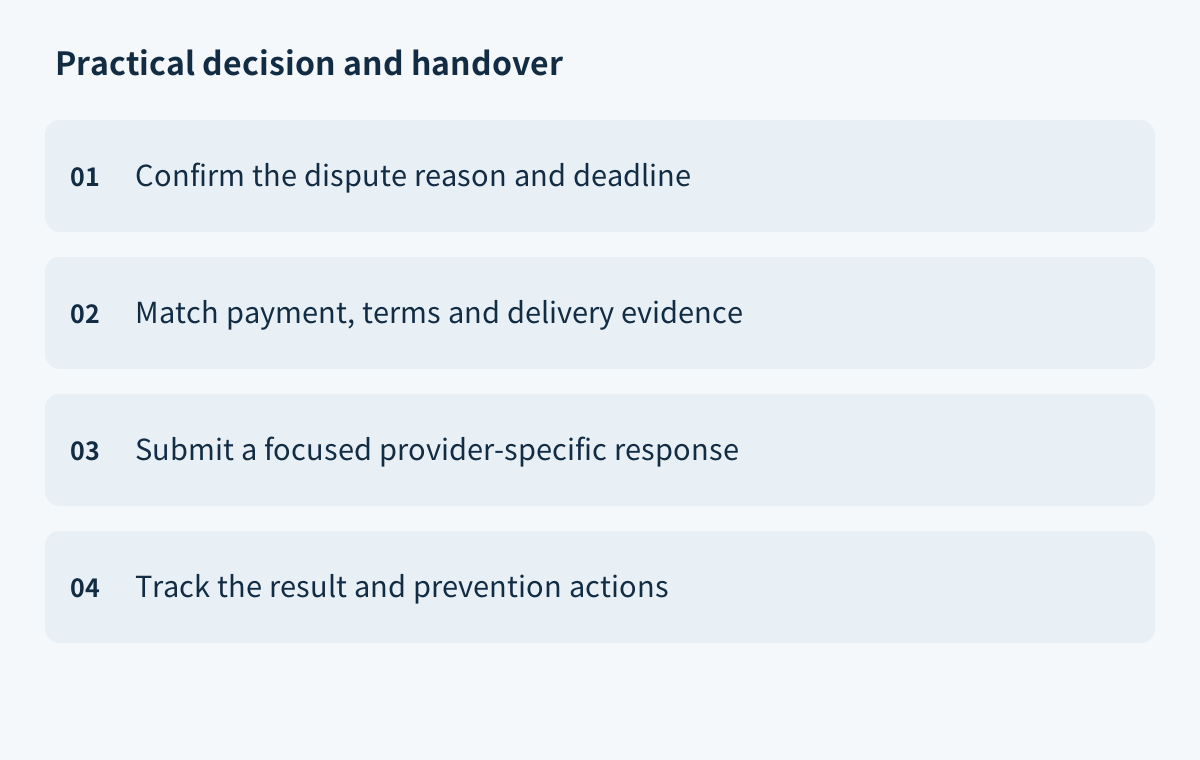
Identify the event, confirm its reason and deadline, match evidence to the claim, follow the provider’s process, and feed the cause back into checkout and fulfillment. For a case-specific question, send an enquiry through the website’s contact channel. This article is not legal or tax advice and does not promise a result.