Published · Updated

A cross-border returns policy should not apply one deadline to every order. The buyer’s market and status, product, contract seller and fulfilment method can affect the applicable rules. Separate statutory rights from any voluntary promises, then connect support, logistics, refunds and tax handling so staff can identify what to check and who acts next.
Segment by market, product and customer type
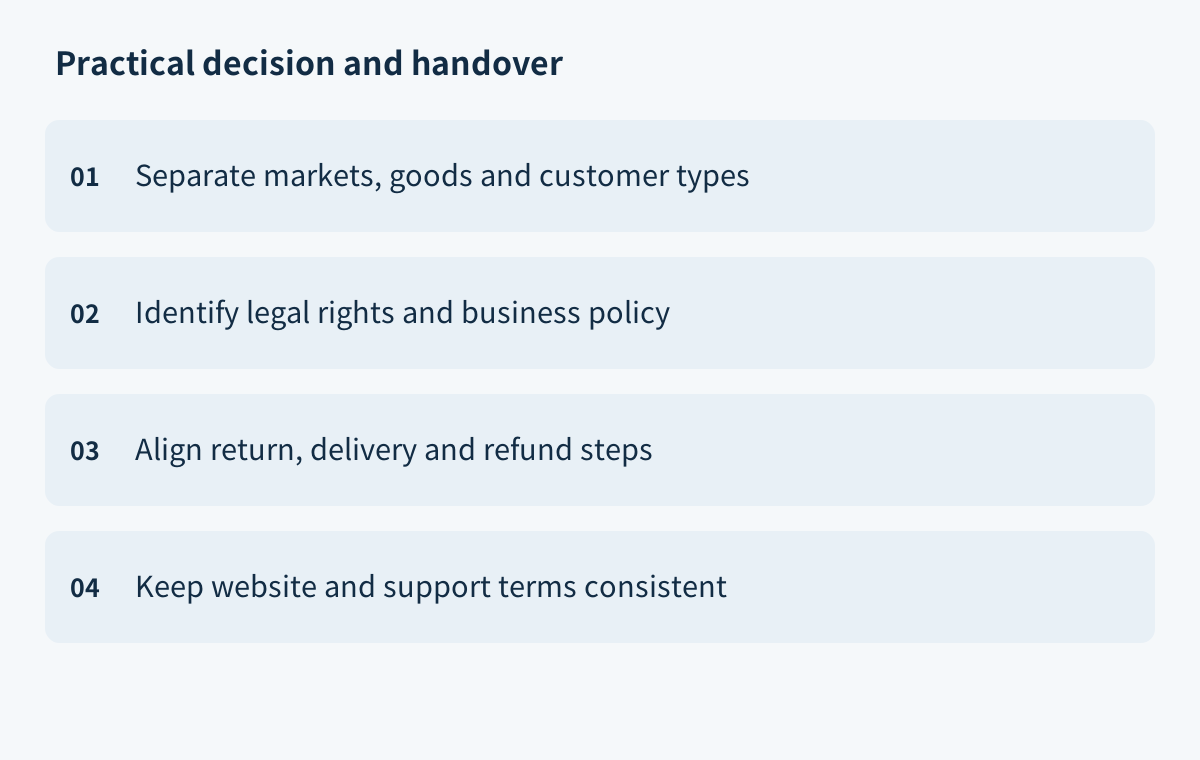
Build a market matrix before setting return periods. For each order, record the buyer’s delivery location and whether they are a consumer or business; whether the product is physical, digital or made to order; the sales channel; the seller named on the order; and the dispatch and return locations. If the platform, brand and payment recipient differ, confirm who contracted with the buyer and who handles after-sales requests.
| Matrix entry | Record for each order |
|---|---|
| Market and buyer | Delivery location; consumer or business |
| Product and channel | Product type; custom-made status; sales channel |
| Seller and route | Contract seller; dispatch and return locations |
| Policy control | Rule source; policy version; exceptions; open questions |
A company’s Hong Kong incorporation does not, by itself, determine every order’s return rules. Track Taiwan, mainland China and Malaysia separately. For markets still under review, note what remains unconfirmed and assign someone to check it. A Taiwan consumer buying an ordinary physical product can be one matrix row; custom-made, perishable and digital items need separate consideration. Separate marketplace orders from direct-site orders when seller, payment or return processes differ. If platform and internal records conflict, assign someone to reconcile the contracting party and after-sales responsibility. Update affected checkout copy, support templates and warehouse instructions when a market, buyer type or product changes. Retain the seller and policy version shown at checkout so staff can trace the decision to the relevant order.
Separate statutory rights from your commercial policy
Show legal rights separately from voluntary arrangements such as exchanges or an extended return window. Under Articles 18, 19 and 19-2 of Taiwan’s Consumer Protection Act, consumers in distance or off-premises transactions can generally rescind within seven days after receiving goods or services, without stating a reason or paying a fee, subject to reasonable statutory exceptions. Applicable exceptions must meet the rules and be disclosed; a blanket “no returns” notice does not itself remove the right. Required transaction information must also be available for review and storage. If the required rescission information was not provided, the seven-day period starts the day after it is supplied, but the right expires once more than four months have passed from the original period’s start. The refund clock is separate: a refund is generally due within 15 days after the goods are retrieved, returned, or the service-cancellation notice is received, depending on the event. (Taiwan Consumer Protection Act, Articles 18, 19 and 19-2; reasonable exceptions for distance transactions)
Article 25 of mainland China’s Consumer Rights Protection Law provides a seven-day no-reason return right for online and other distance sales, with exceptions including custom-made and perishable goods, certain digital products, and newspapers or periodicals. Other goods unsuitable for return by their nature require the consumer’s confirmation at purchase. Returned goods must be intact; the seller refunds the price within seven days of receipt, and the consumer generally pays return shipping unless the parties agree otherwise. Do not apply Taiwan’s deadlines or exceptions to mainland orders. (Mainland China Consumer Rights Protection Law, Article 25)
Check Malaysia’s rules and product category locally before setting a deadline. A Hong Kong Consumer Council statement on 29 June 2026 concerned a policy proposal for a cooling-off period on prepaid beauty and fitness service contracts. That service-contract proposal is not a basis for claiming a general return right for online goods. (Hong Kong Consumer Council statement)
State application rules, return address, costs and refund timing
Before checkout, tell buyers how to apply, what information to provide, what condition the product must be in, where to send it, who pays each cost and when refund processing begins. Give the email address or form, required details such as order number and reason, whether photos are needed, and how to obtain return instructions after review. Identify the return recipient and location, including whether authorisation is required first, so goods are not sent to an unattended dispatch point.
List outbound and return shipping, packaging or inspection fees, and any customs duties or import taxes separately. For cross-border returns, explain who arranges the carrier, how to retain shipment proof, who supplies customs documents and who confirms charges. State the currency with any amount. If internal accounts record refunds in HKD, retain the original charge currency and payment-provider refund record; do not assume they match.
Map the workflow from application and eligibility checks through return instructions, carrier receipt, goods retrieval, refund initiation and customer notification. Assign an owner and record at each step, with an expected update time. Keep legal deadlines separate from internal service targets; an inspection must not shift a legal start date. Explain what will be inspected and how the buyer will hear the result. For refunds to the original payment method, note that the payment provider controls the final posting time. Also state how partial returns affect bundle prices, discounts, gifts and original shipping, including whether a gift must be returned. Keep these calculations consistent with the applicable rules and checkout terms.
Route customer service and logistics by return reason
Different reasons require different evidence and next steps. For a change of mind, check the market, product and applicable statutory or voluntary conditions; do not reject a request solely because packaging has been opened. For a wrong item, colour or missing piece, compare the order, SKU, picking record and parcel photos so a fulfilment error is not treated as buyer preference. For transit damage, retain the outer box, inner packaging, product photos and tracking details for the support and carrier handoff. For a defect or a product that differs from its description, record the batch, specification, problem location and buyer’s description; decide whether quality review or a temporary hold on the same batch is needed.
Flag safety concerns so a potentially risky item does not return to saleable stock through the ordinary process. The case record should include the order number, reason, supporting material, policy version, cost owner, tracking number, case owner and resolution. If an external returns warehouse or logistics provider is involved, confirm what information it receives, when it reports receipt and who decides the next action. These are possible external fulfilment arrangements, not a claim that a particular brand offers logistics services.
Suppose a Taiwan buyer orders a red model but receives a blue one. Support compares the order SKU and shipping label with the buyer’s photo, gives the result to the fulfilment owner and retains the carrier and item records. The team checks the applicable rules and published policy before explaining the return address, shipping arrangement and next update. This example does not assume that a refund or exchange is always required. Use reason codes and required-evidence fields; check order and tracking records before requesting missing information. Route a complete case to the person authorised to decide on a refund, replacement or quality review, and record status changes so the team can follow progress.
Check payment disputes, taxes and special products separately
A refund request, a cardholder payment dispute and a request about import taxes are separate workstreams. For a refund, record the amount, original transaction currency, payment method, refund reference and provider response. For a dispute, track the transaction identifier, response deadline, platform evidence request and responsible owner. If a refund has been initiated while a dispute remains open, check the provider’s latest status and rules before acting again to avoid a duplicate refund or missed deadline. Relevant records may include the product page and policy version, order confirmation, delivery evidence, support correspondence and refund status. Submit only information needed for the case.
Check customs duties and import taxes against the destination, importer, customs status, actual payer and collecting party. Refunding the product price does not automatically return border charges. Identify whether a fee went to a carrier, marketplace, customs authority or another party, then confirm any separate application process and required evidence. Rules vary by market and product, so assign an owner to confirm customs and tax handling. Keep receipts, declarations and refund records separately.
Review custom-made, perishable, opened personal-care, digital and safety-related products against the buyer’s market and the actual delivery method. An exception in one jurisdiction does not establish the same result elsewhere. A Merchant of Record (MoR) arrangement is a market option, not a universal answer for returns or taxes. Paddle’s help page describes its own arrangement, in which it acts as a reseller and seller on record and handles specified VAT and sales tax responsibilities. That does not establish what other providers cover, whether physical goods or refunds are included, or how every jurisdiction treats the arrangement. Read the actual contract and service scope before relying on it. (Paddle on its own MoR and tax arrangement)
Align the website, checkout and after-sales support before launch
Before launch, compare the product page, checkout, returns policy, order confirmation email, support templates, warehouse instructions and refund workflow. Align market scope, product exceptions, application method, return address, costs, refund trigger and policy version. Check whether buyers see key terms before ordering, whether the checkout version is retained, whether support can identify the market from the order and whether warehouse staff know what to inspect. Align legal and operational meaning across translations before publishing so language versions do not create different conditions.
Walk through three scenarios: a change of mind, an incorrect item and a defective product. For each, record the policy the buyer sees, information support requests, instructions sent to logistics, who confirms costs and how the refund decision is documented. If staff must guess an address or who may approve a refund, add the missing condition and owner to the market matrix, then repeat the walk-through. Include the policy version, effective date, source links and exception-approval route in the launch checklist. Record each rehearsal’s order conditions, expected path, result and unresolved issues. When the market, product, platform, dispatch location or logistics arrangement changes, have a named owner identify affected pages and templates, retain the previous version and notify support, fulfilment and finance so open cases remain traceable.
For multilingual pages, see this hreflang guide for multilingual websites and Google’s guidance on localized page versions. They explain how search engines interpret language and regional versions; they do not determine which jurisdiction’s returns rules apply. That decision depends on the market, transaction and product. Keep the policy version, case fields and market owners together so future changes can be traced to affected pages and workflows.
For case-specific guidance, you may raise a question through the website contact page. This article is not legal or tax advice and does not promise an outcome.