
Cross-time-zone handoffs often fail because people record work in different tools and at different local times. The next person may see a stream of updates and still not know which version is current, what is complete, or who is waiting on whom. A reliable handoff lets a colleague assess the current state, risks, and first actionable step without interrupting the previous shift. It need not reproduce the day’s conversation; it should make work boundaries, checked results, and ownership clear. When shifts do not overlap, state assumptions and unresolved items explicitly. Use the diagram below to choose the essential fields, then add detail to match the task. The examples in this article are hypothetical and show how to move from status tracking to completion reporting.
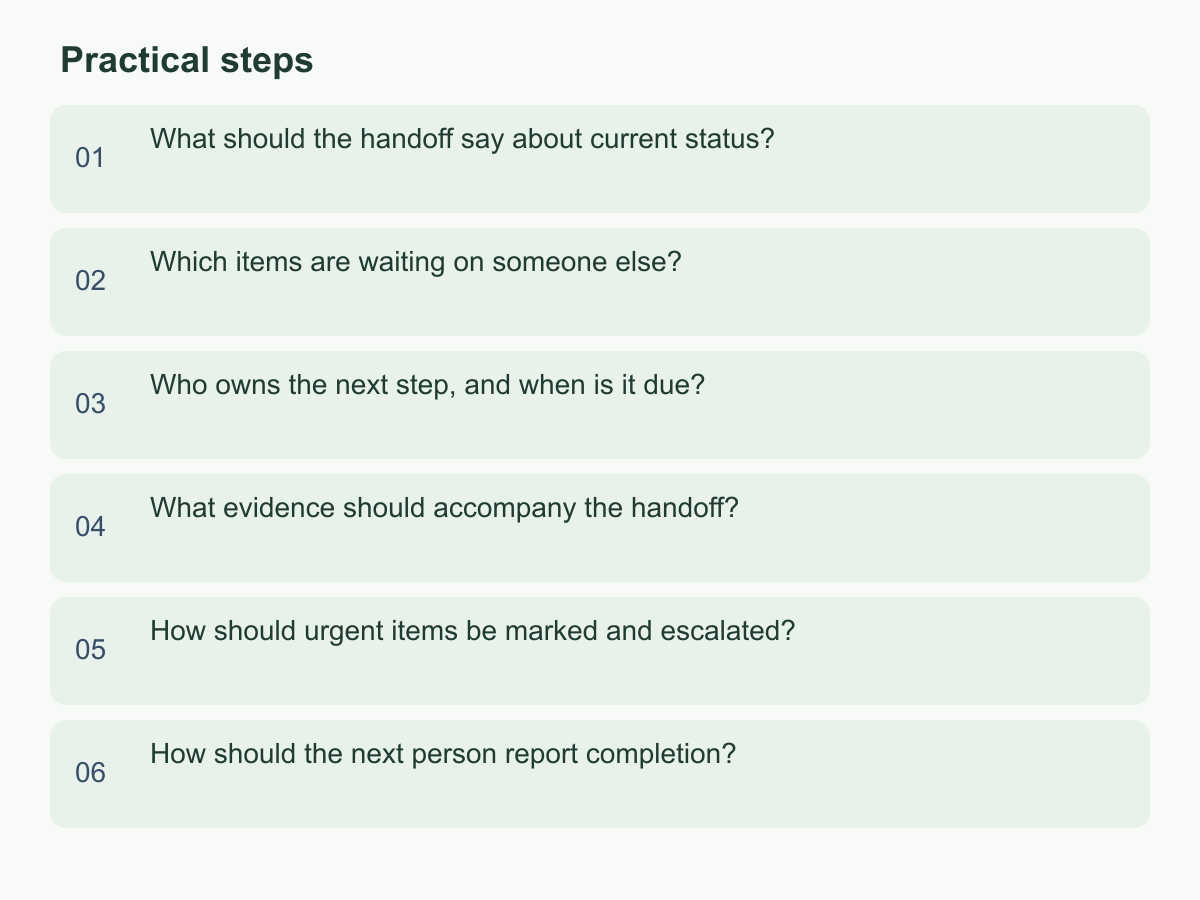
What should the handoff say about current status?
Describe the stage and give the next person something they can check. Agree on a short set of labels—complete, in progress, blocked, not started—and define them: the saved result meets its conditions; there is a clear next step; a prerequisite is missing; no work has begun. Add the latest action, result or artifact, and update time with time zone. Mark estimates and state what remains to be checked and how. Do not substitute hours worked or a projected completion percentage for saved output or a stated completion condition.
For example: “Draft saved in the shared folder. English section complete; Chinese wording awaits the product owner’s confirmation. Last edited Tuesday at 16:20 Taipei time.” This identifies a continuation point without suggesting both languages are approved. Tie status to visible work rather than hours spent. For multi-part tasks, list completed and incomplete items and identify which outstanding condition sets the overall status.
Before handoff, confirm the record answers: Where does the work stand? What happened most recently? Where should the next person resume? Preserve decision context and identify the current version and whether older versions remain valid. If the written status differs from the file, record when you checked, flag the discrepancy, then correct the handoff. Organize this information instead of forwarding a chat transcript.
Which items are waiting on someone else?
Name the person or function you depend on, what they need to provide, and what it blocks. Record request time and time zone, channel, receipt confirmation, expected reply, and source link. If no reply time was agreed, say “to be confirmed”; label estimates as estimates. Separate the other party’s action from work the team can do meanwhile.
For example: “Three name options sent Tuesday at 15:00 Taipei time; no reply. Final copy awaits confirmation; layout review can proceed.” Add a follow-up owner and channel to remind the contact if the agreed time passes; if there is no deadline, ask the task owner whether to set one.
Preserve the original question, context, and requested answer format. If new conditions change sequence, scope, or delivery timing, record the effect and who decides whether to accept them. Silence and read receipts are not approval. List blockers before parallel confirmations. End with useful work the next shift can do—organize candidate versions, check required details, or draft a follow-up—so waiting does not look like inactivity.
Who owns the next step, and when is it due?
Assign one reachable owner, observable deliverable, and clear deadline to each task; a department or “handle soon” is not enough. For shared work, name one integrator and list each collaborator’s contribution. Write the calendar date, time, and time zone; relative terms differ across locations. If the date is unknown, mark it to be confirmed and identify who decides.
The table below is hypothetical; its weekday deadlines illustrate the fields, not real commitments:
| Task | Owner | Deadline and time zone | Completion condition |
|---|---|---|---|
| Verify name | Lin | Wednesday, 12:00 Taipei time | Confirmation entered in the document |
| Reply to question | Zhou | Wednesday, 15:00 Singapore time | Answer and supporting basis added to the record |
| Consolidate versions | Chen | To be confirmed by task owner | Selected version identified and collaborators notified |
In a live handoff, replace weekday references with agreed calendar dates and time zones. Prioritize work that unblocks someone or is closest to deadline, then parallel tasks; resolve prerequisites first. Show whether tasks depend on one another or can run in parallel, so the next shift does not start downstream work too early. Set deadlines within the next shift’s working hours. If workload changes, revise scope and deadline with affected people.
Before handoff, check each task has one owner, completion condition, deadline, time zone, and prerequisites. Ask for gaps or mark them unknown. The recipient acknowledges transfer, flags a conflict, or names a missing prerequisite so the responsibility change is clear. Write the next action as a verb plus outcome and confirm the recipient has required access and context.
What evidence should accompany the handoff?
Attach enough evidence to avoid repeating checks and distinguish results from assumptions and open questions. Include an accessible document or record link, version or filename, last modified time and time zone, and a direct page, section, or item. Verify that the recipient can open it; if not, state the access path and who can help. Summarize each check’s scope, result, and exceptions; identify unchecked portions so a partial review is not mistaken for full confirmation.
For a versioned proposal, link the current and prior versions, summarize changes, and identify the two sections not yet compared. Tie each evidence item to a task or decision and state what it supports, such as approved wording or the need for source confirmation on an amount field.
Move important decisions from private chat into an accessible team record with a summary and date; retain the original link if useful. Before sharing, check for personal data, credentials, or business secrets and limit access to what is needed. Never put passwords or sensitive values in a handoff; use the approved secure process. For changing links, record the version or time checked and ask the recipient to confirm the latest version. If evidence is missing, name the source and verifier instead of stating unsupported certainty.
How should urgent items be marked and escalated?
State why an item cannot wait until the next normal handoff, its latest response time, and the affected decision or delivery. A red color or the word “urgent” does not define priority. Teams can set a few levels—immediate, next working period, routine—and response windows, contacts, and escalation rules for each. Until then, write the specific impact and deadline.
Use the agreed work channel and a traceable task record. Start with the action, owner, deadline and time zone, and context link. Do not disturb off-shift staff for work that can wait. For an after-hours response, confirm the on-call or backup arrangement in advance.
For example: “Pause sending. Owner to confirm the version by [deadline and time zone].” Link both conflicting passages and their locations; do not send only “urgent, please look.” Update affected owners as risk changes and limit alerts to people who can act or need to know. If no on-call window exists, have a manager assign a contact and backup; a document cannot guarantee immediate visibility.
Distinguish a requester’s desired speed, a deadline the team has accepted, and the impact of an actual blocker. If no handler is confirmed, identify the gap and notify the role that can assign one.
How should the next person report completion?
The recipient first checks access and the latest version and update time, acknowledges the handoff, and states the first step and whether the deadline is workable. If the note is incomplete or contradictory, identify the missing field or conflict. Clarify issues that could change direction; list minor questions for follow-up.
When work starts, mark it in progress and record the actual check time and time zone. Preserve any error in the earlier note and the reason for correction. At completion, link the deliverable, name the completion conditions met, list exceptions, and say who must know or approve.
For example: “Updated operating document saved in the designated folder. Two formatting checks complete; source field awaits confirmation from the data provider.” Create a separate task with an owner and deadline for remaining work. If a result still needs observation, assign a follow-up time. If completion is disputed, compare the result with the original acceptance conditions and record who confirmed it and when. Once accepted, record the responsibility change and its time in the shared record so later readers can tell when ownership moved.
Report broken links, missing time zones, or access gaps so the team can improve the template. Add only fields that prove useful. Update the shared task record as well as the message. Try the process on a task crossing shifts: add status, waiting party, owner, deadline with time zone, and evidence link, then have the next person start from that record.
For public information about Chan & Chung, visit its English homepage and confirm details on the relevant page.