
Cross-border businesses often face cash pressure because the dates when receipts become usable do not match payment cycles, rather than because their total balance is too low. A 13-week cash flow forecast maps expected receipts, payments, and opening available cash across consecutive weeks, helping a team see a potential shortfall early. Record sources, assumptions, and owners so actual deposits and debits can correct the forecast each week. All figures below are hypothetical.
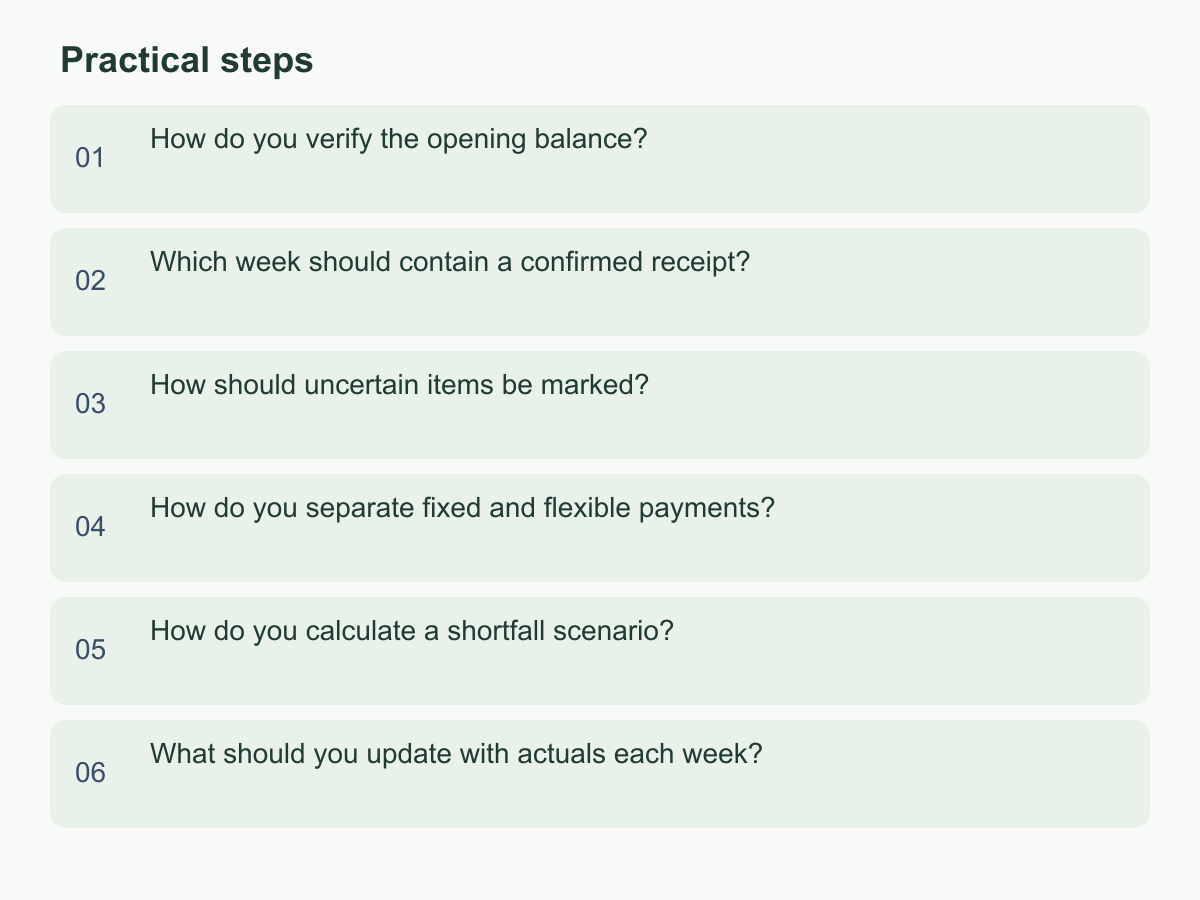
How do you verify the opening balance?
Start with cash that can actually be used on one base date and in a consistent currency view, not simply the available balance in a bank screenshot. For each account, record currency, book balance, posted items not reflected in your records, payments already issued, and restricted or reserved amounts. Put customer funds not yet received in a future receipts week, not in opening cash.
For multiple currencies, keep original balances or convert at a dated working rate, avoiding double conversion. Separate immediately available from restricted funds; forecast only amounts usable for the purpose.
Reconcile bank, platform settlements, internal payment, and outstanding transaction records. Assign each difference an owner and deadline; exclude it from usable cash until resolved. State the start date and weekly boundaries, such as Monday through Sunday, mark week one if partial, and record each source and check time.
List accounts by company or collection entity before consolidating; one company’s cash is not automatically available to another. Have an account owner review available and restricted balances, including pending debits. Reference sources by account’s last four digits or transaction ID and record the reviewer. Show transfers as same-date outflow and inflow, eliminating both on consolidation. Update weekly without silently changing the baseline.
Which week should contain a confirmed receipt?
Use the week when funds are expected to be usable, not merely the invoice date, order date, or customer’s promise. Record each receipt’s reference, currency and amount, expected send date, processing time, possible fees or refunds, account, and latest verification time. Only money received and identifiable in reconciliation records belongs in opening cash.
Estimate future receipts from verifiable evidence such as contract terms, delivery acceptance, invoice status, or written customer confirmation. Without a supporting source, do not label a date confirmed. Cross-border receipts can have invoice, customer-payment, platform-settlement, and bank-availability dates. Track payment and usable dates separately, forecast the latter, and note the assumed gap.
Split deposits and balances into rows tied to their trigger conditions. If only part arrives, record that portion and leave the remainder in its original forecast week. Keep detail traceable to weekly totals. Move a receipt earlier only when the bank or platform confirms availability; a message saying it was sent is not enough. If settlement timing is unclear or near a boundary, use the conservative week and set a follow-up date. Money sent Friday but settled next week belongs in that later usable week, not against an expense due now.
Review receipts Monday; change a week midweek only with new evidence, then reconcile available funds at week-end. Keep a follow-up owner and next contact date on delayed items. Show platform refunds or holdbacks separately with sources; gross order value is not net cash.
How should uncertain items be marked?
Show uncertainty instead of assigning an apparently precise date. Use low, medium, or high confidence, or labels such as “confirmed,” “awaiting customer confirmation,” and “internal estimate.” These are management cues, not measured probabilities. Record an amount range or estimate, expected week, evidence, unresolved condition, follow-up owner, and next check date.
If a customer says they will pay this month but has not confirmed a date, place the amount in the expected week as awaiting confirmation and note the conservative action if it remains unconfirmed. It is not cash already received. Keep potential orders in a separate scenario column unless they meet stated evidence criteria for the baseline, such as a formal purchase order, completed acceptance, or payment schedule.
After follow-up, retain the prior expected week, revised date, and reason. Track delays by customer, payment method, or process. Give each receivable a unique ID so it cannot appear both as scheduled and possible. Review unanswered items weekly or at month-end; after the internal follow-up limit, move them to a risk scenario or drop them from the baseline.
Labels should guide action: reconcile confirmed funds, contact customers about pending receipts, and find evidence for internal estimates. They keep the forecast conditional and handoffs clear. Past punctuality can inform an estimate but does not confirm a new transaction. Likewise, verify that a payment notice covers the right amount, currency, and recipient; a reminder is not proof of settlement.
How do you separate fixed and flexible payments?
This distinction helps identify when funds must be reserved and where there may be room to adjust; it does not make an existing commitment freely deferrable. Treat as fixed payments those amounts and due weeks that can be verified from an existing contract or approved schedule. Record supplier, purpose, currency, due date, expected debit date, paying account, payment owner, and supporting document.
Distinguish invoice date, contractual due date, and expected cash-out date. The forecast uses the week cash should leave the account, while payment handling follows the existing commitment and internal approvals. Flexible items may include non-urgent purchases that can be rescheduled, unplaced project costs, or work that can begin in stages. Note the earliest possible week and condition for deferral; do not turn an unsupported budget into a fixed payment.
An agreed annual software renewal about to be charged is fixed. A new paid tool without approval belongs in an optional scenario with a decision deadline. Separate categories such as payroll, taxes, logistics, advertising, and suppliers to clarify ownership; categories do not set legal priority or due-date rules.
Review weekly for new commitments, amount or date changes, and cancellations, recording the source and approver. Confirm unclear invoice due dates with the responsible person. For foreign-currency payments, show currency and the rate assumption for the expected payment date. If deferral is uncertain, keep the original week and assign someone to confirm. A “committed / awaiting approval” field distinguishes a budget from an order. Use a supportable base amount and put the upper end of a range in a stress scenario. After approval, update timing and commitment notes, not only the payment amount.
How do you calculate a shortfall scenario?
For each week, use: closing available cash = opening available cash + receipts expected to be available − payments expected. The next week’s opening equals the previous week’s closing. Keep currencies separate or convert using an explicit estimated rate; do not hide foreign-exchange movements in operating cash flow.
This shortened three-week example is purely hypothetical, in one currency, and its units are only for illustration. Extend the same calculation through all 13 weeks and state the business’s own minimum cash buffer.
| Week | Opening available cash | Receipts | Payments | Closing available cash |
|---|---|---|---|---|
| Week 1 | 100 | 30 | 45 | 85 |
| Week 2 | 85 | 15 | 50 | 50 |
| Week 3 | 50 | 10 | 30 | 30 |
Week one closes at 100 + 30 − 45 = 85; week two at 85 + 15 − 50 = 50; week three at 50 + 10 − 30 = 30. If management sets an internal buffer of 40, week three is 10 below it. This is not an external requirement or prediction, but a trigger for discussion.
Stress-test a one-week receipt delay or earlier flexible purchase, recalculating affected and later balances. A positive 13-week total can still hide a week when a payment cannot be made. If the week-two receipt of 15 moves to week three, week two closes at 35 instead of 50. After the 15 arrives in week three, its closing balance remains 30, but the potential shortfall appears earlier.
For each scenario, identify the changed transaction, assumption, and trigger. Keep the baseline and list actions with latest decision dates: confirm a receipt, reschedule an uncommitted cost, coordinate staged delivery, or arrange funding already approved. A gap does not guarantee financing; do not add unapproved arrangements to baseline cash. Mark the lowest closing balance and first week below the buffer. Avoid double-counting shared transactions, and retain the formula, version date, and reason so others can recalculate. Management sets its operating buffer; label it as an assumption.
What should you update with actuals each week?
Preserve forecast and actual history instead of replacing estimates with actuals. Close on the same day each week, placing expected receipts beside deposits, expected payments beside debits, and opening and closing balances side by side. Check dates and amounts against bank and platform records.
Update at least six fields: actual receipt date and amount; actual payment date and amount; latest expected week for each outstanding receipt; new or cancelled transactions; latest opening available balance; and next confirmation date for each forecast item. Keep original values, updater, and reason so variances are not overwritten. If an expected receipt does not arrive, move it to the most credible later week and record the delay and new evidence. For early or cancelled payments, distinguish verified changes from preliminary messages.
Use the actual closing balance as the next opening balance. Keep unreconciled amounts marked pending and separate from confirmed cash. Roll the forecast forward one week: mark the completed week actual, add a new week at the end of week 13, and update remaining dates rather than rewriting the whole table.
Classify differences as timing, amount, omission, or exchange-rate assumption, and assign an owner and deadline. Recalculate scenarios if a difference changes the shortfall week. Before sharing, verify weekly balance links and traceable totals. Use consistent columns—forecast, actual, variance, reason, next step—and define variance as actual minus forecast for both receipts and payments. If the base date or currency view changes, save a new version and explain why for consistent comparisons.
Start by choosing a base date and verifying first-week receipts and payments. For related information, visit the Chan & Chung English homepage.