
Cross-time-zone collections often stall at handover: a payment date sits in a message thread without its currency, governing time zone, or next action. A per-invoice log connects the promise, financial status, and follow-up task. The fields below help colleagues trace each open balance to its invoice and source commitment, see what to verify, whom to ask, and when to review it.
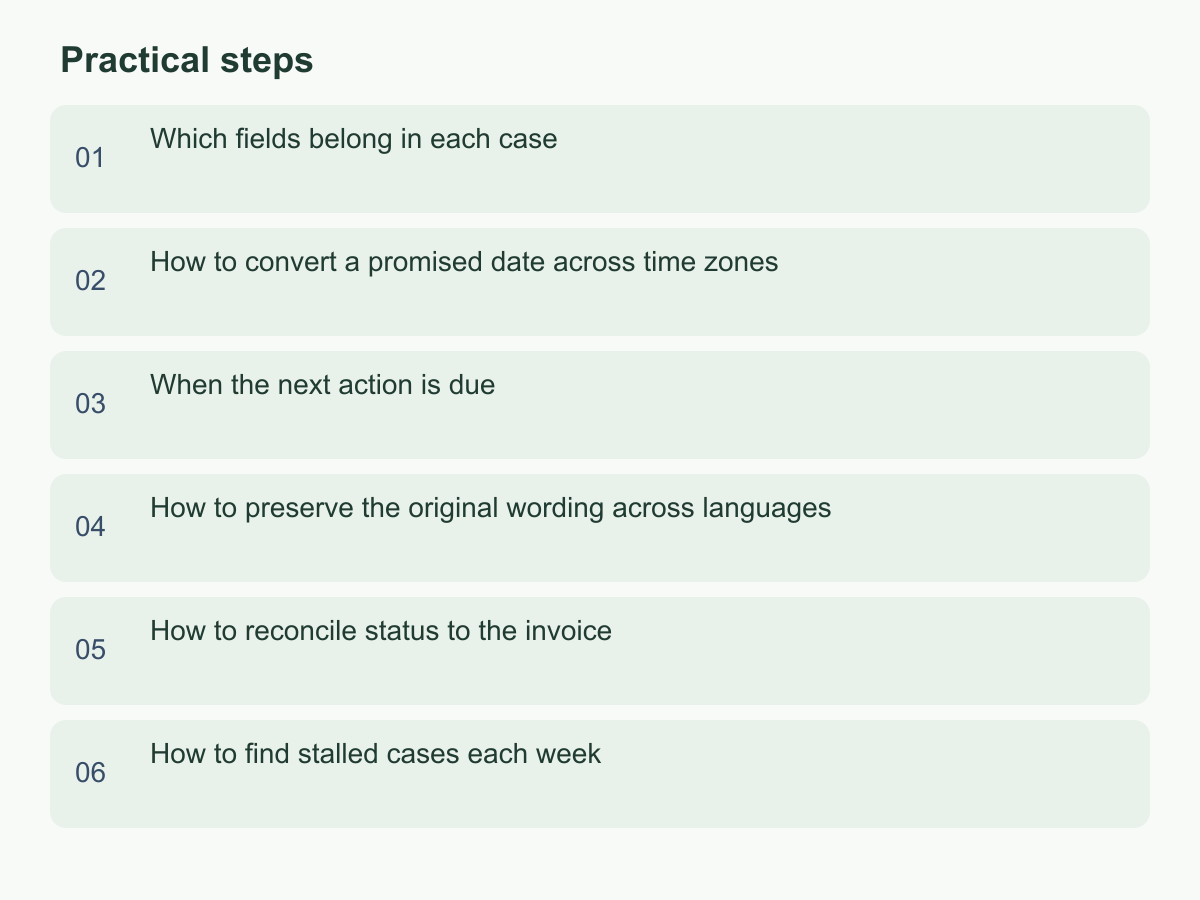
Which fields belong in each case
Keep customer records separate from invoice cases. One customer may have several invoices, promises, and disputes, so use one tracking row per invoice and link it to the customer and contact through an account identifier. Include customer and contact, invoice number, issue and due dates, open amount and currency, latest contact time and time zone, the customer's exact words or a labelled summary, promised payment date, owner, question to verify, and next action with its due time. Record who updated the row and when.
Keep the receivable in its original currency. If a home-currency estimate is needed, store the exchange rate, conversion date, and result separately so they do not replace the original amount. Use fixed status choices, such as Contact needed, Promise received, Payment verification pending, Partially paid, Dispute being handled, and Closed, and add a short reason.
A purely hypothetical row could say: Customer A; invoice A-104; USD 1,200 open; promise for October 22 in the customer's time zone; last contact October 18 at 16:10; bank receipt to verify; owner Lin; next action, check the account on October 23. If one conversation covers several invoices, update each separately and link them to the shared contact record; do not enter total customer debt as one invoice's balance. Record account identifiers and invoice addressees for related companies or abbreviated names. When contacts change, retain old and new details and the change time so old promises are not carried forward. Keep notes factual, flag assumptions as pending, and use consistent status definitions.
How to convert a promised date across time zones
Record the promise's date and time, time zone, and source. Preserve wording such as “Oct 22 before noon,” then confirm the year, full date, and cutoff time. If only a date was given, mark it “local date; time not provided” rather than assuming midnight.
When possible, store the named time zone and converted UTC time; otherwise record local time and UTC offset. Subtract the source offset to get UTC, then apply the receiving colleague's offset, checking for a date change. For a purely hypothetical example, 09:00 on October 22 at UTC+08:00 is 01:00 UTC on October 22 and 20:00 on October 21 at UTC−05:00. Show both dates because the same promise falls on different days for the customer and team.
Daylight saving time changes offsets by date, so “US time” or a fixed hour difference is not precise enough. Record a city or standard time-zone name and use the offset in force on the promise date. Distinguish the customer's original time from the team's display time; never overwrite one with the other. If the customer says “I'll pay next week,” ask for the date, amount, and currency, and mark the promise awaiting confirmation. Prefer year-month-day to an ambiguous short form such as 03/04, and state the date convention if a short form is required. Have a colleague check conversions across midnight or daylight-saving changes. If the promise changes, retain the prior value, change time, and reason beside the current date.
When the next action is due
Every open case needs an action, owner, and due time, plus any triggering condition. Use a task that can be marked complete, such as “check the account and update the balance” or “ask the customer to confirm the remittance date,” not just “follow up.” Record the worker's time zone and, when needed, the customer's zone for contact during working hours.
Keep the promised payment date separate from the team's next-action date. A promise for the 22nd does not mean the team must wait until then to check the account: it could schedule a receipt check on the 23rd and contact the customer if no funds appear. If a task remains incomplete when due, record why, set a new date, and assign an owner.
Route cases by status: for a future promise, check for payment after it; for an overdue promise with no receipt, check internal records before contacting the customer; for a dispute or missing document, assign someone to identify the issue and set a response time. Close each completed task and create the next to avoid stale reminders. At handover, review the earliest overdue task; verbal updates do not replace the log.
If an action depends on a reply, set an internal review date. Schedule the new owner's reminder for a time they can act, not automatically for the customer's promise date. Record holidays, shift limits, or access restrictions and name an alternate owner if needed. If ownership changes before a task is due, update the owner and handover time. When a deadline cannot be met, assign a replacement before it if possible and record the actual completion date, not the original target.
How to preserve the original wording across languages
Keep three layers distinct for each contact: an excerpt in the original language, a working translation or summary, and the team's interpretation with anything still to confirm. Translation can change the force of a payment promise, the reason for withholding payment, or the scope of a dispute.
Quote only sentences about the invoice, amount, promise, payment method, or dispute. Record the language, sender, channel, and message time, and link to the source in a system the team may access. Identify who prepared a summary and whether it was checked. For example, “I will try to pay next week” means an attempt with no firm date, not a definite promise; ask for the date, amount, and currency. Preserve uncertain wording in its original language and mark it for confirmation.
For phone calls, record the date, participants' roles, what was confirmed, and who wrote the note. Label recollection as a summary, not a verbatim quotation. If a promise changes, add a dated entry and retain the old one to distinguish a changed commitment from a translation error. For multiple emails, label each entry with date, channel, and source location; identify the attachment or page supporting an amount or date without treating it as an unconfirmed promise. Before replying, check the latest original message for a corrected or withdrawn date. If a colleague or machine translation prepared the summary, record its review status and compare amounts, dates, negation, and conditions with the source before changing case fields. Keep unrelated conversation and unnecessary personal or bank information out of ordinary notes.
How to reconcile status to the invoice
A case status should trace to the invoice and payment evidence, not just say “handled.” Keep the invoice number, issue date, original-currency total, amount received, unreconciled balance, and status update time. For each partial payment, list its date, amount, currency, and available transaction reference.
Check the customer, invoice number, and currency, then determine whether a receipt is full, partial, duplicated, or unconfirmed. A similar bank-screen amount alone may not identify the invoice. Use available payment evidence or internal financial records. While a match is uncertain, mark Payment verification pending, assign someone to check, and set a review date. If the customer reports a deduction, short payment, or mismatch, separate disputed and undisputed amounts and record the difference, explanation, missing documents, and owner. Do not close the whole invoice because part is disputed.
For example, a hypothetical EUR 900 invoice with a verified EUR 300 receipt has EUR 600 remaining and is Partially paid: EUR 900 minus EUR 300 equals EUR 600. If the receipt belongs to another invoice, preserve the correction reason and operator, then update each affected case. A verbal statement in a collection message does not replace reconciliation.
Before closing, verify evidence for a zero balance, check for unresolved disputes, and record the final updater, date, and reason. Treat a customer remittance notice as a lead: record when it arrived and the reference to check, but do not mark the invoice paid until the receipt is reconciled. If one payment covers several invoices, list each allocation and confirm the allocations equal the verified receipt total. Each status change should identify its supporting source.
How to find stalled cases each week
A weekly review should find cases without a reliable next action, not just rank overdue balances. Filter open cases by status and next-action date. Check for passed promises, overdue payment checks, ownerless disputes, missing original wording or time zones, and overdue tasks without completion. Each row should show customer, invoice, open amount and currency, last contact date, promised date and time zone, blocker, owner, and next-action due date. Sort by earliest due action and problem type.
For each case, decide whether new evidence changes the status, who will act and by when, and whether a manager must decide a discount request or dispute. If nothing has changed, record why—such as waiting for payment evidence, no customer reply, or an unconfirmed internal receipt—and set another review date. “Continue to follow up” is not a plan. For a stalled case, check whether the last task was completed, the message reached the customer, or a payment was recorded against another invoice before choosing the next action.
Keep the review date, participants, changed fields, and unresolved items to compare progress next week. Remove closed cases from the active task list but retain their records. If the list is long, use separate views by due date, dispute status, or owner without hiding invoice differences. Sample stalled cases: can a colleague identify the balance and currency, latest evidence, blocker, and next action from the record alone? If not, complete those fields. Comparing new promises, completed actions, and cases awaiting verification may reveal repeated date changes or missing-document requests. Treat these as process clues, not performance figures.
Choose one open invoice today, complete its fields, and ask a colleague to take it over using only the record. For information about Chan & Chung, visit the Chan & Chung website.