
When an item goes out of stock before dispatch, do not cancel the order immediately. Identify each affected line, verify replenishment information, and offer choices that can be fulfilled: wait, split the order if practical, consider a substitute, or cancel under the existing policy. Keep promised dates, extra costs, and the customer’s decision in one traceable record. Parcels already handed to a carrier are shipping issues; after-sales returns follow the applicable policy.
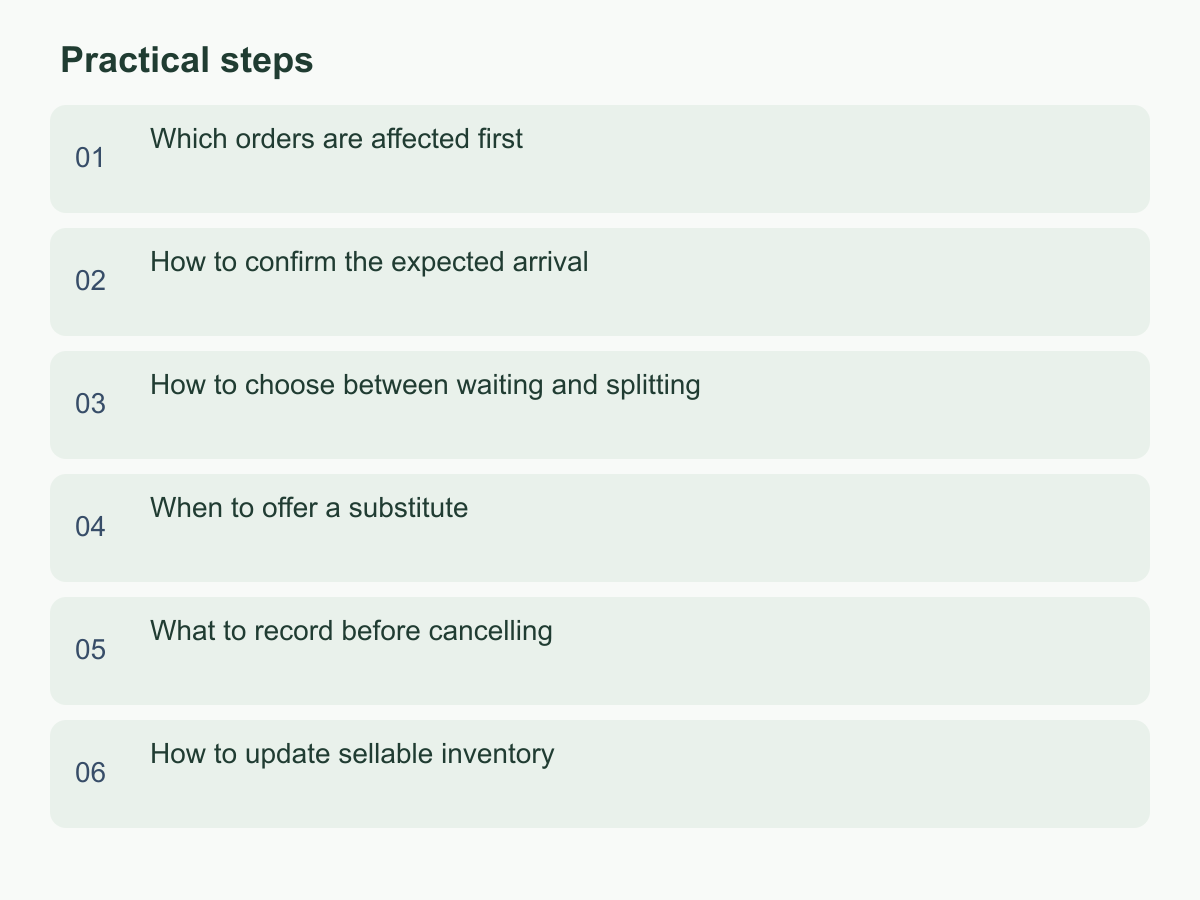
Which orders are affected first
Start with orders not yet dispatched that include a variant with no allocatable stock. Record the order number, SKU and variant, quantity ordered, reserved quantity, shortage, original promised dispatch date, destination, payment status, and owner. A shared product name does not make sizes, colours, bundles, or warehouse locations interchangeable. Before calling it a supplier shortage, check reservations, unposted stock counts, goods not yet put away, and delayed order deductions.
Prioritise by promised date, whether the shortage blocks the whole order, payment status, and whether available items can ship independently. List all orders affected by a limited supply, apply the existing allocation rule, and keep the reason for changes; do not rank only by who follows up most often. For example, if ten orders need the same item but stock covers four, record the original allocation and unmet quantities before deciding which orders take priority. Mark the other six as awaiting a choice, and do not count a supplier forecast as stock on hand.
The working list should show current status, shortage reason, last confirmation, next follow-up, options sent, and the person responsible. Preserve old and new quantities or dates. Freeze unapproved manual reallocation and assign one list owner; notify customer support and the warehouse after decisions so the same unit is not promised twice. Where channels share stock, compare each channel’s committed quantity before accepting more orders. Keep unresolved orders on the tracker, and verify unclear warehouse or variant details before replying.
How to confirm the expected arrival
Separate the estimate into supplier dispatch, carrier collection, warehouse arrival, inspection, and availability for allocation. A supplier’s statement that it will ship next week does not mean the goods have left the supplier or can be sent to the customer that day. Ask for the exact item and variant, quantity, shipping origin, delivery terms, whether it will arrive in batches, current status, and the next time progress can be confirmed. Mark estimates as estimates and record their source.
For cross-border or inter-warehouse replenishment, include transit and receiving time in your internal fulfilment estimate, and keep supplier information separate from your calculation. Give the customer a realistic date range, its basis, what could change, and the next update time. If no reliable milestone is available, say it is being checked and when you will reply; do not choose for the customer. For example, a supplier’s November 6 shipment date is only a dispatch estimate. Confirm transport from the origin and receiving at the designated warehouse before estimating fulfilment. Log the contact, reply, quantity basis, owner, and next check.
If a date changes, identify affected orders and preserve the previous promise instead of overwriting it. When sources conflict, record each source and time, then ask for a clearer dispatch or delivery milestone rather than selecting the most convenient date. Each update can state what is confirmed, what remains open, and when the next response will come. Send it at the agreed time even without progress, and recalculate timing and cost differences between waiting and splitting instead of reusing an outdated option.
How to choose between waiting and splitting
Waiting is suitable when an item cannot be substituted, items are meant to be used together, or a second shipment adds cost with little benefit. Before splitting, confirm that available items can be packed independently, order and address rules allow separate dispatches, and the backordered items have a workable date. Assign responsibility for additional shipping, storage, or processing. Ask whether the available items are useful on their own and whether multiple parcels add customs paperwork or delivery coordination. If cost or timing is unclear, confirm it before asking the customer to choose.
The figures below are hypothetical. An order has two items, one in stock and one on backorder, and the original delivery charge is HKD 45. If sending the second box also costs HKD 45, the total is HKD 90: HKD 45 more than waiting and shipping together.
| Option | When it may fit | Check first |
|---|---|---|
| Wait | The customer prefers one delivery | Replenishment date and next update |
| Split | The available item is useful alone | Cost and date for each shipment |
| Defer | Cost or arrival is unclear | When missing information will be available |
Calculate the order’s full delivery cost, identify who pays each part, and state whether the customer will be charged extra. Get agreement before creating separate fulfilment batches. List each item, estimated dispatch date, extra charge, and next update; asking only whether the order can be split leaves the impact unclear. If the customer rejects an extra charge, return to waiting or the existing cancellation policy. Compare both parcel charges, packaging, and staff time, confirm two dispatches are allowed, and record each batch’s quantity and date for the warehouse.
When to offer a substitute
Offer a substitute after confirming the shortage and finding a candidate that can be compared. Check use, key specifications, size or capacity, compatibility, pack quantity, and price. Explain similarities and differences, including any price change or required accessories; a similar name alone does not establish interchangeability. If you lack enough information to assess fit, share the product details as unconfirmed rather than presenting a guess as a recommendation.
List the original item, candidate, available quantity, price difference, fulfilment arrangement, and response deadline. Let the customer accept, wait for the original, or cancel under the existing policy. If the candidate has a different capacity, for example, state that difference and its price, and ask whether it is acceptable. Keep the original order pending until the customer approves the specific replacement; do not ship first and ask afterwards.
After approval, record the reply date and channel, approved SKU and quantity, price adjustment, and person making the change. Update picking instructions too. If the customer declines, record the choice and return to waiting, a feasible split, or cancellation. Check brand, model, or compatibility limits. Where a difference could affect use, provide comparison details and a product page or photo with an explanation. State whether the price increases, decreases, or stays the same. A general expression of interest is not approval of the specific SKU, price, and arrangement; ask before changing the order.
What to record before cancelling
Check the order status and existing cancellation policy first. Confirm whether payment was taken, any part was fulfilled, or a shipment or fee was arranged but not carried out. Give the customer the available waiting date, split cost, and substitute details, and explain each option’s effect. Do not replace a decision with a vague promise to handle it later or present a supplier estimate as confirmed. If policy does not say what to do when the customer is silent, escalate to someone authorised to decide; silence is not agreement to cancel.
Record the order number, unavailable item and quantity, cancellation scope and reason, options offered, customer’s explicit choice, notification time and channel, person making the change, and payment follow-up status. If only the unavailable item is cancelled, retain the order contents before and after the change, amount reconciliation, and remaining work. Link the transaction if payment or a refund needs adjustment, and name the follow-up owner and time. A submitted request is not a completed adjustment.
If the customer requests cancellation of only the unavailable item and asks for the rest to be sent as usual, retain that message or a traceable conversation reference, cancelled quantity, items kept, amount-check owner, and completion status. Use verifiable reasons; for example, the supplier has not confirmed an arrival date and the customer chose to cancel. Check whether the stock reservation must be released and alert fulfilment staff. If the customer has not replied, log contact attempts and the next owner, then follow policy. After notifying the customer, reconcile the order, payment, and reserved-stock records, marking unfinished steps with an owner and follow-up time.
How to update sellable inventory
Supplier confirmation does not make stock available for sale. Wait for the goods to reach the designated location, then receive them by SKU, variant, quantity, and warehouse. Resolve count differences and complete the receiving record. Keep items awaiting inspection, put-away, or label correction out of allocatable stock. Before changing availability, check existing reservations, cancellations in progress, and shared channel stock. Add only quantities confirmed as available, and record the operator, time, source document, and reason.
Suppose twelve units arrive, but only ten are confirmed as allocatable and two still need checking. Add ten to available stock. If three are assigned to waiting orders, seven remain for new orders. Honour existing commitments, then synchronise quantities and reservations across channels. Until that is complete, pause the listing or use a conservative available quantity to prevent overselling. These figures are examples; actual availability depends on the receiving count and allocations.
After cancellation or substitution, verify that the original item’s reservation has been released before adding it back. Keep before-and-after quantities, related order, and operator for each movement. Identify the inventory source of truth and synchronisation owner, and list which channels are done or pending. If system stock differs from the physical count, record the gap and investigator, then correct the system based on verified results. Track each affected order until it is allocated, remains waiting, or is cancelled. A useful tracker has six columns: order number, SKU, promised date, available option, extra cost, and customer decision. If you are planning to take a Hong Kong company into overseas markets, visit Chan & Chung’s website for related information.