
Once an agreement is signed, the practical work begins: turn the delivery, document, payment and response items the parties have confirmed into a tracker the team can update line by line. It helps people see what to do, who supplies it, who checks it, which signed document to consult and where progress stands; it does not decide what a clause means. Keep the source wording in view. If wording is unclear or versions differ, return to the parties for confirmation instead of filling gaps yourself.
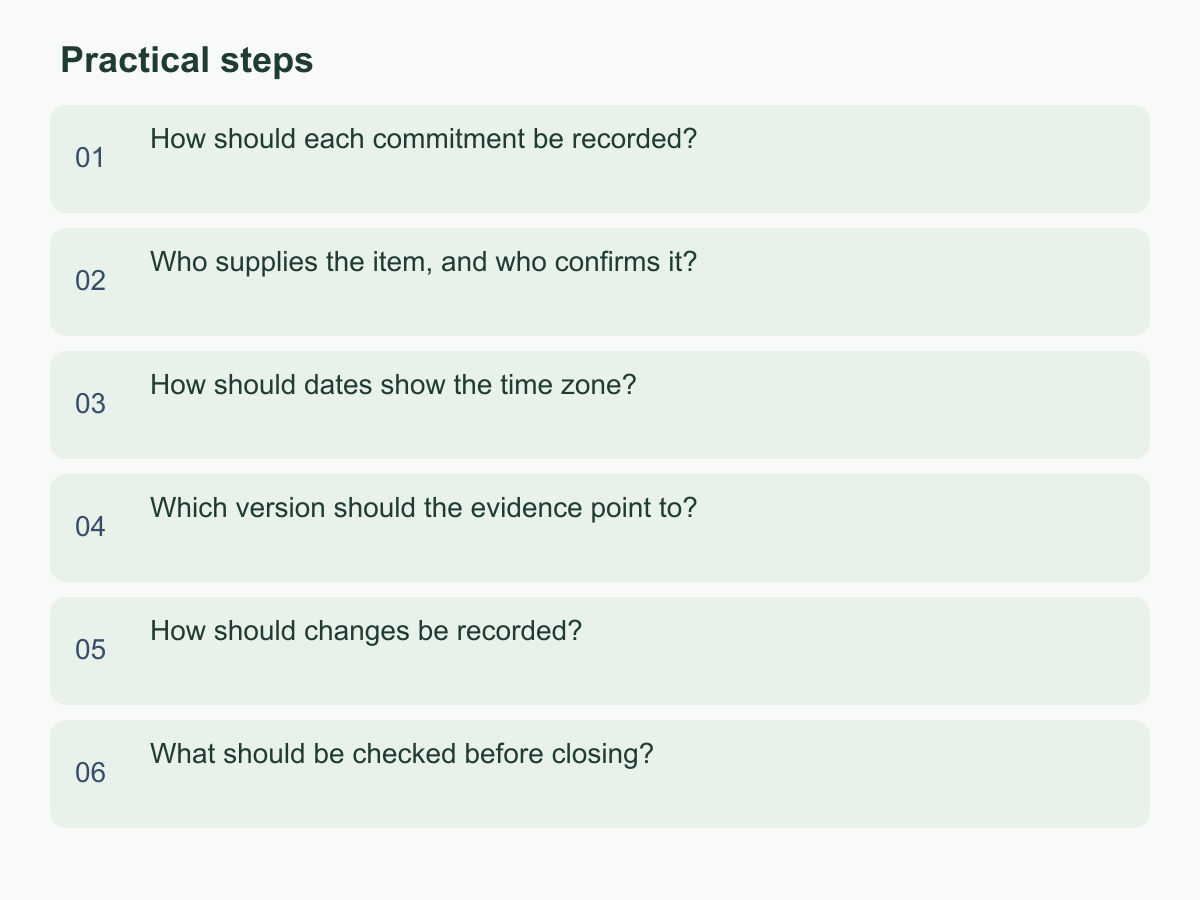
How should each commitment be recorded?
Make each row one trackable result. For each confirmed item, record the action, recipient, completion condition and source location. Use neutral verbs such as provide, submit, pay, reply or confirm. Preserve any stated format, quantity, language, delivery channel and prerequisites; do not add a missing deadline or quality standard. If wording is unclear, mark it for clarification, note who raised the question and the next follow-up. Do not turn an open question into a commitment.
Separate external commitments from internal work. Partner delivery is external; team follow-up and evidence filing are internal. Split sequences such as delivery, review and correction into linked rows so a general “complete” status cannot hide unfinished steps. The table is hypothetical only.
| Field | Illustrative entry |
|---|---|
| Item | Provide a test report |
| Completion condition | Receive the specified format; if none is stated, clarify |
| Provider / confirmer | Party A contact provides it; Party B contact confirms receipt |
| Timing / source | Enter the confirmed deadline and time zone; link the signed version |
| Status / evidence | Awaiting delivery; after receipt, link the access-controlled record |
Keep “received,” “awaiting confirmation” and “checked” distinct; receipt is not review. Trial one row first: it should show what is due, how receipt is recognized and where the source is.
Who supplies the item, and who confirms it?
Distinguish the provider, who delivers or replies under the confirmed record, from the confirmer, who checks the result against listed conditions. They may be the same or different people; naming someone grants no extra authority. Add an internal owner to follow up, route records, preserve evidence and update status. This is a team assignment, not a new promise by the other party.
Check the signed documents and later written confirmations for the parties and named contacts. Record a person's name, company or department, role and working contact route only when verified. If only a company is named, record it and mark the individual contact unconfirmed. If a contact has left or details fail, note what you checked and make replacement a team task; do not infer a successor from an old email. Keep personal contact details in a suitably restricted record.
If Party A delivers and Party B reviews, list their contacts as provider and confirmer and name a project owner to track progress. On receipt, mark “received,” not “confirmed,” until reviewed. If pages are missing, record the gap, reply contact and next step without inventing acceptance criteria. Verify role questions through a channel recognized by both parties.
How should dates show the time zone?
For each time-sensitive item, record the date, time, time zone and confirmed source. Keep the calendar date distinct from the deadline time. If the source states a date but no time, write “time not specified” and arrange clarification; do not add local midnight, close of business or another customary cutoff. Use a clear format such as YYYY-MM-DD. For a stated time, add its time-zone name or UTC offset.
For wording such as “by close of business Friday,” confirm whose business hours apply, which date is meant and whether the other party must coordinate. For a Taipei-London delivery, retain the original wording and mark the zone pending until written confirmation gives a date, time and zone. A converted time may help internal scheduling, but label it as the same deadline in another zone, not an additional deadline. Check the offset for that date instead of copying one from an older entry.
Review time fields for consistent formatting, especially at month-end, year-end, non-working days or zone changes. If a confirmed date changes, retain the original value, change time, confirmation source and updater rather than overwriting history. A reader should distinguish unresolved, confirmed and converted times and trace the basis.
Which version should the evidence point to?
Each row needs a source explaining why it is tracked, and execution evidence of delivery, payment or response. Link to the signed document and record its file name, version identifier, signature status and relevant page, section or attachment. If the original has no version number, use its recognizable file name and details; do not present a self-created label as a party-agreed version. Link operational detail with its confirmation time; a summary does not replace the original wording.
Use stable links intended reviewers can open with appropriate access. Ask another person to confirm both records are readable. If access is missing, mark it pending and assign an internal owner; a file name alone is not a completed check. Avoid temporary download URLs, personal desktop paths and uncontrolled public links. Keep source and execution evidence in separate fields so the basis and result remain clear.
For a pending report, link the source to the signed document and attachments. After receipt, add the file and receipt record to the evidence field. If draft, signed and jointly confirmed versions exist, label each status and purpose; do not replace the original basis with the newest-looking file. If the tracker conflicts with signed text, pause completion, check the original and later joint confirmation, then record the resolution.
How should changes be recorded?
Treat a proposed change as an event; do not erase the earlier entry. Record who proposed it, when, what changes, affected items, status and a link to the message or document. Until confirmed, mark it pending and keep the original row. Internal assessment or preparation may proceed if labeled.
After confirmation, update the current instruction but retain earlier and revised records, confirmation source, updater and update time. If a change affects several rows—for example, a new date changes the sequence of delivery, payment and review—check each related link, owner and status so other follow-ups do not contradict it. If sources differ, flag the discrepancy and seek confirmation; the newest file alone is not proof of agreement.
Suppose one party proposes a new format for a deliverable. Add a “format change pending confirmation” entry linked to the proposal, while keeping the confirmed format in the original row. Update the current instruction only after confirmation, preserving the earlier format and basis. If the other party confirms a date change but not the format, track them separately and check against confirmed terms until both points are clear. Notify affected colleagues after an update so copies, reminders and evidence links stay aligned, with a traceable history.
What should be checked before closing?
Review each row; an engagement can seem nearly finished while items remain. For each delivery or document, link the item, identify its source version and confirm the named review is complete. For a payment, check the confirmed amount or payment condition, responsible person and accessible record. For a response, preserve its content and date and time. A sent follow-up does not complete the next action. Trace each item from source to execution evidence.
For incomplete, delayed, cancelled or disputed items, keep status, blocker, owner and next step. Do not mark them complete to close the list. Change or remove tracking only with linked confirmation from both parties; otherwise leave it open. Before handover, check access, versions, time zones and the next internal owner; record who checked and when. This administrative check does not decide legal effect or responsibility.
If two rows remain pending, state which record is missing, who needs to reply and when each will be reviewed again. Preserve evidence links for completed rows and hand over the list and source index, identifying verified statuses, open questions and where to begin checking. Start with one signed document: extract one confirmed delivery item, fill one row and verify its source link opens for the intended reviewer.