
An interruption in overseas operations can grow from a small dependency: an experienced colleague is unavailable, a company account stops working, the source of a record is unclear, or an external contact cannot be reached. To reduce guesswork during recovery, start with critical work and trace its dependencies through people, permissions, data, and outside services. Then check whether a delegate and fallback process can actually take over. This map is about operational dependencies and single points of failure, not a directory of every document the company holds.
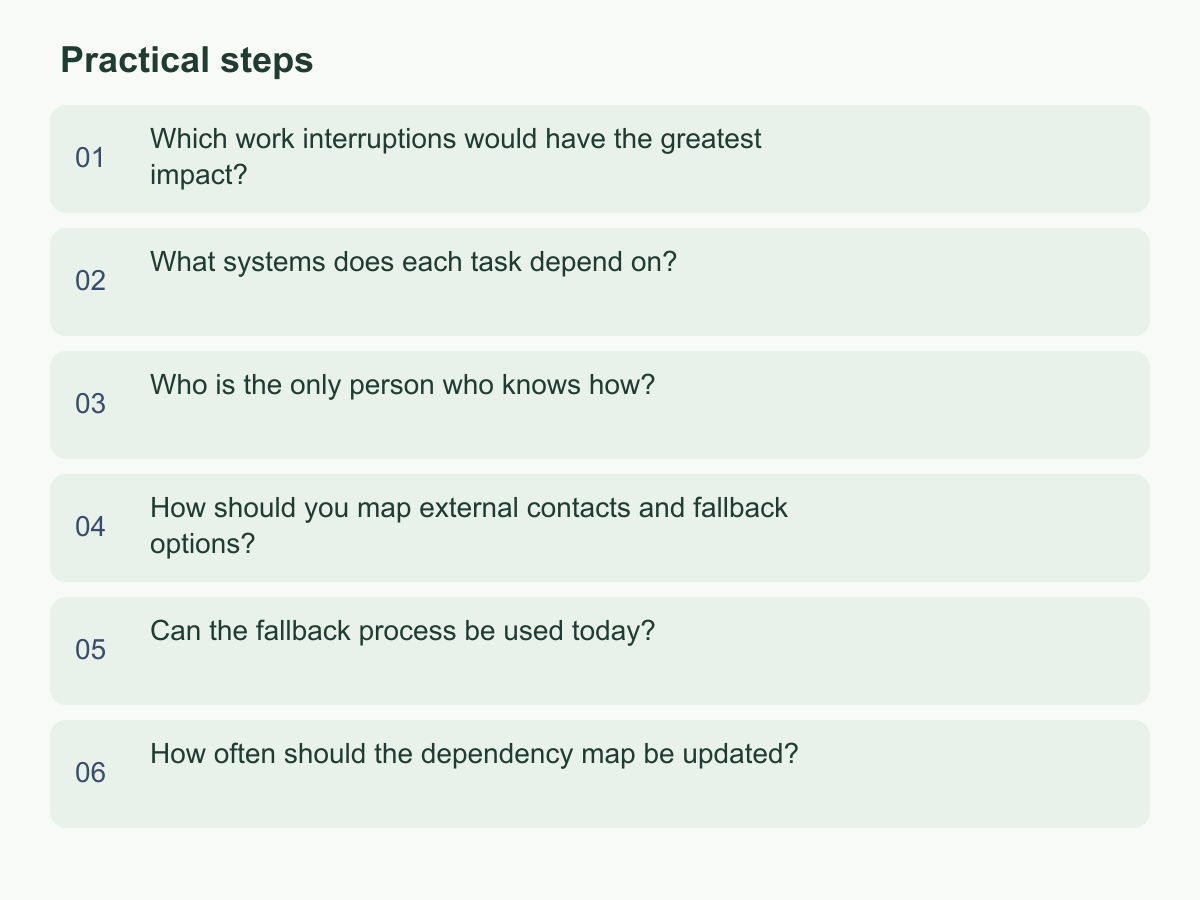
Which work interruptions would have the greatest impact?
Rank by outcome, not department or software. Describe verifiable results: confirming an order, checking stock before dispatch, reconciling a payment, answering a customer, preparing month-end records, or handing over administration. For each task, record its trigger, owner, completion evidence, tolerable delay, and whether missed work can be recovered. For payments, distinguish a transaction not yet approved from one submitted but unreconciled. The first needs an authorized decision-maker; the second requires preserving its reference and checking the source record. Do not simply resubmit.
Assess impact separately from frequency, using team records instead of guessed percentages. Consider effects on customers, cash, delivery or staff, record reconstruction, and downstream errors. Set a few priority levels: who assigns them, what triggers escalation, who is notified, and when commitments stop. Distinguish safe manual workarounds that are easy to reconcile from work that cannot be repeated. If teams disagree, have the task owner, receiving role, and manager agree on the ranking and reason; revisit it after recovery against actual impact.
For example, assume the order inbox is down while the stock report is delayed. Check whether an authorized person can still consult a trusted inventory source. If yes, record orders in a controlled log with the time, customer identifier, item, handler, and pending status; compare entries and mark transfers after recovery. If stock cannot be verified, collect requirements without promising delivery. This hypothetical ranks work by consequences and recoverability, not by how important its title sounds.
What systems does each task depend on?
For each high-impact task, map its chain: who performs it, which service and company account they use, which records they read or change, who approves the work, where data comes from, and who receives the result. Show sign-in portals, multi-factor authentication devices, company email and domain, shared files, order or inventory records, payment notices, reconciliation data, and external providers as connected nodes. Mark shared dependencies such as an identity account, phone, or administrator; systems relying on the same access point are not true backups.
For every node, record its name, purpose, managing role, required permissions, data location and format, upstream and downstream links, recovery route, fallback, and last verification date. Keep passwords, verification codes, and full customer records out of the map. Instead, note who safeguards credentials, how access is requested and approved, and how to recover it if the administrator is unavailable. Name the trusted source for each data type and assign responsibility for conflicts between independently updated records. Show the minimum workflow during an outage: what can continue, what must wait, and what needs reconciliation after recovery. This exposes single points of failure and downstream steps that might be repeated.
For example, a cross-border order might pass through a business inbox, shared order sheet, inventory check, and customer reply. Link these to the mailbox administrator, authentication device, domain control, and person verifying stock. A delegate unable to authenticate is blocked even if the inbox works; an editable sheet is not enough if stock is unverified. Ask a delegate to follow the map once and add guidance wherever an unwritten explanation is needed.
Who is the only person who knows how?
Ask whether someone else can safely complete the task when its key person is absent. Separate dependencies into knowledge, access, and decisions: one person knows the exceptions; one person can sign in; or one person can approve or stop the work. Each needs a different remedy. A procedure does not grant approval authority, and a delegate should not borrow a personal account.
Work with the task owner to document checkable steps: what to verify first, common errors, normal handling, exceptions that require a stop, who decides, and what evidence to leave. Name the delegate or role, permitted work, required access, and escalation contact. Limit permissions to what the task needs. Passwords and authentication codes are not handover materials; update account ownership and recovery routes when roles change or someone leaves.
For example, a delegate can practise month-end preparation with a reconciled prior-period sample: locate sources, repeat the steps, compare differences, explain unresolved items, and record the handover. The sample teaches the process; it does not establish any real accounting result. If unusual differences still require the owner's judgment, state when to stop, whom to contact, and what can continue while waiting. Do not label this full backup. Evidence of handover is the delegate completing the task independently and explaining their checks. If no one is ready, arrange shadowing, document judgment points, confirm who can authorize the work, and track training on the task itself.
How should you map external contacts and fallback options?
Organize contacts around the work they support. Common dependency categories include bank or payment-service support, cloud help desks, domain or email administration, suppliers, logistics providers, external accounting support, and regulator information contacts. These are examples of business dependencies, not providers every company uses. Link each contact to a situation such as account recovery, payment-status confirmation, delayed shipping, or data correction. State which internal role will contact them and who may represent the company.
Record the institution or service, relevant role, available channels, service hours and time zone, non-sensitive case identifiers, where account or contract references are kept, escalation routes, and an alternate contact. Keep authentication details, passwords, one-time codes, and unnecessary customer information out of shared maps. Store attachments in an approved, access-restricted location. An alternate is a fallback only if they can handle the same issue, understand the context, and have appropriate authority. Note the last successful contact method and issue category, but reconfirm routes when service hours, roles, or account conditions change.
For example, if the email administrator is unreachable, record who can submit a support case, where to find the tenant identifier, who tracks the case number, and how to escalate. Keep sign-in secrets out of instructions. For logistics, name who confirms a replacement carrier, where tracking data comes from, and who approves customer notices. Review routes regularly and after provider, account, or owner changes. Verify them without creating a real transaction; record the date, result, and follow-up owner.
Can the fallback process be used today?
Judge a fallback by evidence, not by whether it is documented. Check that the delegate can sign in, retrieve the right data, work within their authority, leave a traceable record, and later reconcile, deduplicate, and transfer entries when systems return. Mark any missing step as pending with its blocker, owner, and next action. Define when manual intake must stop to prevent duplicate orders, payments, or delivery commitments.
Begin with a controlled exercise. Record the scenario, test data, participants, stop conditions, and success evidence. A tabletop walkthrough tests whether people can find the steps and contacts; then check access and data retrieval without changing official records. Use simulated data for payments, external notices, filings, and formal submissions, following internal authorization. Record elapsed time, blocked steps, missing permissions, unreachable contacts, and reconciliation differences; assign fixes and retest.
For example, if the order system is down, a controlled spreadsheet should name one registration owner, required fields, a unique identifier for each entry, how others can see an order is already handled, what must be confirmed before a promise, and how entries return to the system and are reconciled. If email works but stock cannot be checked, keep the request pending rather than guessing a delivery date. The fallback is exercised only when sign-in, authority, data sources, and reconciliation work. Ask someone other than the usual owner to complete part of it from the map. Borrowed accounts, undocumented questions, or guessed statuses reveal dependencies still to fix.
How often should the dependency map be updated?
Use event-triggered updates and a regular review because people, permissions, tools, and processes can change before an annual inventory. Review affected tasks and linked dependencies when someone changes roles or leaves, an account administrator or provider changes, a new system launches, workflows change across markets, or an outage or exercise reveals a gap. Check high-impact tasks more often if useful; a quarterly full-map review is an adjustable management rhythm, not a statutory deadline or industry rule.
Assign a maintainer to coordinate updates. Task owners confirm workflows and data; system administrators confirm accounts, permissions, and recovery routes; managers confirm priorities, delegate arrangements, and acceptable stop conditions. Record the editor, date, reason, affected scope, open work, and evidence location without copying secrets into the change history. Give each gap an owner and checkpoint, such as delegate access still needed, an external contact unverified, or no owner for transferring manual records back. Ask affected owners, delegates, and administrators to confirm changes. If the dependency sequence changes, run a short exercise. Remove obsolete contacts and replaced procedures from the current map while retaining necessary change history.
A review that only confirms the spreadsheet exists can create false confidence. Choose a dependency behind a high-impact task and ask someone outside its ownership to identify the access point, trusted data, stop condition, and escalation contact. Compare their answers with the map. Record mismatches, assign a correction, and verify it; do not describe an untested fallback as effective.
As a next step, choose one task whose interruption would be hardest to recover from and walk the chain with its owner and delegate. Confirm access, trusted data, decision boundaries, external contacts, and reconciliation; assign the first gap to a role and review date. Extend the exercise to other high-impact work so the map supports everyday handovers and recovery. For official information about Chan & Chung, visit the English homepage.