
Overseas sales teams may use terms such as “interested” or “quoted” differently. Buyers repeat information, while managers cannot see what happens next. A shared pipeline records observable buyer progress, the evidence behind it, and the next action. The six-stage framework below is a starting point to adapt to a team’s process and market.
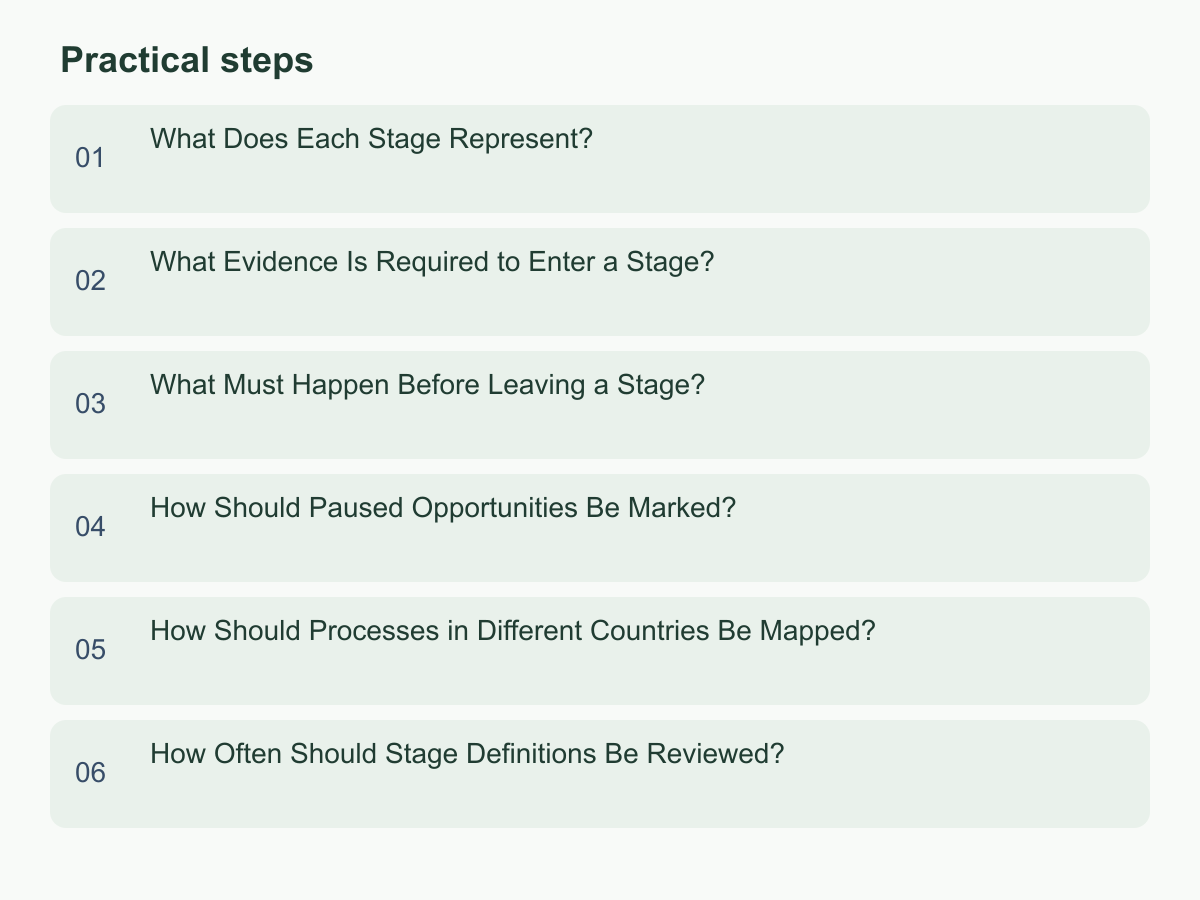
What Does Each Stage Represent?
A stage answers one question: what observable progress has the buyer made? It measures buyer progress, not seller effort or confidence. A team might use six shared stage categories: not contacted, contact established, needs confirmed, solution under evaluation, commercial terms being confirmed, and a terminal outcome recorded as won or lost. Define the event and evidence for each, plus where the opportunity stays if the event has not occurred. An introductory email proves outreach; advancement requires a buyer reply confirming a relevant discussion.
Add stages only for distinct buyer events. Separate solution evaluation from commercial confirmation when buyer actions differ; otherwise combine them. The definition and record should let a colleague identify the stage.
For example, a Taiwan SaaS team contacts a Malaysian retailer. After a call, the seller feels optimistic, but the buyer has not described the process to improve, evaluation participants, or decision path. Keep it at contact established. When the buyer explains the problem and agrees to another discussion, it can advance. Record a practical action, such as an interview, separately: the stage is achieved progress; the next step is planned work. Won and lost are terminal outcomes; silence alone is not lost. Managers should see the status and missing buyer event in the record.
What Evidence Is Required to Enter a Stage?
Write entry criteria as buyer evidence, not maturity impressions or internal tasks. For each stage, name required evidence, its location and recorder, and what happens when it is missing. For needs confirmed, capture the buyer’s problem or goal, affected business area, and agreed next check-in. “Buyer has a need” is too vague for a colleague to take over.
Separate required evidence, which supports advancement, from useful context that should not block it. Meeting notes, emails, or buyer documents can serve as sources. Summarize the key point, date, speaker, scope, and agreed action; regions need not use identical templates.
“Thanks, received” confirms delivery, not evaluation. A stronger signal is a buyer describing the need to reconcile orders across two markets, naming a finance colleague to participate, and agreeing to review the process next week. Record event, source, date, recorder, and next step. Keep sensitive attachments under access controls; do not copy personal data into uncontrolled fields. If colleagues disagree, clarify the threshold with a counterexample. Test it by hiding the stage name and asking a colleague to judge from evidence. External inquiry qualification is separate from CRM progress.
What Must Happen Before Leaving a Stage?
Exit criteria specify the buyer event for the next stage and the handoff. A follow-up email, draft quote, or checked task records seller work; none proves buyer progress alone. Move from contact established to needs confirmed after learning the buyer’s problem, goal, or use case and agreeing a next step. Move to solution evaluation after both sides confirm solution scope and evaluation plan. Require only necessary conditions.
Write rules as “Only after X may the opportunity move to Y,” with a qualifying and non-qualifying example. At handoff, point to the evidence. If incomplete, record what is missing, who will provide it, and the review date; keep the stage unchanged.
Suppose a buyer asks to compare two implementation scopes. The seller sends a proposal but does not know who will evaluate it or when they will discuss it. Keep the opportunity under solution evaluation; record open questions, owner, and date. Commercial confirmation needs buyer evidence of confirmed scope, decision participants, and a plan to discuss terms. At transition, hand over the owner, next step, due date, and background. If the buyer asks to wait, mark it paused. Mark lost only after a clear decline or choice of another solution.
How Should Paused Opportunities Be Marked?
Paused means no executable buyer progress now, with a reason and review condition. Keep the last supported stage and add pause status. Record the reason, buyer’s words, date, owner, restart condition, and review date. Reasons include an unopened budget cycle, missing decision-maker, or changed priorities. “No response” is an observation, not a promise to reconnect.
Pause differs from loss: it preserves a restart condition; loss closes tracking. If a contact changes roles, record what is known and what needs confirmation rather than assuming a successor inherited the decision. If the team awaits internal information, record that blocker instead of blaming the buyer.
For example, a buyer says a system transition takes priority this quarter and agrees to reconnect next quarter. Record who will contact them and retain the needs and solution history. If replies stop, follow the outreach rhythm and log attempts. At review, decide to contact again, move the date, remain paused, or close as lost, with the reason. On resumption, use new buyer evidence to select a stage and verify an old proposal remains current. Review overdue pauses to choose what to revisit or close.
How Should Processes in Different Countries Be Mapped?
Keep local language, titles, meeting customs, and purchasing steps, mapping their evidence to shared statuses. Ask regional owners to list common events and proof. Translating field names alone fails because a phrase can imply different commitments. For each local field, state its question, owner, and use point. Include it in cross-region reports only when it supports a shared meaning. The sample map is hypothetical, not a countrywide rule.
| Shared status | Hypothetical local label | Verifiable event |
|---|---|---|
| Contact established | Taiwan: initial discussion | Buyer replies and agrees to schedule a needs discussion |
| Needs confirmed | Malaysia: needs interview | Buyer confirms problem scope and next step |
| Solution under evaluation | Japan: solution review | Buyer confirms evaluation content and participants |
Test the map by hiding local labels on recent opportunities and asking another owner to judge from evidence. Compare with shared definitions. If agents or partners participate, record who supplied information, who the end buyer is, and which step occurred; an intermediary’s reply is not decision-maker confirmation. If a region discusses terms before evaluation, map completed events instead of forcing its sequence into the shared order. Assign a mapping owner and keep counterexamples. If evidence fits no status, flag it for clarification rather than inventing a regional stage.
How Often Should Stage Definitions Be Reviewed?
Sample opportunities monthly; review definitions quarterly and after material market, channel, or handoff changes. Include newly advanced, long-running, won, and lost cases. Check evidence, next steps, and mappings. With weak records, identify unclear definitions, recording problems, or training needs before changing wording or fields.
Use the same sampling method and period, including incomplete records. Ask a colleague in another region to review summaries without stage names. Sort findings into definition, field, training, or one-off issues.
A sample may show sent proposals counted as evaluation before buyers confirm scope or a discussion plan. Clarify the rule, add pass/fail examples, then recalibrate affected opportunities with regional owners. Track sample period, size, and exceptions. Record each change’s effective date, reason, approver, and affected fields; retain the prior version. After CRM changes, inspect screens and records. This reveals process differences; it does not guarantee higher win rates or revenue.
Start with five open opportunities in one market. Compare each stage with its recorded buyer evidence and next step, identify the most common missing buyer event, and add it to field guidance and handoff practice. Learn more about Chan & Chung on the English website.