
A personal data incident log gives a team a shared timeline of discovery, data in scope, impact assessment, containment, notification decisions, and follow-up. Assign an incident ID and controlled storage location; separate confirmed facts from open questions, and give each unknown an owner and due point. Record the last update and evidence index. Restrict access because the log may itself contain sensitive information.
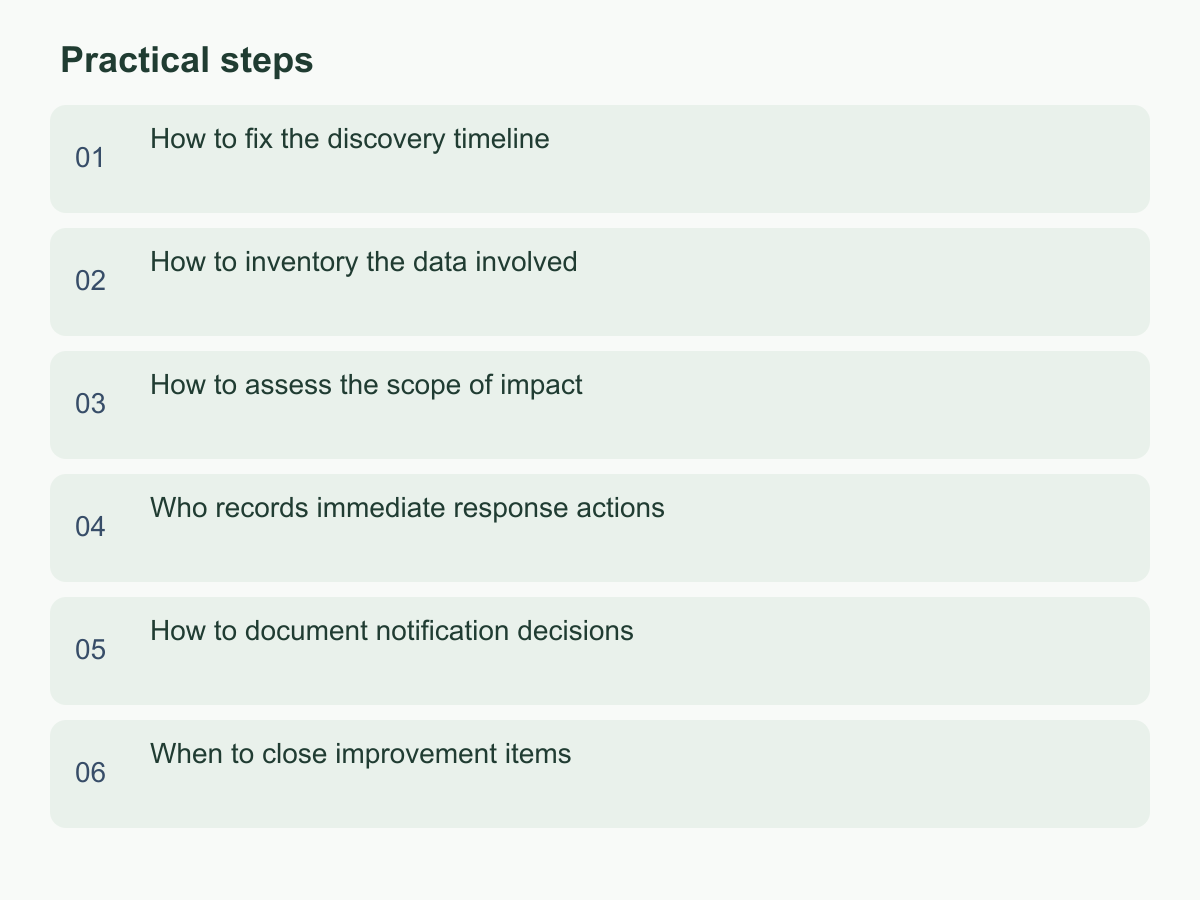
How to fix the discovery timeline
Record when the anomaly was first noticed and how it surfaced. Preserve the source time zone and system clock: discovery is not necessarily when data was first accessed or left the organisation’s control. If a customer report reaches support at 14:20 and an alert fired at 14:08, log the alert, when staff read it, the report, and owner confirmation as separate events.
For each entry, capture the event, source, recorder, evidence location, and status. Sources may include an alert capture, access log, ticket, or call summary. Keep original files rather than cropped screenshots alone; note each file’s name, origin, and custodian. Cross-check automated notices against human confirmation. If times conflict, retain both and explain the discrepancy instead of overwriting the earlier value.
Show estimates as estimates, with a confidence level and the next check. Note whether clocks were synchronised and the time basis used; if they cannot be compared reliably, keep original values instead of converting them into precise minutes. Version each edit with its editor and reason. In the example, 14:08 is the earliest signal and 14:20 staff confirmation; neither alone proves when the incident began.
How to inventory the data involved
List potentially involved systems, business processes, data categories, and storage locations, then verify what was actually in scope. Check accounts, tables, exports, backups, attachments, and third-party flows. Record who ran each query, when, its criteria, and its result. Map synchronised copies, temporary storage, and delivered copies so review does not stop at the main system.
Describe groups of people, identifying fields, account or contact details, count status, and who holds or can access the data. Consider whether separate data points can be combined to identify someone. If totals are uncertain, label them pending and state which dataset and query limits were checked; do not present a partial search as a full count.
Use one row per data group with location, category, involvement status, count, verification basis, and custodian. Mark each as confirmed, possible, checked with nothing found, or not yet checked, and state query scope: a clean result covers that query, not every copy. Mask a necessary sample, restrict access, and assign each open item an owner and completion condition. Reconcile every location against the systems list before impact assessment.
How to assess the scope of impact
Separate whether unauthorised access is established from what consequences individuals might face. List evidenced access, download, alteration, deletion, or temporary loss of availability. Then describe unconfirmed routes with the supporting evidence, time range, and confidence. Assess identifiability, data sensitivity, credentials or financial contact details, exposure duration, potential search or reuse, and mitigation. These factors organise facts; they are not a universal score.
Distinguish known impact, reasonably possible impact, and no impact observed so far, with evidence and gaps for each. If internal high, medium, or low labels are used, define them consistently and do not present them as external legal conclusions. Include indirect risks, such as account lockouts after a password reset or impersonation using exposed contacts, as assessed possibilities rather than outcomes.
In a hypothetical example, a test export lists 12 contact records, its link was externally readable, and logs confirm 3 successful openings. Record 12 listed records and 3 confirmed openings; whether others were copied is unknown. Three openings do not establish that there were only three recipients or that someone read the file each time. Check link availability, download records, and included fields; keep people counts separate from access events.
Who records immediate response actions
Assign an incident owner to coordinate information and maintain the timeline. The person authorised to decide should confirm measures and follow-up owners. In a small team, one person may cover both tasks, but entries still identify executor, approver, and time. A system administrator may preserve logs or apply restrictions, a process owner may check affected activity, and management may handle trade-offs; these are working arrangements, not legal roles.
For each measure, record reason, scope, execution time, intended effect, actual result, and evidence location. Name the resource when suspending an account, revoking permission, rotating a key, or disabling an endpoint, and record how the result was verified. Note service interruption considered. Preserve logs or images before an action may erase them; if restriction must come first, record the visible state and remaining evidence.
At handover, mark actions complete, in progress, awaiting approval, or blocked. Give each open item an owner, next update point, and escalation contact. An instruction sent is not proof of effect: check that a revoked link or credential no longer works, then log the result. Record failures or widened impact and the recovery measure. For an external provider, share only the request summary needed and response status.
How to document notification decisions
Show how the team reached a notification decision from the facts. Establish the regions, people, and data-control relationships involved, then check relevant official guidance and rules. For cross-border incidents or multiple parties, assess each region separately. Record the decision-maker, advisers and roles, source or guidance version, questions considered, unresolved facts, and review time. Ask a qualified professional to confirm interpreted thresholds or deadlines; do not assume a fixed number of days.
Consider sensitivity, identifiability, evidence of access, possible consequences, mitigation, and remaining uncertainty. Whether the choice is to notify, defer, or not notify now, record the reason, approver, and conditions that trigger another review. State what new evidence could change a decision not to notify. For a notification, retain recipient group, channel, approved message, send time, and response status; explain known facts, practical steps, and a contact point without turning possibilities into facts.
Where controllers, processors, or platforms share the work, specify who supplies facts, who assesses their own obligations, and who approves communications. Set an owner and point for missing information. Preserve the source consulted and revisit it if facts or rules change. The log records the decision process; it does not replace jurisdiction-specific professional advice.
When to close improvement items
Create improvement items from incident causes or control gaps. Group them by purpose: prevent recurrence, reduce potential impact, improve detection, or clarify handovers. Give each item an ID, specific action, owner, target date, dependencies, completion evidence, and verifier. Keep immediate containment separate from longer-term work on permission design, process gaps, exposed backups, or training. A third-party request remains open until evidence or a response confirms completion.
At closure, point to a reviewed access list, configuration change, sample check, exercise record, or revised instructions. A ticket marked done, promise, or purchased tool alone does not show risk fell. Compare evidence with completion conditions and check for new risks. If work falls short, keep the reason, alternative plan, and revised date in history. If completion is impossible, document accountable risk acceptance, its scope, and review conditions.
Track incident status separately from improvement status: urgent response can end while improvement work remains open. At final review, give every open fact a conclusion or owner, record the basis for notification decisions, confirm evidence remains readable at its stated location, and set review points for longer-term measures. Preserve change history, final approver, and closure reason so later readers can see what was completed and what risk was accepted. A useful first step is to create a controlled log with these fields and assign the incident owner to record the first timeline entry. For more about Chan & Chung, visit the English-language website.