
When a lead moves from marketing or a partner to an overseas sales team, contact details often survive while source, context, and responsibility for the next step do not. A shared handoff process records where the inquiry came from, what is known, who owns it, when to respond, and how outcomes return to the source team.
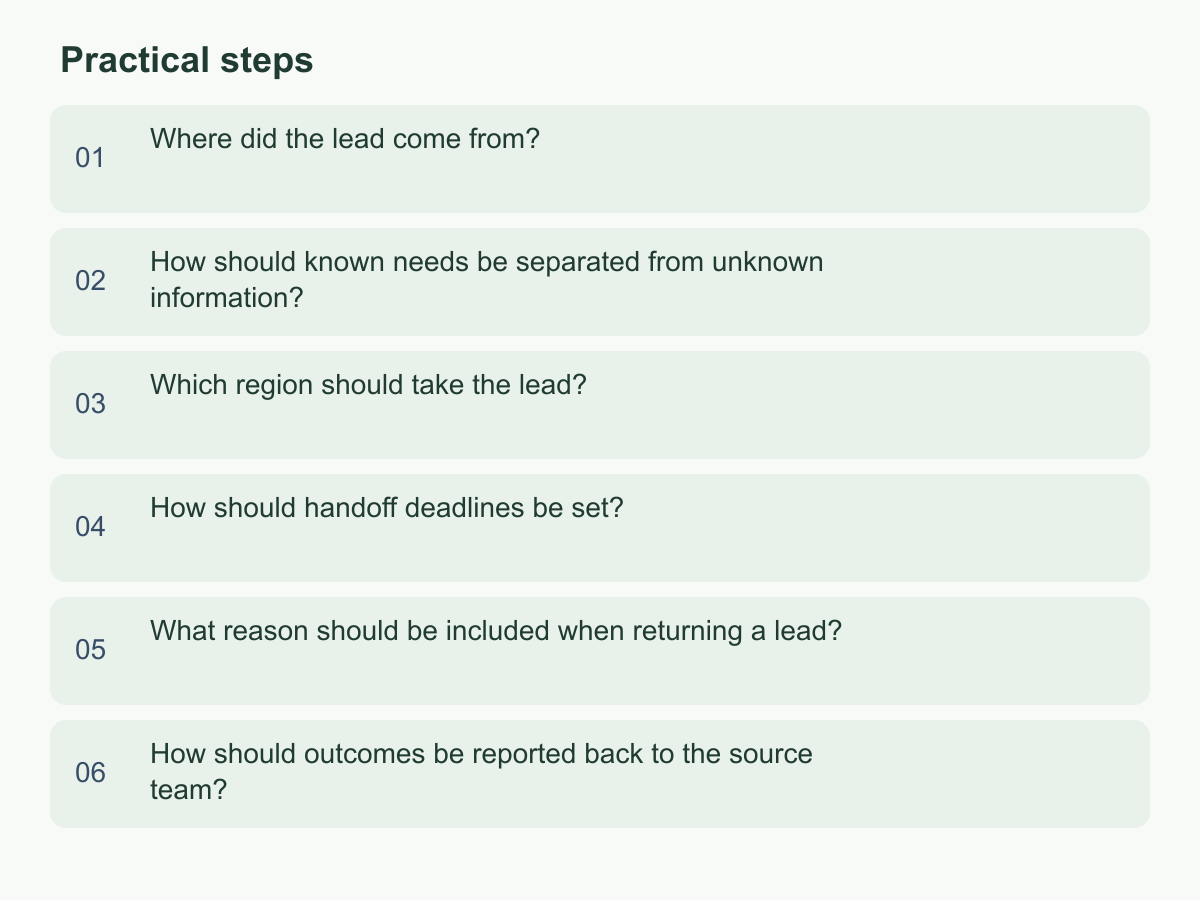
Where did the lead come from?
Record who supplied each lead, when, and through which entry point; “website” alone is too broad. Capture first-touch source, latest interaction, campaign or content, landing page, received time and time zone, and form or referrer separately. For referrals, include partner and date. Add a short message summary or source link. Preserve both first discovery and the interaction that prompted today’s conversation.
For example, a prospect reads a website article, attends a briefing two weeks later, then comes through a partner. Record the article as first touch, briefing as recent interaction, partner as referral, each dated. Note what the contact supplied versus what sales added. If the source is unverified, mark it unknown and explain why. Keep the original URL or campaign code beside tracking data so a form redesign does not erase useful context.
Keep one record in an approved shared workspace both teams can access; avoid scattered screenshots and forwards. Agree on categories such as form, event, partner, customer referral, organic social, and unknown, while treating them as labels rather than intent. Review sample handoffs weekly; if “website” or “other” dominates, improve the form or referral template. Count one lead once and retain secondary touches.
How should known needs be separated from unknown information?
Separate confirmed facts from questions, and cite a source and date for each. Capture the contact’s words, company and role if provided, requested topic, preferred language and contact method, and agreed next step. Preserve wording: “interested in overseas markets” does not confirm a specific expansion plan. Distinguish quotes from team summaries.
Mark gaps as “not asked,” “not provided,” or “awaiting reply” instead of leaving blanks. Do not infer budget, target jurisdiction, decision authority, or timing from nationality, language, domain, or company name. Keep the question distinct from the answer: “target market not confirmed; owner to ask which market is the priority.”
For call details, record the date, note-taker, and whether information is quoted or summarized. Flag consent to contact or a usable method if unconfirmed; do not treat privately collected details as permission.
For example, if a form says “interested in expanding into Southeast Asia,” record: “Target country not confirmed; no budget provided; prefers Chinese contact, per form.” The sales owner can confirm the priority market and participants on the first call, then record who updated the details and when. The lead stays actionable because the next question is clear without inventing a service need.
Which region should take the lead?
Route using agreed rules, not nationality, phone code, or language alone. Criteria may include the market named by the contact, requested contact time zone, preferred language, current account owner, or relevant expertise. Name a primary and backup. For multi-market inquiries, appoint one coordinator so regional teams do not approach the same company separately.
The routing table should show how each field affects assignment, the owner and backup, effective date, and maintainer. Route existing customers to their account owner first; use the named operating market for regional assignment and requested time zone to plan contact. Language can guide communication matching but not market ownership. Missing key fields go to a shared clarification queue.
For example, a Taiwan-based contact says the company serves Malaysia and requests English during a time window. If rules route by target market and serviceable time zone, use the market-owner table rather than location alone. If no rule covers the combination, let the coordinator hold it temporarily and ask a manager to define the route. This describes a process, not a regional service.
Keep one current owner and record why and when a lead is reassigned. Update rules before using them for new cases after a market or staffing change.
How should handoff deadlines be set?
Set separate clocks for acknowledgment, owner acceptance, first contact attempt, and overdue escalation; “as soon as possible” cannot be audited. Each target needs a start event, working calendar, time zone, owner, and backup. Define after-hours, holiday, leave, and system-interruption rules in advance. These are internal targets, not promises to contacts.
Start at recorded form receipt or completed referral, not when someone opens email. Acknowledge incomplete leads while giving someone a separate deadline to collect missing details. If a clock pauses or restarts, log why and who changed it.
For example, a team targets acknowledgment within two working hours and a first attempt within five working hours that day. For a Tuesday 10:00 a.m. arrival on a 10:00 a.m.–6:00 p.m. workday, acknowledge by noon and attempt by 3:00 p.m. An after-hours lead starts in the next working period under the written rule. This is adjustable, not an industry standard; track acceptance separately from attempted contact.
Alert a named backup with the record link, obstacle, and needed action. Review misses monthly by cause—missing details, time-zone mismatch, capacity, or failed alerts—and address the obstacle before shortening targets.
What reason should be included when returning a lead?
Return a lead with an observable reason, missing item, and next owner. Categories can include duplicate, market outside routing rules, missing contact details, pause request, unclear need, existing owner, or no appropriate next step. Avoid vague labels like “low quality”; a score does not explain the handoff.
Include the record link, confirmed facts, contact attempts or duplicate checks, missing fields, suggested question, next owner, and reply deadline. Link a possible duplicate record for reconciliation. If routing is unclear, name the missing field. If the contact asked to be approached later, record the requested timing and source.
Separate “return for information” from “decline and reassign.” The first names who will supply the missing field and by when. The second means information is sufficient but another owner should handle it; the current recipient confirms reassignment. Send internal problems, such as an outdated owner list, to its maintainer rather than a partner who cannot fix them.
Preserve original receipt time, handling history, and status-change owner. Start with a small reason list; add categories only when real cases show they lead to different actions.
How should outcomes be reported back to the source team?
Agree on status points: accepted, contact attempted, two-way contact established, awaiting reply, next step arranged, paused, or returned. Define each; a sent email is not two-way contact. Updates should include date, owner, next step, and review time. Share only details the source team needs.
Choose one authoritative record across tools and assign someone to keep it current. If systems cannot sync, state where and when the latest update lives. Compare acceptance, successful contact, return reasons, or handling time only with enough data; give the scope and denominator. Describe small or in-progress samples as accumulating; do not call non-response a failure or infer channel performance from incomplete results. Feedback should name a specific form or referral improvement.
For example, an event produces 12 records: 3 accepted, 2 awaiting contact details, and 7 unassigned. Report those statuses, not 12 completed handoffs. Name who will supply the 2 details and by when; assign the other 7 and record why they remain unassigned. Add later outcomes with dates instead of overwriting history. Periodically trace a lead from source through owner, deadline, and outcome to find process gaps.
For practical information related to Hong Kong companies expanding overseas, visit Chan & Chung.