
Organizing meetings for a cross-border team means deciding what needs live discussion, whether the timing is fair, and how work continues afterward. Start with the decision or action the team needs, then choose the format and set repeatable practices for time-zone rotation, agendas, and follow-up. A useful system includes the people needed to decide and gives everyone else enough information to keep moving.
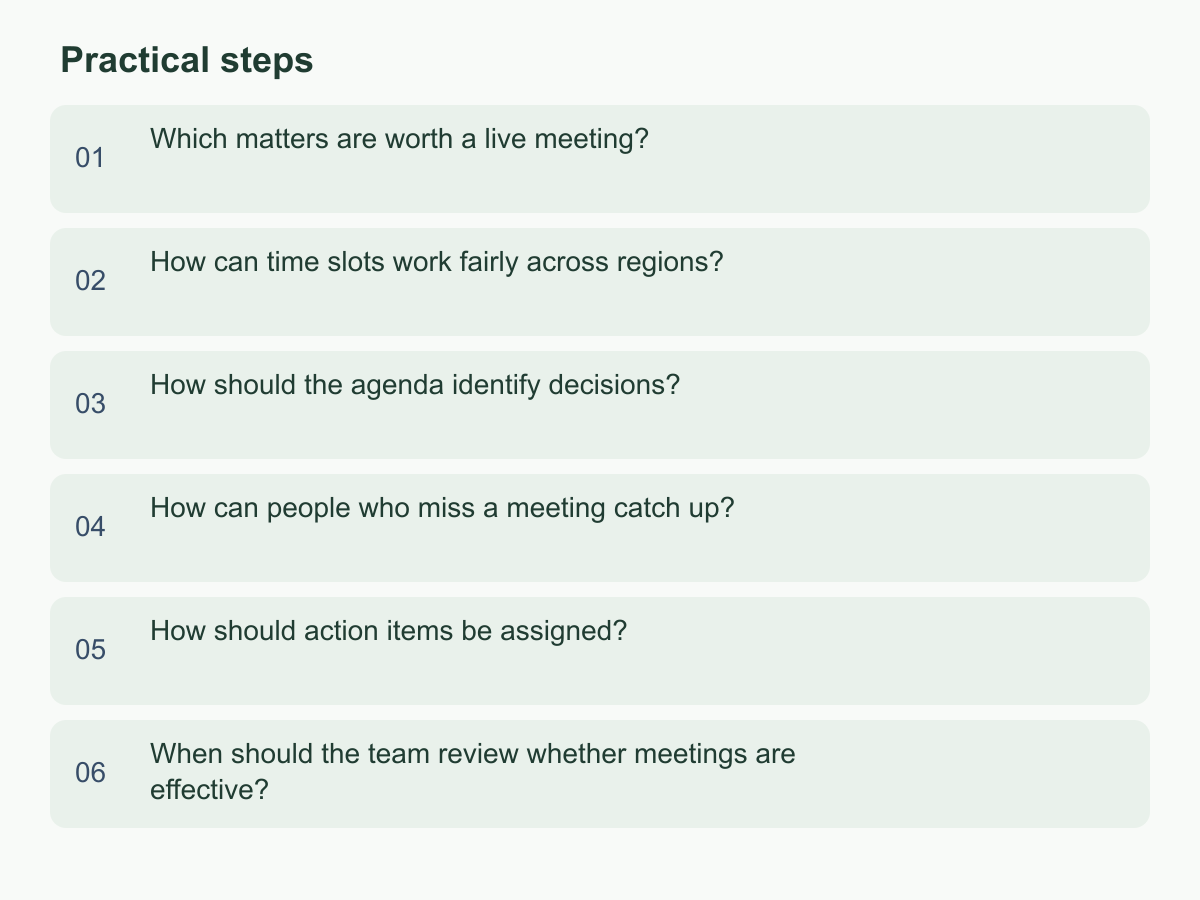
Which matters are worth a live meeting?
A standing meeting should solve work that cannot move efficiently through writing. Meet when roles hold different context, one person’s answer changes another’s next step, or an asynchronous wait would block work. If one person only needs to provide information, request it by a deadline. Urgency alone is not enough: identify who is waiting, what they need, and when, then choose a deadline or live discussion.
Work backward from the output. Meet to choose an option or clear connected blockers; use time-limited written comments for input without live debate. For settled information, send an update with a named owner. If product, operations, and support must agree on a launch sequence because a support constraint could change rollout steps, discuss it together. To announce a date, a written notice with a question channel is simpler.
Before inviting people, name what they should do afterward: confirm a sequence, choose an option, or identify missing information. State who provides context and who decides. Share background and response format in advance; a large attendee list does not mean everyone needs to speak. Reserve live time for differences the group can resolve. If no action or decision is needed, add context or use an asynchronous format.
How can time slots work fairly across regions?
List essential participants’ locations, working hours, caregiving responsibilities, and handoff times; mark overlap. Do not schedule only for the host’s time zone or treat technical availability as fairness. If overlap is limited, share information asynchronously and reserve live discussion for decisions needing it. Label each invitation with time zones and check local times on the actual date, especially around daylight-saving changes.
Set a rule for recurring meetings: rotate convenient slots, consult affected regions before urgent calls, and let absentees submit comments and read the summary. Keep acceptable local-time windows by region. If no slot works, use a representative or asynchronous process. Only essential participants should take inconvenient times; explain the trade-off and how others contribute.
Rotate the convenient time across regions. This three-round example needs local-time checks:
| Round | Region given priority | Approach |
|---|---|---|
| First | Asia | Choose an acceptable overlapping time |
| Second | Europe | Use another checked time |
| Third | Americas | Reserve a more suitable time |
After each round, record who took the poor slot and whether absent colleagues could contribute in writing. Adjust if the same person repeatedly gets it; paper rotation alone is not fair. Give urgent exceptions a reason. If they become routine, review the live format and decision process.
How should the agenda identify decisions?
Make each agenda item clearly for people to know, discuss, or decide. Name a facilitator, output, background, decision-maker, and time limit. For a choice, list options and relevant criteria—such as delivery order, capacity, risk, or customer impact—so everyone answers the same question.
Move information updates to pre-reading. Give clarification items a specific question and decision items a clear outcome. To choose between a phased launch and releasing a feature all at once, show both options, prerequisites, and who will confirm resource availability. “Discuss feature launch” is not a decision. Mark missing information as unconfirmed.
Identify the minimum information each decision needs. If it is missing, assign someone to fill the gap and a time to return. Treat durations as limits; protect time for high-impact choices. If an item runs over, record what is deferred and what must happen before it resumes.
Close by restating decisions, open questions and why they remain, and when they will be checked. If the decision-maker cannot attend, name an authorized delegate or reschedule. Without someone able to decide, use the session to organize options, not record a decision. Explain added items and include the materials’ version.
How can people who miss a meeting catch up?
Give absent colleagues enough context to continue, not a replay. Beforehand, share a short note with why the issue needs attention, what is known and unknown, options, decision-maker, and affected work. Put details at a stable link with a version or update date; explain unfamiliar terms or handoff practices.
List pre-reading and response questions in the invitation. For a colleague missing the meeting, ask by a deadline how each option affects their work. Bring that input into the discussion, then share the decision and whether it changed the outcome. Tell everyone if materials change substantially.
Afterward, record the decision and rationale, open questions, action owners and deadlines, and links to the agenda and materials. A recording or transcript can supplement, not replace, a searchable summary; follow consent and access rules. Give absent colleagues a window to add information. If new facts could change the decision, confirm it; if they only add context, update the record.
Use three prompts: what was decided, why, and who does what next. For open issues, name the missing evidence and reply deadline. Replace “see the notes” with the relevant section and first action; mark changes so late readers can identify the current version.
How should action items be assigned?
Turn “we will handle it” into a verifiable assignment: task, one accountable owner, deadline with time zone, completion criteria, dependencies, and progress location. Name collaborators or approvers as needed, but not the whole team as owner. Use an exact date and time instead of “tomorrow” when regions differ.
Example: “Lin Yi will update the handoff checklist by Thursday at 16:00 Hong Kong time. Completion means naming an owner for every handoff point and filling all confirmable fields. Lin Yi will post it in the shared record and flag items needing a decision.” This is illustrative; confirm real owners and dates. For dependencies, name the person, latest reply time, and who adjusts next steps if the information is late.
Use checkable criteria, such as an uploaded attachment and complete required fields; replace “follow up” with a result. Flag dependency risks before the deadline so the facilitator can adjust scope, timing, or sequence.
Before closing, read assignments aloud so owners can confirm task, deadline, dependencies, and blockers. Record them in the team’s existing tracker with status and latest update. For shared work, name one coordinator and split independently checkable parts. Review overdue, blocked, or decision-dependent items at the next meeting; keep routine progress asynchronous.
When should the team review whether meetings are effective?
Start with the meeting’s problem. Attendance and meeting count alone do not show effectiveness. Track recorded decisions, reopened issues, overdue actions, absent colleagues’ progress, and regions’ inconvenient times. Use these signals to improve the process, not rank individuals. A reopened decision may reflect missing context, an absent decision-maker, or changed conditions; check the record.
Review a defined period, such as four consecutive weeks, as a trial. If a meeting type produces no decisions, check whether its agenda is only status or the decision-maker is missing before canceling it or replacing it with an update. If decisions happen but one region cannot follow through, improve the recap or time rotation before adding meetings.
Look for process causes such as waiting for a decision, late input, or underestimated workload. Change one practice at a time and note when it starts. Ask people in different time zones what helped and what added burden. Compare the meeting’s purpose with its record, choose one observable adjustment—shorter duration, a new rotation, or comments before discussion—and review it next cycle.
Next, record the decision, owner, deadline, and review date.
For more information about Chan & Chung, visit the English homepage.