
An overseas operations meeting should turn report figures into questions, decisions, owners, and next checks—not read every column aloud. Beforehand, align the comparison period, currency, metric definition, and report version. In the meeting, verify unusual figures before discussing causes, then record decisions and follow-up times. The examples use hypothetical sales, collections, cost, and delivery data; confirm each definition against your own process.
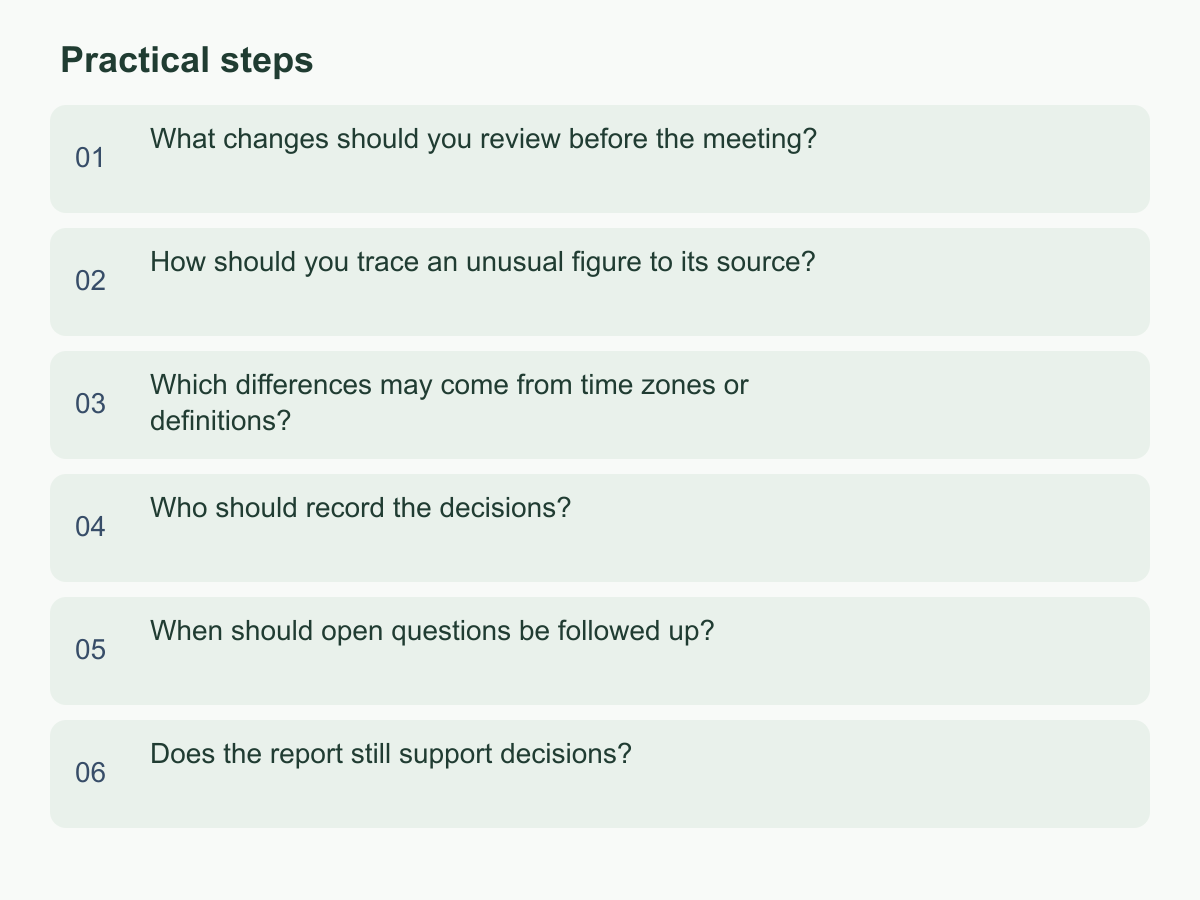
What changes should you review before the meeting?
Before the meeting, turn the report into a change list. For each metric, show current and comparison periods, difference, direction, source, and update time. Choose a comparison that answers the question, such as this month versus last, and state whether periods contain equal days. Show budget or target gaps separately.
Rank items with agreed criteria such as amount, percentage, duration, cash tied up, delivery impact, or team dependencies. If no escalation threshold exists, show both amount and percentage and ask an authorized decision maker to set one. Keep stable trends that could affect plans, including slow collections, rising inventory, or delivery backlogs.
For example, sales of 1.2 million versus 1.08 million are up 120,000, or about 11.1% (120,000 ÷ 1.08 million). Confirm both periods use the same currency, business days, order statuses, and calculation method; then ask whether new orders, average order value, or recording dates explain the change. Put only items needing action on the agenda, with the question, information provider, and time needed. Send the report version and cutoff in advance; label missing data and its expected arrival instead of using a blank or zero.
How should you trace an unusual figure to its source?
Turn each exception into a repeatable query: metric, period, currency, market, calculation rules, and report version. Identify source layers such as transaction and collection records, expense documents, imports, or manual adjustments. “Why is this different?” lacks enough scope to retrieve the same data.
Work from total to detail. Group by market, channel, product, customer, or status, then use order, collection, or document identifiers to check source records. Record filters, extraction time, row count, and total. For conversions or manual arrangements, note the rate date and steps. Restrict sensitive data; notes need only follow-up identifiers.
Suppose collections show 96,000 in a report and 92,000 in the detail: a 4,000 gap. Confirm currency, period, and statuses match; check possible duplicates, refunds, unsettled transactions, or period differences as hypotheses, not conclusions. Separate identified items from the unexplained balance and retain source locations. If records agree but the report differs, compare imports, categories, aggregation, and filters; if records conflict, name the document and confirmer. Record checks and missing evidence; do not substitute a plausible number.
Which differences may come from time zones or definitions?
An apparent exception may reflect a period boundary, time zone, or definition. Confirm the date field and cutoff: an order, payment, platform settlement, bank deposit, and company entry may fall on different dates. Month-end and weekends magnify this; midnight in one location may still be the prior day elsewhere.
Confirm what sales, collections, and costs count. Sales may count orders placed, payments received, goods shipped, or net sales; collections may mean customer payment, channel settlement, or bank receipt; costs may be incurred, paid, or estimated. Matching labels do not guarantee matching definitions. Check currency: compare original and converted amounts, plus exchange-rate dates.
For example, a platform payment completed late Sunday in one location may appear as a Monday bank deposit elsewhere. Daily totals differ even if the full settlement-period total matches. Compare the full-period total, then dates and transaction identifiers; log any remaining gap.
If definitions differ, preserve the original and make a separate like-for-like comparison. Record conversion rules, effective date, and confirmer; do not quietly change historical definitions. If alignment is impossible, show both versions, their purpose, which supports the decision, and a review date. Compare only matching periods, scope, currency, and definitions; label others not comparable.
Who should record the decisions?
Name a recorder and distinguish three roles: the person raising an exception presents evidence; the decision maker confirms options and trade-offs; the action owner commits to work and a reporting time. Roles may overlap, but each decision needs a final approver.
Record the issue and impact, report or source, options, decision and decision maker, action owner, completion criteria, and follow-up time. For an unresolved collection gap, identify missing transaction details, which figure will not be used yet, and when the owner will report back. If action is deferred, note why and what would reopen the issue. Avoid “research further.”
Use the team’s existing document or task tool, access rules, and naming conventions; keep source links and version changes traceable. Before closing, read decisions and actions aloud. The decision maker confirms the trade-off and authorization; the action owner confirms the work and timing.
Afterward, link notes to the report or source and tell relevant colleagues where they are recorded. If direction changes, add the evidence, change, and confirmer instead of overwriting the earlier decision. At the next meeting, check the prior deliverable and deadline before adding exceptions. This distinguishes incomplete execution from a decision to reopen or an issue that has cleared.
When should open questions be followed up?
Set a dated checkpoint for each open question; “next meeting” is not a date. Match urgency to impact: if an issue may affect payment arrangements, customer delivery, resources, or a scheduled decision, report sooner and state when the decision maker needs the facts.
Assign one lead; define evidence, deliverable, and completion test. For a collection gap, compare same-period lists, provide identifier matches and the unexplained amount, and report by an agreed date. Name supporting colleagues’ inputs and due times; the lead coordinates and reports.
Schedule around dependencies: check an expected source file arrives before comparison; if external information is pending, set arrival and final-report checks. Include the time zone for cross-border deadlines.
At follow-up, mark complete, waiting, blocked, rescheduled, or needing a decision, with evidence or a link. Close only when criteria are met. If evidence disproves the earlier explanation, reopen and record the reassessment and lead. Explain overdue work before revising the deadline or escalating.
If a time-sensitive trigger occurs, such as a widening gap near a decision deadline, notify the decision maker as agreed and retain the basis rather than waiting. If nothing changed, review status and blockers without repeating background.
Does the report still support decisions?
Review recent meetings: which figures changed resource allocation, operating plans, or the next step? Which metrics appear each time without prompting a question, check, or action? Keep a metric when it answers a decision question and different results could lead to different actions. Otherwise, consider reducing it, moving it to an appendix, or updating it less often.
Retain fields that reveal issues, support comparisons, or verify decisions; check that they are available, defined, and owned. For long-running gaps, state the scope and a plan to fill them instead of entering an estimate or assuming zero. If staff repeatedly assemble a figure by hand, document the steps and sources before considering a process change. State what a report revision should improve, and preserve past periods and definitions so trends remain understandable.
Check whether the report is practical to use. If meeting time goes to explaining labels, finding sources, or recalculating totals, definitions, update responsibilities, or presentation order may need attention. Keep transaction detail accessible while the main view focuses on summaries, changes, and questions. Totals must remain traceable to supporting sources.
At the next review, check whether a revision reduced reconciliation, made sources easier to find, or helped the team revisit decisions and follow-up.
Before the next meeting, choose one frequently questioned metric and bring together its source, definition, owner, and latest decision. Add open questions, owners, and reporting times to the team’s existing follow-up record. To learn more about the brand, visit the Chan & Chung website.