
When an overseas incident begins, the immediate problem may be unclear ownership: whom to notify, who may pause work, and who can update customers. A contact card names the primary and backup contacts, approver, and external communications owner. A decision-rights table distinguishes protective steps staff may take from commitments that need approval. Verify the card against the team’s actual shifts, risks, and authority.
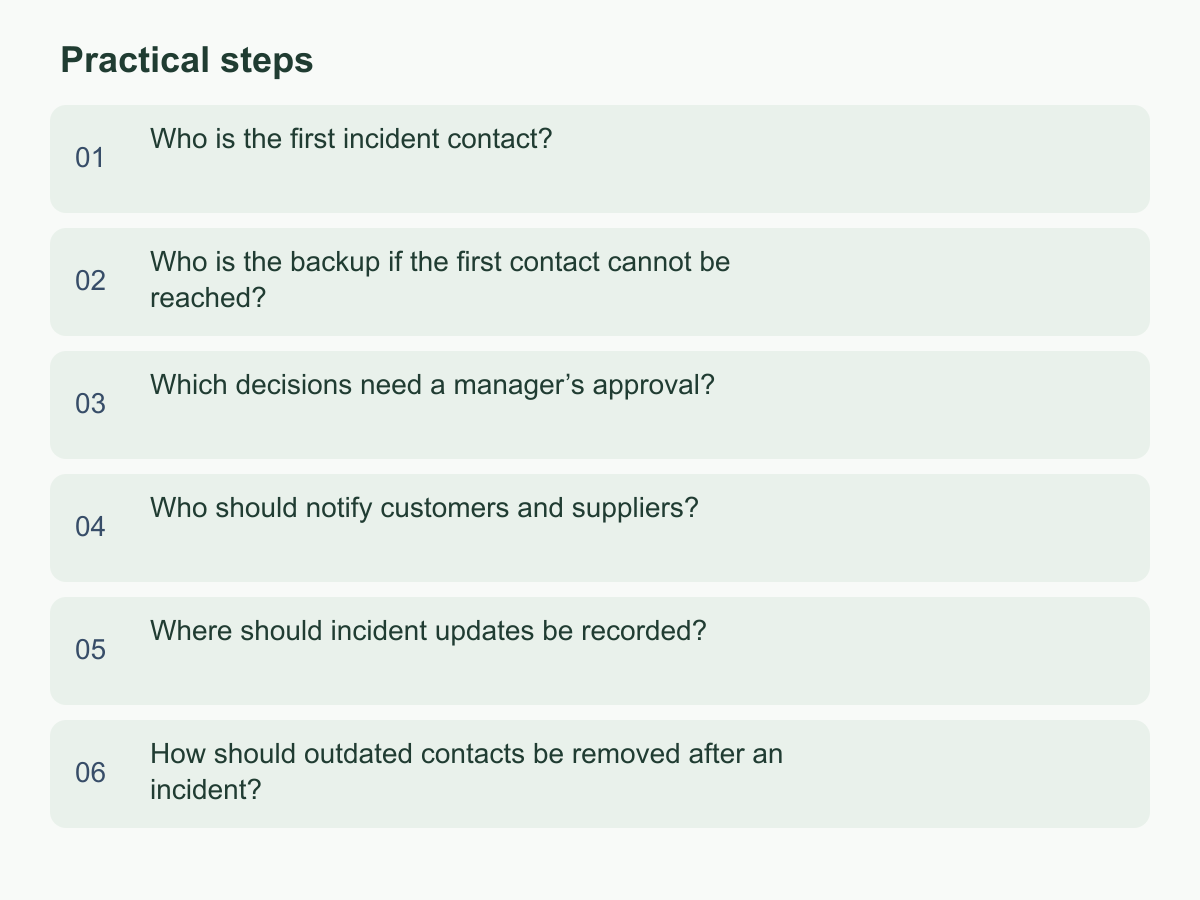
Who is the first incident contact?
The first contact should be the on-shift response coordinator, rather than the senior manager. List role, name, time zone, hours, and primary and alternate channels. Keep it accessible to on-call staff and date each confirmation; a mobile may fail.
Confirm when it began, affected markets, systems or orders, known facts, actions taken, and next update time. Separate observation from explanation: a payment page that keeps loading is observable; a bank-decline explanation still needs checking. This prevents guesses from becoming stated causes or recovery promises.
Assign tasks by role: operations gathers facts, a technical or supplier contact checks system or delivery status, and an authorized manager decides whether to pause work. The first contact coordinates rather than doing everything. Keep passwords, one-time codes, payment or identity details off the card. Follow established procedures for safety, cybersecurity, or cross-border data incidents; do not share sensitive screenshots in group chats.
For example, if Taiwan staff find Singapore orders cannot ship, the on-duty person alerts the operations contact with the affected batch, discovery time, and any pause already made. The contact assigns logistics to check warehouse status and flags decisions needing a manager, showing ownership.
Who is the backup if the first contact cannot be reached?
Record who calls next, what triggers the call, which alternate channel to use, and where to log each attempt. Set the trigger by severity and time zone; for example, contact the backup if the primary misses an internally chosen acknowledgement period. It is an internal rule, not a service commitment. Name roles in order, coverage hours, authority, and the next approver. If both contacts share one failed channel, two names still leave one route.
A backup must be able to receive facts, judge whether to escalate, and see which actions are authorized. If they cannot approve an external commitment, show how to reach the approver. Label local partners as external suppliers or advisers. Keep and routinely test two channels. Limit access to personal numbers and update permissions when roles change.
Suppose the primary is unavailable late at night in Europe. The on-duty person follows the trigger, contacts the backup, and logs the time, response, and known facts. If the backup can coordinate but cannot approve pausing new orders, they contact the approver. While waiting, staff use only a pre-authorized safeguard and keep escalating. This avoids delay or shifting authority to an external contact.
Which decisions need a manager’s approval?
Set authority before an incident. Separate reversible safeguards, commercial-impact decisions, and external commitments. For each, name authorized staff, the approver and alternate, an impact limit, and where to record the decision. The table offers planning prompts; set thresholds for company contracts, customers, cash flow, and risk. These are not legal standards.
| Decision type | Define in advance |
|---|---|
| Pause one affected process | Whether on-duty staff may act and when to report it |
| Extra costs or compensation | Approver, limit, and record location |
| External recovery-time promise | Who verifies status and approves wording |
| Contract, data, or regulatory issue | What to preserve and which qualified professional to consult |
Name who consolidates updates across affected markets. Staff may take a pre-authorized reversible step, such as pausing one batch, then report and log it. Do not extend that authority to deleting data, changing customer records, promising compensation, or closing operations. For higher-impact decisions, list an approver and backup. Route legal, tax, banking, or data questions to a qualified professional; the card cannot replace case-specific advice.
For example, staff authorized to pause new orders can log the time. Refunds and compensation promises need manager approval. State that reporting authority is not approval; silence is not consent.
Who should notify customers and suppliers?
Assign primary and backup contacts for customers and suppliers. Colleagues send verified findings to them to prevent conflicting accounts. Each update should state confirmed facts, known impact, any requested action, and when the next update will come. Mark causes under investigation. Do not assign blame or promise an exact recovery time; if there is no news, say what is being checked and when you will report again.
Notify only affected people. For one delayed logistics batch, contact its customers and carrier, not every market. If payment, login, or data functions may be affected more widely, confirm the scope before expanding notices. Give suppliers only needed order or tracking details through an approved channel. Keep customer data, payment details, and unverified cases out of open groups. Send legal, contract, or regulated-notice questions to a qualified professional.
For example, if an overseas warehouse reports delayed scans, the contact can describe verified batches, likely delivery impact, and the next update without calling it warehouse negligence before the cause is known. The incident lead checks recipients and wording, saves a copy, and sends corrections through the same contact if facts change.
Where should incident updates be recorded?
Use one company-approved record location with access controls. Calls, groups, and email may alert people, but copy key facts and decisions into the record. Put its location and owner on the card. Choose an offline form in advance; after recovery, transfer its notes to the main record and mark when they were entered. Include time zones so cross-shift events stay in order.
Record an incident identifier, discovery time, reporter, scope, verified facts, open questions, actions, decision-maker, approval time, external recipients, and next update. Link to evidence with appropriate access. Remove unneeded personal or payment details from screenshots while keeping context. Add corrections as new entries rather than overwriting, and note who changed what and when. Set access and retention under company policy; define handover fields so the next shift sees current status, owner, and next update.
For example, if an order status stops synchronizing and the issue is found at 16:40 Taipei time, log the affected order range, checks performed, and when a manager approved pausing synchronization. Preserve the time zone if another team converts it. The next person should find the latest status and next step without rebuilding the story from a chat thread.
How should outdated contacts be removed after an incident?
Before closing, confirm the record is complete, unfinished work has an owner, and customers or suppliers have received follow-up. Review temporary numbers and permissions. Mark superseded cards retired, retaining their date or handover record to identify the current copy. Handle private details under company policy and retain required decision records.
Review the card at handover, during routine checks, and when staff, time zones, suppliers, tools, or authority change. Confirm the primary, backup, approver, and communications owner are reachable. Test numbers and alternate channels during a low-risk exercise; record who checked and when. Assign and test a replacement before removing a former owner’s access. Keep one controlled source and link its current version.
Afterward, check whether contacts answered, escalation reached the right people, approvers were available, updates were consistent, and records were readable. Assign each improvement an owner and due date. If a contact fails again, change the backup route or exercise and update the card’s version and reviewer.
Fill in a one-page card with the current primary contact, backup, approver, and notification owner, then test each handoff before the next shift. For related perspectives on Hong Kong companies and overseas operations, visit Chan & Chung’s homepage.