
When an overseas client misses an invoice due date, follow-up depends on accurate records, clear commitments, and reliable handoffs across time zones. This guide shows what to verify, what to include in a reminder, how to track replies, when to escalate, and when to pause routine contact. The intervals are adjustable workflow examples, not legal requirements.
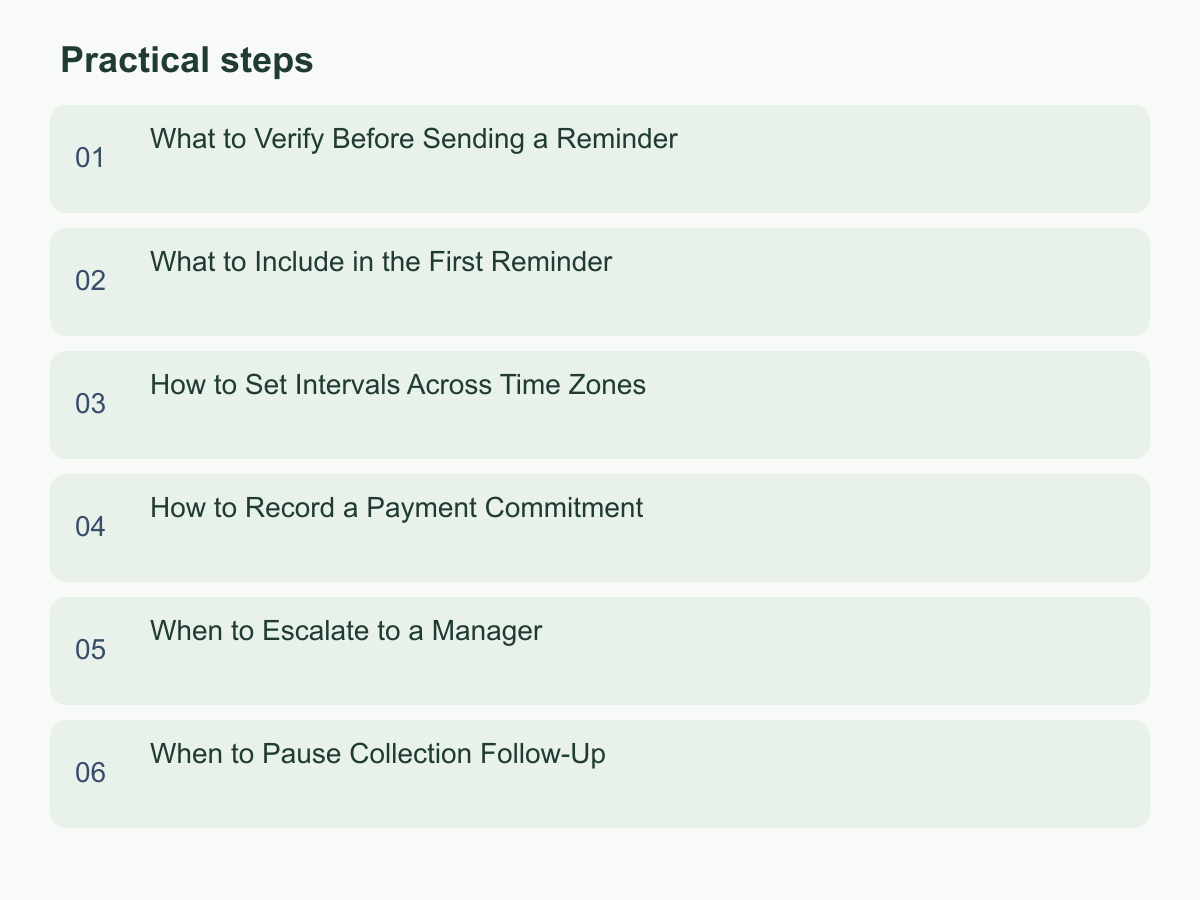
What to Verify Before Sending a Reminder
Before contacting the client, confirm the invoice name and number, currency, amount, payment terms, due date, and payments already recorded. Check for credits, partial payments, refunds, transfers still processing, earlier reminders, and whether the invoice was reissued or voided; use only the latest valid version. If bank details changed, verify through an established company contact already on file, not details or a phone number in a forwarded or new email.
Compare accounting and sales records, noting when each was updated. Resolve differences with the responsible person before stating a balance. Read recent correspondence for payment dates, invoice questions, or requests for documents; resolve open issues and include relevant documents before asking for payment. Confirm that the recipient still handles payments, copied recipients are appropriate, and attachments open.
Recalculate amount less payments, checking decimals, currency, and references. Send foreign-currency differences through the normal accounting process rather than guessing an exchange rate. Record the sender, time, amount referenced, and next review date. A three-column checklist—“Checked,” “Needs confirmation,” and “Owner”—makes handoffs clear. Treat unchecked items as unknown, not facts.
What to Include in the First Reminder
Keep the first reminder neutral and specific. State invoice number, issue and due dates, currency, unpaid amount, and any partial payment, and attach the invoice or statement. Ask if it arrived; state that your records do not show payment. Do not blame the client, call a bank posting delay non-payment, or assert unverified interest, legal consequences, or service suspension.
Ask for a specific expected payment date. If payment was arranged, invite the client to share its date or transfer reference for checking. For example: “As of the date of this email, we have not yet matched payment for invoice INV-204 for USD 1,200 in our records. If payment has been arranged, please let us know the payment date. If you need the invoice resent, just reply and we will help check it.” Replace the illustrative number and amount with verified details.
For multiple open invoices, list each separately and distinguish paid, under review, and unpaid amounts. Name a contact, reply route, and review date. Use a searchable subject such as “Payment reminder | Invoice number | Due date.” Keep the sent email and exact attachment version with the case. Follow the confirmed contact chain; ask the main contact to forward it instead of copying a large group when appropriate.
How to Set Intervals Across Time Zones
Adjust intervals for the client’s time zone, payment history, amount, and promised dates. These are internal examples, not legal deadlines. Record both zones; use a shared reference for office coordination, and write the date and zone instead of “tomorrow morning.”
If no reply arrives within three business days after the first reminder, one brief follow-up during the client’s workday may be appropriate. If Friday is the promised date, wait until it passes before checking or asking for an update; allow for time differences and bank processing.
| Checkpoint | Action |
|---|---|
| After due date | Reconcile; send the first reminder |
| Three business days later | Follow up during client daytime if there is no reply |
| After promised date | Check payment; ask for an update if needed |
| Still no reply | Prepare manager handoff; do not automatically strengthen the tone |
Adjust for holidays and known leave; ask if working days are unclear. If the client says payment is in progress or requests later contact, stop default reminders and use the agreed review date. Before sending, read the latest email and notes. Log the sending date separately from the review date, plus the time zone and next owner. Calendar prompts can help, but check payment status, latest reply, and contact details before each message.
How to Record a Payment Commitment
Record each commitment so a colleague can act on it: who made it and when, invoice, amount, promised date, confirmed method, known obstacle, next owner, and review time. Write the full date and relevant time zone. If the client says “next week,” ask which day. For a partial commitment, record the promised amount and leave the rest unconfirmed.
Use fields such as “Promised date,” “Promised amount,” “Amount to verify,” “Contact,” “Evidence link,” and “Next step,” and retain the client email or an agreed meeting summary. For example, if the client says, “I’ll pay USD 800 on Friday, and I’ll confirm the rest next week,” record USD 800 against Friday; do not turn the balance into a firm commitment. After Friday, check the account, then refer to the agreement and ask whether payment was arranged or blocked. If it was sent but has not appeared, mark it pending bank verification and pause duplicate reminders.
At handoff, update status and owner. Show the next action, trigger date, and unverified details; distinguish client statements from internal assessments, and note who changed the record and when. After a call, send a summary marked “awaiting confirmation” until accepted. Keep only necessary payment and contact data in shared records with controlled access.
When to Escalate to a Manager
Escalate on observable triggers: repeated reminders without reply; missed promised date without a new date; disputed balance or payment; several overdue invoices; or relationship risk. These are internal triggers, not statutory standards.
Prepare a concise summary: invoices and reconciliation; message dates and recipients; replies; commitments and whether met; open questions; proposed step; and decisions needed. Distinguish silence from a document error, pending transfer, or amount dispute. Pause automatic reminders and ask accounting to check a disputed balance. If the amount is acknowledged but more time requested, give the proposed date and reason to someone authorized to decide.
Record the decision, approver, invoices covered, and review date; assign one client contact to avoid conflicting terms. Refer legal claims, cross-border enforcement, or specific-contract questions to an appropriate professional. This is operational guidance, not legal advice or a promised outcome.
Keep the response proportionate. A document issue on a small invoice may need clarification first; repeated errors across invoices or an explicit transaction denial may merit earlier review. Set who may approve extensions, installments, or a work pause, and when the manager should respond. If client contact is due without a decision, check internally rather than changing terms yourself.
When to Pause Collection Follow-Up
Pause routine reminders when records conflict, the client raises a question, or payment is under review. Triggers include a missing invoice, purchase-record mismatch, unposted or returned transfer, changed payment details, possible duplicate, credit, or refund.
A pause neither writes off the balance nor confirms the client’s account; the next action is fact-checking. Record the reason, source, needed documents, checker, and review date; notify colleagues across time zones. For changed bank details, call back using a company number on file or another established contact. Do not use a number in the new email or update details before verification.
Record installment amount and dates, and refer the proposal to an authorized decision-maker; routine staff must not guarantee acceptance. After checks, record whether reminders restart, the account is corrected, or follow-up closes, with the reason and notification. If unclear, set another review. For suspected fraud, misdirected payment, or exposed information, stop acting on the message and follow the incident process.
Keep the paused case visible with a next check. Treat payment proof as a reconciliation lead: verify payer, amount, currency, date, and invoice link; mark settled only when payment is recorded. Track disputed and undisputed portions separately when only part is in dispute.
Practice the handoff on one case: verify the facts, record the latest reply, assign an owner, and set a review time. For a question about a specific situation, contact Chan & Chung through its English-language website.