
Cross-border projects often depend on contacts in different time zones, outside suppliers, document handoffs, and approvals from several parties. A risk register helps a team distinguish facts from predictions and record possible events, impacts, preventive actions, owners, and first responses before a problem occurs. It is a planning tool, not an incident log or a substitute for legal judgment. The examples below are general; teams can set scales to fit their own process.
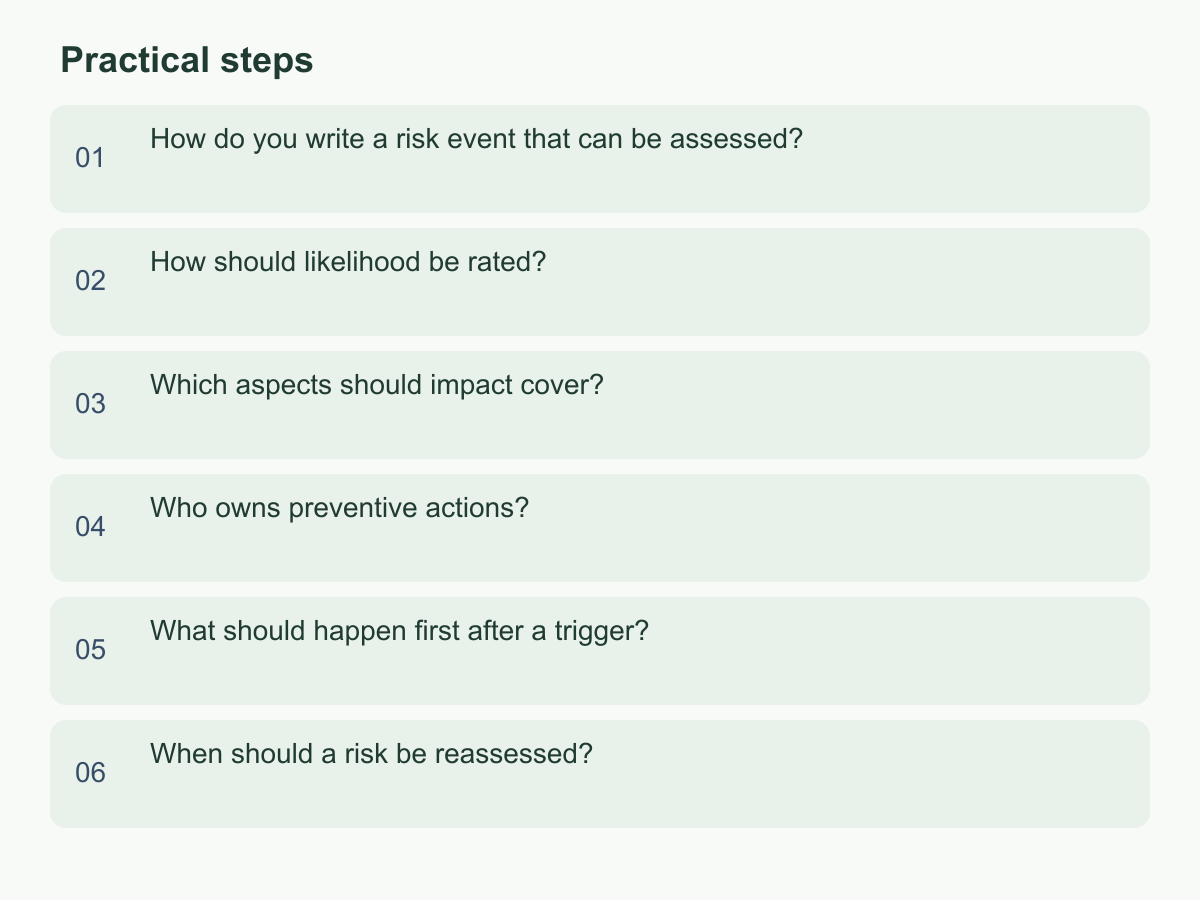
How do you write a risk event that can be assessed?
Describe a situation the team can recognize and act on, not an abstract label such as “supply chain risk.” Use: “Because of [cause or dependency], under [time or condition], [event] may occur, affecting [objective].” Separate confirmed facts from assumptions. Facts might include a contractual delivery date, the current contact, or a completed test. Mark predictions as assumptions and state how and when they will be checked.
For example, replace “The overseas launch may be delayed” with: “Because the local channel has not completed its review of campaign materials, approval may still be missing before launch, affecting the campaign schedule.” Record the facts (“materials submitted; response date unconfirmed”), cause (“review timing unknown”), possible event (“approval not received before launch”), and impact (“schedule adjustment”). If the cause is unclear, write the question to investigate instead of labels such as “market instability.”
Keep one main event per row; split combined payment, delivery, or staffing issues so each can be rated separately. Use consistent fields: risk ID, description, facts, assumptions, likelihood, impact, preventive action, owner, trigger, and update time. Ask an executor to explain what could happen, what is known, and who acts next. If their explanation differs, revise the entry or add evidence. A short risk name may serve as an index, but keep the causal description.
How should likelihood be rated?
Likelihood supports consistent ranking; it is not a precise prediction. Set an assessment window, such as the current phase or time before the next delivery, and record the basis: prior records, progress, dependency responses, and open assumptions. A low/medium/high scale is easy to maintain; a one-to-five scale allows finer ranking. Define each level. For example, low might mean arrangements are verifiable and no major dependency is unresolved; medium, one key assumption remains open; high, a trigger is near or several required conditions are unmet. If information is missing, mark “to be assessed” and assign someone to verify it rather than treating unknown as low.
Distinguish a possible risk from evidence it is already happening; an active issue may need its own record. On a team-defined one-to-five scale, a supplier-delay risk rated likelihood 3 and impact 4 yields 3 × 4 = 12. A risk rated 2 × 5 = 10. These are ranking cues: 12 does not mean a 12 percent probability, and a score alone does not determine acceptance.
Review causes and controls: a confirmed delivery window and tested alternative may lower likelihood; an unresponsive supplier or missing critical document may raise it or leave it pending. Record the assessor, rationale, and date. Consider the exposure window, how many required conditions are complete, and whether controls were checked in practice. Confidence, seniority, or a customer’s tone are not probability evidence. If reviewers differ by two levels, keep their reasons, resolve the disagreement, and have the designated role finalize the rating; do not average without new evidence.
Which aspects should impact cover?
Consider effects on project goals and dependencies across timing, cost or resources, quality, customer commitments, operational continuity, data and access, reputation, and cross-team handoffs. Rate only relevant dimensions and explain the path of impact. Name affected milestones; identify possible extra effort or rework without inventing costs; state which acceptance condition may fail or who may be unable to work. “Two tests need rescheduling and customer acceptance may move” is more useful than “major impact.”
Separate direct and knock-on effects. A delayed cross-border payment test may move the test window; if a reconciliation exercise depends on it, handoff arrangements may also be affected. Teams must check their own workflow. Where impact is hard to quantify, use a condition or range: “If acceptance must be repeated, it will use the planned handoff window; effort still needs estimating.”
Set severity anchors that fit the project, such as whether a manager must make a trade-off, a committed milestone changes, or a core deliverable is affected. Do not score possible legal liability as a conclusion; record the question and refer rights, obligations, or compliance interpretation to an appropriate professional. Use scores for decisions within the same project, not comparisons across projects with different teams and tolerances. If impact depends on a customer choice or outside reply, record the condition and confirmation date, then update when known.
Who owns preventive actions?
Assign at least one person to drive prevention for each risk, and list collaborators or decision makers. The owner tracks who acts, the deadline, and evidence of effectiveness; they do not assume everyone’s responsibility. Avoid “the team” or a department as owner. Separate the executor from the approver when they differ.
Actions should address causes. A single-contact risk calls for a backup contact and handoff information; an unconfirmed dependency calls for a deadline and an alternative sequence. “Improve communication” is incomplete unless it says who contacts whom, what they confirm, and when the register changes. Record each action’s owner, due date, completion evidence, escalation contact, and needed resources.
For cross-time-zone work, agree on an overlap window or asynchronous response deadline and a shared document location. Do not assume a message was seen. If campaign materials may be late, the owner can request a missing-items list from the channel contact by a set date; if no reply arrives, send the impact to the project decision maker to consider changing launch scope. The person closest to the cause should usually do the prevention, while a project manager coordinates. When roles change, name a successor and record the handoff; an ownerless row is a management gap. Confirm the owner has information access, time, and decision channels. Keep one primary contact even when managers remove blockers and others update the register.
What should happen first after a trigger?
Define observable triggers, such as a missed reply at an agreed checkpoint, a failed test, or inconsistent document versions. Record the first safe, reversible steps: verify the signal, preserve records, notify the owner and decision maker, assess alternatives, and update affected plans. State who may authorize a pause, schedule change, or reduced scope; do not leave executors to make unclear commitments.
If a trigger occurs without actual loss, update the risk row with the judgment and next check. If service interruption, misplaced data, or failed delivery has occurred, create a separate incident or issue record with timeline, current state, impact, responders, and open decisions, then link it to the risk. This keeps prevention and response distinct while showing whether assumptions and controls held.
For contractual rights, regulatory duties, security, or personal safety, follow established notification and protection procedures and seek appropriate professional guidance. A risk register is not legal advice or a replacement for formal incident response. Address urgent effects before documentation. Set verification deadlines, notification order, and when an alternative needs a decision. If a signal proves false, record what was checked and why the risk remains open or is downgraded. Afterward, review whether the trigger was clear, who received information and when, and what preventive action should change.
When should a risk be reassessed?
Review risks at regular checkpoints, such as milestone meetings or before a major dependency handoff, and when conditions change: a supplier, scope, schedule, or owner changes; new test results arrive; or prevention is overdue. A short, fast-moving project can combine reviews with progress meetings. Across teams, confirm every dependency has a response or is marked unconfirmed. Do not rerate just because a date arrived; check whether facts, assumptions, exposure, or controls changed.
Keep the prior and revised judgments, reasons for changes in likelihood or impact, evidence, confirmer, next review date, and proof of completed controls. An action’s completion does not automatically remove a risk: check whether it reduced likelihood, impact, or only uncertainty. Record why and when a risk was closed. If it remains but is accepted, record who accepted it and the review conditions; retain its history. Give a successor the open actions, triggers, and escalation route.
At setup, select three to five risks most likely to affect key milestones. Complete facts, assumptions, cause, impact, action, owner, and checkpoint, then confirm with executors that each entry is actionable. Review high-impact risks, near triggers, and overdue actions first. Give every open row a next action. Managers can check replies or supporting evidence rather than relying on color labels alone. Record review decisions in the project decision log so verbal agreement has a clear owner.
Start with one milestone that has an unconfirmed dependency and complete a row using these fields. Visit Chan & Chung for related information.