
A project may be a few days behind, but do not treat every new date as an approved extension. To measure slippage, keep the confirmed milestone baseline separate from the latest forecast derived from actual progress. The baseline answers when delivery was agreed; the forecast answers when completion now appears likely. Their difference is the schedule variance. This article sets out a traceable method for cross-border teams to find records, calculate dates, and compare adjustments. All examples are hypothetical, not standard durations or commitments. Track six items: baseline, latest forecast, variance, cause evidence, options, and who confirms a change.
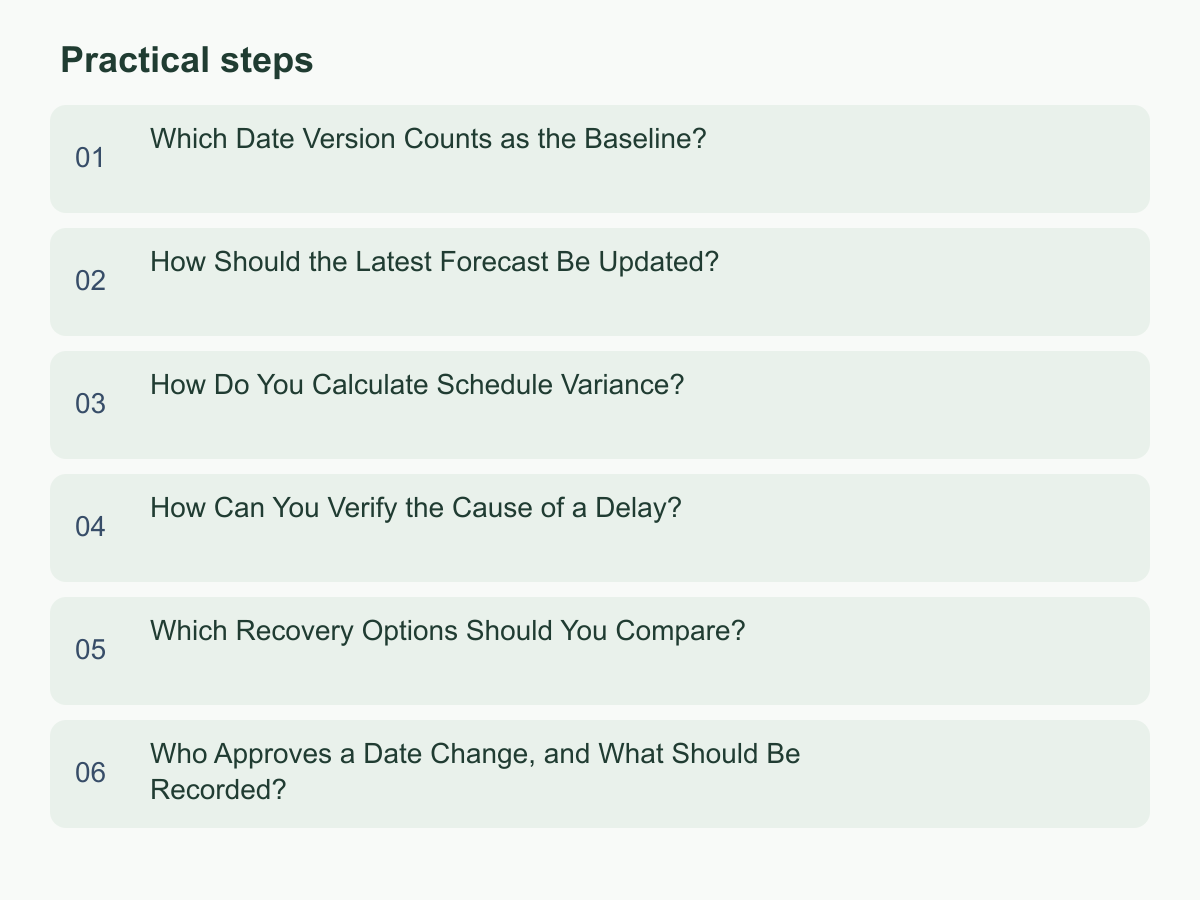
Which Date Version Counts as the Baseline?
Start by identifying the milestone and the date version to compare. A baseline is the date confirmed by the agreed owner for the same deliverable after its scope is clear. It is not automatically the first Gantt chart, the most prominent date on a meeting slide, or the date that now seems most reasonable. Record the deliverable name or ID, completion criteria, baseline date, version, reason it took effect, confirmer, and a record others can retrieve. If the only wording is “around the end of June,” mark the baseline provisional and ask for a precise date and scope. Do not silently convert it to June 30.
Suppose an overseas website refresh was agreed for June 30, covering Traditional Chinese and English pages, and meeting notes confirm it. A later tracker showing July 3 is a new forecast; it does not become the baseline just because it appears in the latest file. If both sides later approve another language or different deliverables, create a new version, retain the old one, and state the new scope and effective point. That prevents a scope change from being miscounted as ordinary slippage against the original plan.
Keep the confirmed baseline in its own field and record when it was last checked. If no approval record can be found, ask the sponsor, delivery owner, or counterpart and mark the date “pending confirmation.” Give each milestone its own completion criteria and baseline; do not compare a launch date with an interim handoff. Match versions by deliverable ID or clear name, not just by file name or modification time. Replies or meeting summaries can guide the search, but remain provisional until confirmed; hindsight is not proof of the original agreement.
How Should the Latest Forecast Be Updated?
Update the forecast from completed and remaining work, not by copying the baseline or asking only how many days remain. Confirm the latest accepted output, unfinished tasks and owners, external or predecessor dependencies, and the checks or approvals still needed. Record the reasoning alongside the date.
For example, suppose that on June 20 the page copy is approved, but English proofreading and link checks remain. Ask when each can finish and whether they can run in parallel. If link checks depend on the English page, include that dependency in the estimate. If they can run concurrently, state the assumption instead of shortening the date by intuition.
Use a time zone the main project contacts can recognize, and note the update time and person. If a handoff crosses midnight between regions, specify the local date so the same moment is not read as different dates. When a key input is unknown, give a provisional date and state why, such as “supplier response pending,” instead of hiding uncertainty behind a firm-looking date. Keep previous forecasts so changes can be traced to changed assumptions. Ask owners to report accepted work, remaining tasks, external dependencies, and the next date they can confirm in a consistent format. For linked milestones, use the dependency that controls completion rather than averaging estimates. If design can only be finalized Tuesday and translation can start Wednesday, use Wednesday as the dependency start and ask the translator for a completion estimate. If a date has no work basis, call it a target, not a forecast.
How Do You Calculate Schedule Variance?
Fix the calculation method first: schedule variance in days = latest forecast date − baseline date. With calendar-day subtraction, a positive result means the forecast is later, zero means the same date, and a negative result means it is earlier. Use the same time zone and date precision for both dates, including a consistent rule if delivery has a cutoff time. If working-day impact matters, show it separately and name the work calendar used; do not mix working days with calendar days in one figure.
Assume a baseline of June 30, 2026, and a latest forecast of July 6, 2026. Subtracting the dates gives +6 calendar days. If the forecast changes to June 27, the variance is −3 days, meaning three days early. These differences measure the distance between dates. They do not, by themselves, mean six days of work were lost or establish cause or responsibility. Keep the baseline, forecast, calculation method, result, and update time together.
If scope and baseline version are formally changed, retain the variance against both the original baseline and the new version, and state what each comparison answers. Do not overwrite an old date to make the variance zero. For unfinished work, use the forecast date; after completion, record the actual date separately to distinguish forecast variance from actual variance. If a commitment specifies only a month, do not invent an exact day. Clarify the baseline or show a date range and mark that a precise calculation is not yet possible. In a spreadsheet, use date values and subtract baseline from forecast. June 30 to July 6 is six full elapsed days, not seven days counted inclusively. Weekends and local holidays may affect working days, which are a separate measure.
How Can You Verify the Cause of a Delay?
Variance is an outcome; determine the cause from event records rather than inferring it from the date difference. List the work on which the milestone depends, then check when each input was needed, when it actually arrived, who confirmed it, and whether rework, waiting, or new tasks occurred. Separate observations from explanations. “A draft was sent for confirmation on June 18 and a response arrived June 21” is a checkable event. “The other party was uncooperative” is a judgment and cannot stand alone as the cause.
If the team attributes a delay to a supplier, find the agreed deliverable, the correspondence, and the actual receipt time. Then check whether the item really blocked the next work. If it arrived on time but had the wrong format and the team did not check it promptly, the cause may involve acceptance or internal coordination rather than an external delay. Where records are missing, mark the cause unknown and assign someone to gather evidence instead of filling gaps with recollection.
An event log can include date, event, source, affected work, status, and open questions. Ask whether the forecast would still change if the event had not occurred, which milestone it affected, and whether any work could proceed in parallel. If unclear, label the cause unverified and distinguish the direct trigger from contributing conditions. For example, a translation delivered one day late may appear to cause a one-day slip, but if acceptance staff were unavailable for three days, acceptance may control the completion date. Map predecessor and successor work, confirm whether their sequence is necessary, and check whether later recovery absorbed the impact. For recurring blockers, look for a shared source such as unresolved inputs or incomplete handoff criteria. Treat an event as a candidate main cause only when it can be linked to the milestone date.
Which Recovery Options Should You Compare?
Once the cause is checked, compare practical changes instead of treating “speed it up” as a plan. Identify what can change: dependency order, delivery scope, available people, confirmation timing, or quality checks. For each option, state its prerequisites, owner, expected date effect, added cost or quality risk, and a fallback if the prerequisites are not met. If deliverables are added or removed, confirm the scope and date. If only the sequence changes, check that it will not create rework later.
The following hypothetical comparison starts with a June 30 baseline and a July 6 forecast, a variance of +6 calendar days. The other dates illustrate how to compare options; verify them against actual workload, dependencies, and availability before relying on them.
| Hypothetical option | Possible date | What to confirm |
|---|---|---|
| Keep the current sequence | July 6 | Existing dependencies remain; quality steps stay in place |
| Run independent tasks in parallel | July 3 | No dependency conflict, and owners can coordinate |
| Deliver core content first | July 2 | The counterpart accepts staged delivery and later items have dates |
Do not choose an option only because it shows the earliest date. Parallel work can add coordination and integration effort, making completion later. A core version may not meet the actual need if it cannot pass external acceptance. Record the basis for each estimate, choose the option that current evidence makes most feasible, and name who must confirm each prerequisite and by when. If the information is not enough to compare options, retain the current forecast while gathering it rather than promising an uncertain recovery. Separate fixed constraints, such as an external commitment, required quality checks, or another party’s availability, from adjustable conditions. Extra people may help when work can be divided and handoffs remain manageable; advancing unblocked work may not change the final milestone. Align assumptions before comparing estimates that were made on different bases.
Who Approves a Date Change, and What Should Be Recorded?
Show the estimate and evidence to the roles responsible under the project’s existing arrangements. Work owners provide remaining tasks and dependencies. The project owner assembles the variance, evidence, and options. The sponsor or counterpart authorized to confirm the milestone decides whether to accept a new baseline or delivery approach. If the date affects a handoff between parties, obtain confirmation from the relevant contacts. Updating a tracker does not, on its own, authorize a change to an agreed date.
Keep at least the milestone and acceptance criteria, original baseline and version, latest forecast with updater and time, calculation method, observed facts and sources, affected dependencies, options considered, decision maker, decision, and effective date. Link to meeting decisions, email, or work records that relevant team members can access. If the tool overwrites old values, save a dated version or decision record so the previous state can be reconstructed.
Until approval arrives, label the proposed date “pending confirmation,” keep the old baseline, and plan against the conditions already confirmed. After approval, create a new version and notify affected task owners so estimates, dependencies, and handoffs stay aligned. Confirm whether the decision keeps the original deliverables, uses staged acceptance, or adopts a new scope; each describes a different completion state. If the decision maker requests another assessment, record the requested information, response deadline, and next review point while leaving the change pending. Once agreed, notify everyone who schedules work, supplies an input, or receives the deliverable, and ask whether their dependencies still hold. Updating only the main tracker can leave downstream teams working to conflicting dates. Keep the original record location and version number for reference. As a practical next step, select three upcoming milestones and record one row for each: baseline date, latest forecast, evidence link, and person who must confirm. Learn more about Chan & Chung on the English homepage.