
Cross-border operations can be disrupted by a failed login, an unanswered handoff, or unreconciled records, leaving a team unsure whether to proceed, pause, or notify customers. A tabletop exercise lets people rehearse contact, backup, approval, and recovery steps using staged messages, without shutting down a real system. This script focuses on verifiable decisions and named improvement owners.
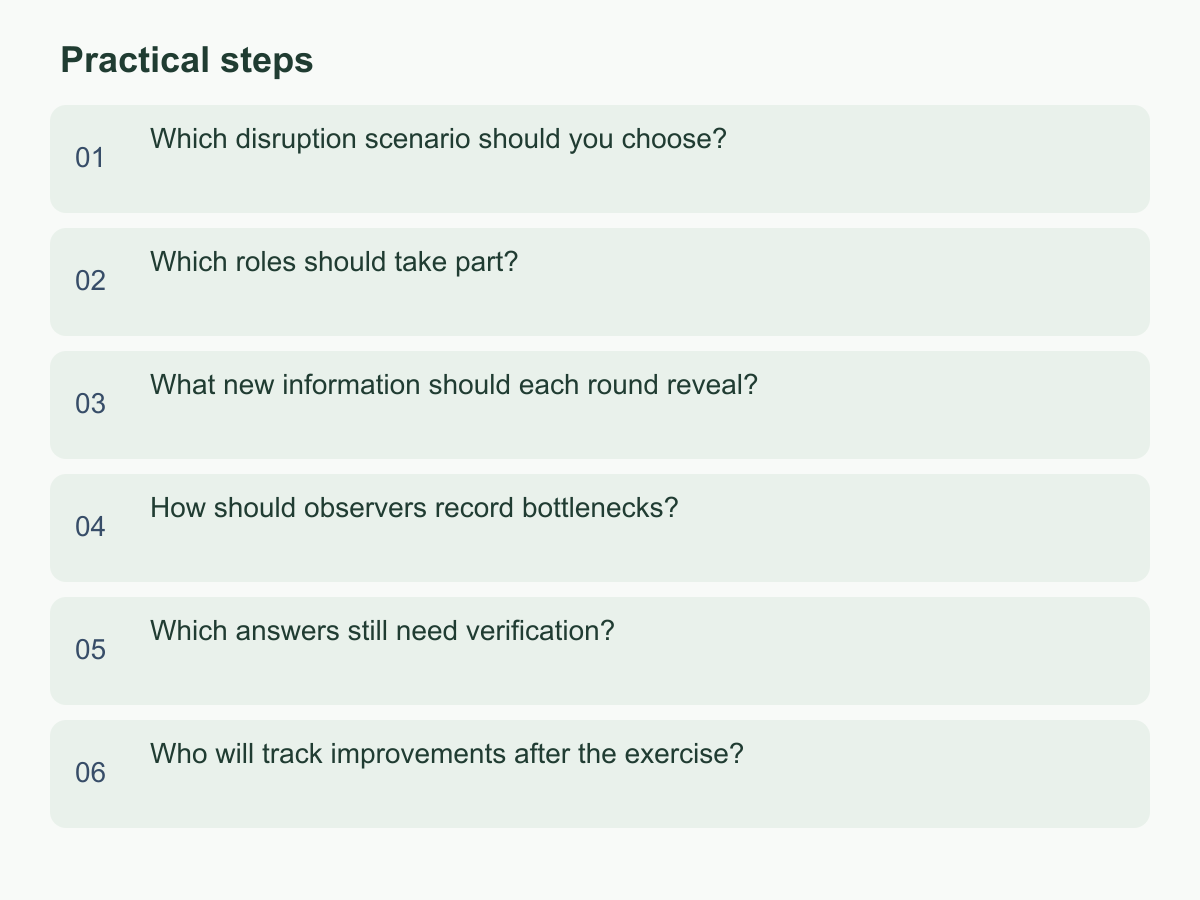
Which disruption scenario should you choose?
Choose an event that could stop work but still lets the team make decisions in a meeting. Examples include an unavailable primary payment channel, loss of access to a core operating account, a warehouse or carrier stopping order acceptance, or unreadable cloud records. Avoid starting with “every system is down”: with too little information, the only answer may be “call IT.” Select one failure with a clear dependency, then list affected customers, regions, workflows, and the latest decision point.
Map the order-to-delivery steps, then identify where a pause could affect cash, customer commitments, or record integrity. The scenario card should state the exercise time, known facts, unknowns, and conditions participants must not assume. For example, on Tuesday morning an external payment service cannot be accessed and submitted payment status is unclear. Customer service has received two inquiries, with no current evidence of a data breach. This is hypothetical, not a claim about any provider’s features or commitments.
The goal is to identify who verifies the situation, contacts customers, decides which transactions to pause, and escalates the issue. Keep to one primary failure and two or three affected workflows so the facilitator can release information gradually and see where decisions stall.
Define success before starting: participants need not restore service, but should identify who makes inquiries, who approves pausing or continuing work, conditions for using a backup step, and the next update time. Name the senders and recipients of simulated messages so no real provider or customer mistakes an exercise prompt for an incident notice.
Which roles should take part?
Bring together the people needed to complete the decision chain; the whole organization need not attend. Assign a facilitator, decision owner, process operator, external communications contact, and observer. A person may hold multiple roles if each assignment is clear.
The facilitator releases scenario cards and new information without solving the problem. The decision owner decides whether to pause transactions, use an alternative process, or notify management. The operator locates records and operating steps; the communications contact prepares questions or updates for customers, partners, or providers. The observer records who obtained information, when, and who approved the next step.
Name a deputy for each key role and confirm they can access contact details, permissions, and records. For cross-region work, note time zones and contact windows; sending a message does not prove it was received. At the opening, ask each person to restate their responsibility and independent authority. If someone cannot, record the role definition for verification and observe where the process stalls.
For example, a finance operator may reconcile pending payments but lack authority over shipping. An operations lead may pause new orders, while a designated manager must approve an alternative payment process. Put these boundaries on role cards. Confirm usable contact channels, including an internal method if work email is unavailable. Record options without actually disabling accounts or sending incident notices. If a key person is absent, have the deputy follow existing documentation rather than rely on unwritten knowledge. Confirm who declares the exercise complete.
What new information should each round reveal?
Release only enough information in each round to affect a decision, and record when it arrives. First describe the failure and ask the team to define its impact, name a contact, and identify records to check. Next add an operational pressure, such as more unreconciled orders or a partner requesting an answer. Then provide a recovery or worsening signal and ask when work can resume, how backlogged records will be reconciled, and who will update others.
Ask four questions each round: What is confirmed? What is missing? Who owns the next action? What triggers escalation? Record observable answers, such as “confirm the status of two transactions within ten minutes,” rather than “communicate regularly.” This assumed 30-minute plan is an exercise schedule, not an incident-response standard.
| Time | New information | Decision for the team |
|---|---|---|
| 0 minutes | Payment tool inaccessible; two payment statuses unknown | Who checks records, and should shipment pause? |
| 10 minutes | A customer asks for a delivery time | Who replies, and what can they commit to? |
| 20 minutes | Tool is available, but some records are unreconciled | Who approves resumption, and how are duplicates prevented? |
If participants ask for an answer, ask what information they need to decide. Log out-of-scope developments as future scenarios. Allow brief lookup and discussion time, then ask the decision owner to state the rationale, action owner, and next report time.
Test recovery criteria with conflicting updates, such as a report of restored service while records remain unreconciled. Ask which source is trusted, what evidence is missing, and what temporary control applies. If the team waits, ask how it limits risk; if it uses a backup, ask who approves and how it is recorded. Before the next update, have the recorder repeat the decision, owner, and next report.
How should observers record bottlenecks?
The observer preserves a replayable decision record, not a score of who responded fastest. For each key decision, record the time, triggering message, options, decision-maker, evidence used, next owner, and promised update time. If the answer is “check again,” specify who checks, which source they use, and when they report back.
Note which contact list or process document people searched, whether it was where expected and current, and whether anyone took a conflicting action. Use neutral observations: “The deputy’s number was found at minute 12 because the list named only the primary contact,” rather than judging someone’s attitude. Group bottlenecks as missing information, unclear authority, failed contact, unavailable tools, missed handoffs, or unclear recovery criteria. These categories point to process changes, not personal labels. Record guesses based on information participants could see at the time.
| Time | Observed action | Evidence or impact | Issue to address |
|---|---|---|---|
| 12 minutes | Finding the deputy contact took several minutes | List named only the primary contact | How should the list be maintained and accessed? |
| 18 minutes | No one notified customer service after shipment paused | No message owner was assigned | Who owns customer updates? |
Before ending, have the observer read back the three most important facts and ask participants whether the account matches what happened. Preserve disagreements and records that may resolve them. Identify the call, approval, or handoff that stopped instead of writing only “communication was poor.”
Use a consistent format and time zone; separate participants’ words from interpretation, label speakers’ local times, preserve original notes, and record where an unfound document was searched.
Which answers still need verification?
The exercise shows how the team thinks; it does not verify external rules, contract terms, or a platform’s current status. Sort answers into three groups: supported by existing records, awaiting internal confirmation, and requiring an external source. Existing evidence might include the deputy list, an approved backup step, or the latest handoff record. Internal questions might include whether a contact is still in role, who can approve a pause or resumption, and which orders remain open. External checks could cover a provider’s transaction status, a partner’s contact window, contract notice methods, or matters requiring legal or other professional judgment.
“Refunds are usually possible” or “the bank will handle this in a few days” is not verification. Record whom or what to consult, who will ask, and when to follow up; save the source and confirmation date. Do not assume a jurisdiction requires notice within a particular period, a transaction can certainly be reversed, or a backup method is compliant. Check specific obligations against relevant official information or an appropriate professional. Use minimal personal or payment information; never put live credentials in shared notes.
A verification list can include the question, current assumption, source or person to consult, document name or link, reviewer, completion date, and applicable scope. If an internal handbook conflicts with an external reply, preserve the conflict and ask someone authorized to decide which version applies before updating the operating card. Mark answers confirmed, partly confirmed, or unconfirmed so one email is not treated as applying to every region or transaction. Keep an evidence summary and tell the next shift what limits remain. Until verified, leave the item as a question, set a review date, and mark the operating card with the limitation.
Who will track improvements after the exercise?
Give each improvement an owner, deliverable, due date, and acceptance check. Turn notes into actions: update the deputy list, document who approves a shipment pause, prepare a customer update draft, or verify a provider’s inquiry channel. Prioritize issues that block several people or could cause an incorrect payment, duplicate shipment, or loss of contact.
Define checkable outcomes. “Find the current deputy list in the shared location” is clearer than “improve contact procedures.” Having someone who did not participate follow the steps for a simulated handoff shows more than a completed document. Set due dates according to risk and workload. When the owner finishes, replay the original bottleneck: can the team find the deputy, transfer approval authority, and explain recovery criteria? If the check fails, create a specific follow-up action.
The facilitator may circulate a summary, but each owner should confirm acceptance; an operations lead can review overdue items. If there is no exercise record yet, schedule a session: choose one failure, list the roles and three rounds of messages, and assign an observer who is not making decisions. If an action depends on an external reply or permission change, record who is being awaited and what temporary control applies. Progress updates should state evidence completed, remaining blockers, and the next check-in. If a due date is missed, the manager should reset it or reduce exposure. Store the revised file where the team can find it, with its version date and approver.
For related information about Hong Kong companies and overseas business arrangements, visit the Chan & Chung English website.