
When a cross-border shipment is delayed or documents do not match, confirm the goods' location, the differing field, and the next contact owner. This triage keeps verified facts, open questions, and next steps together so teams do not repeat inquiries or present estimates as confirmed delivery times. Verify options with the carrier or document contact; none is an arrival promise.
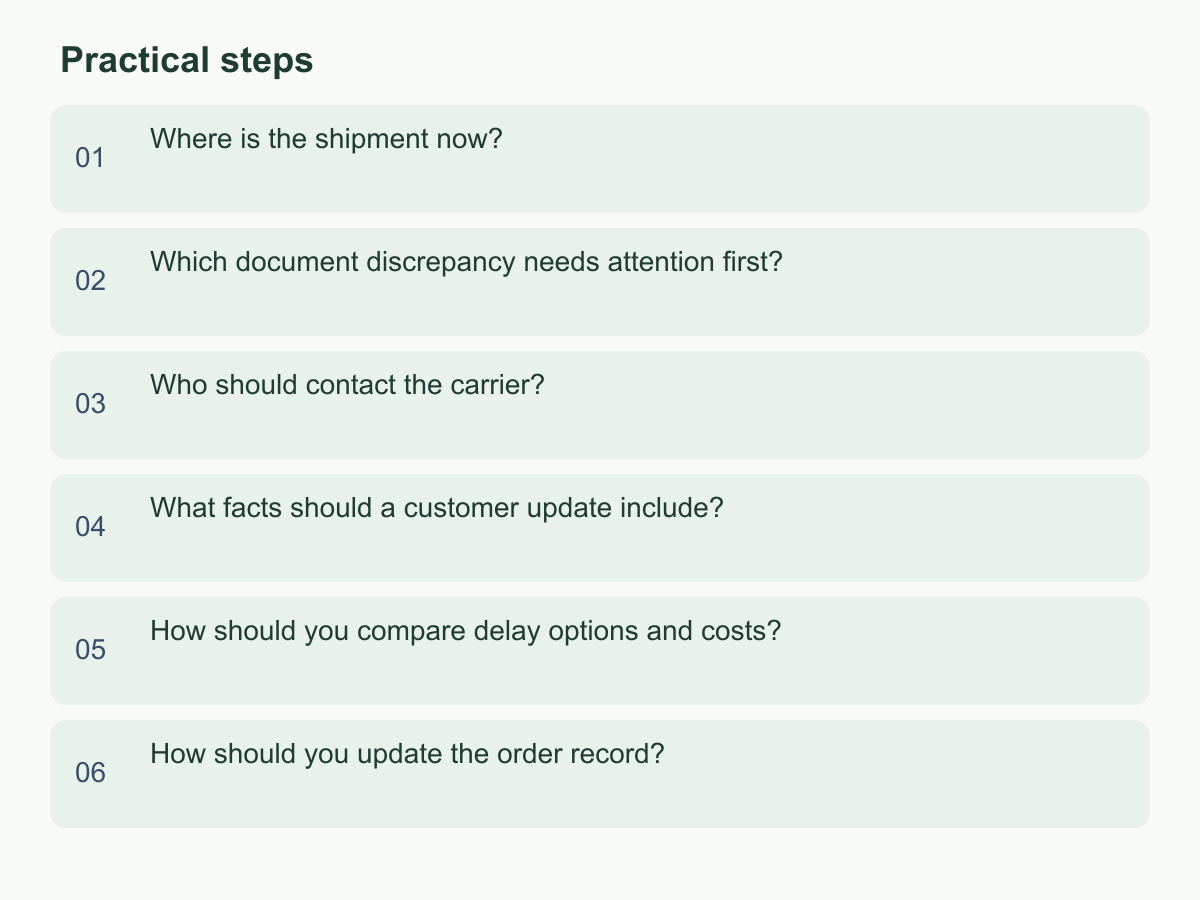
Where is the shipment now?
Record the latest confirmed event separately from the system's destination. With the bill of lading, tracking number, or order reference, ask the carrier or booking forwarder for the event, location, timestamp and time zone, source, movement status, and next confirmable point. An old scan or estimated arrival date alone does not prove the shipment is stuck. Verify supplier-only screenshots with the carrier or booking forwarder and save the reply in the same exception record.
Use four routes: not handed over, in transit, awaiting documents or inspection, or delivered with a receipt dispute. Check handover and pickup evidence; the next event and update; the missing document, its provider, and recipient; or delivery records and photos of packaging and quantities.
| Shipment status | First check | First contact |
|---|---|---|
| Not handed over | Handover and pickup records | Supplier or warehouse |
| In transit | Latest event and next stop | Booking contact or freight forwarder |
| Waiting for documents or inspection | Blocker and required information | Carrier or document contact |
| Delivered; receipt disputed | Delivery record and site evidence | Recipient and order owner |
If tracking shows arrival at a transfer point but the supplier says there was no handover, compare evidence and scan time zone. Mark the location “unconfirmed”; do not tell the customer customs is holding the goods. Timestamp checks. If the location is unavailable, ask when and through whom to check again and mark “awaiting update.” A route on a map is not a live location. Keep conflicting updates with their sources and reconcile them.
Which document discrepancy needs attention first?
Ask whether the mismatch prevents identification, handover, or current processing. Prioritize the shipper or recipient, item name or model, and quantity if the carrier or forwarder says work has stopped because of the discrepancy. Similar names can refer to different goods, so do not dismiss a mismatch as a typo. Next check addresses, contacts, package counts, weight, or dates when they affect delivery or reconciliation. For formatting, internal notes, or translation choices, preserve the original and ask the party using the document whether correction is needed.
Log the document, field, current and expected values, evidence, and reviewer. If invoice and packing quantities differ, check dispatch records and the person who packed the goods before editing either file. Before handover, hold the mismatched version. If it has already been sent, ask how to format the correction, where to send it, and whether receipt must be confirmed. Preserve the old version and label the revision. Change a document only after its responsible owner verifies the value.
If the mismatch blocks work, pause the affected document transfer; ask the issuer to confirm its source and the receiving contact how to deliver a correction. Label versions and revision times across the file set. If the impact is unclear, mark it “to be confirmed,” ask whether work continues and whose response is needed, then reprioritize. For quantities, distinguish pieces, cartons, and units, and check the dispatch and packing records.
Who should contact the carrier?
Choose an external contact with authority to represent the shipment and access booking or waybill details—often the booking contact or named forwarder. Assign one internal exception owner to coordinate updates and prevent duplicate inquiries. This owner need not prepare every document but must know each action owner and reply time.
Keep three roles clear: the external contact asks about status, blockers, options, and required information; the document owner verifies invoice, packing, or recipient details and supplies an evidence-based version; and the order or operations manager approves a split, redirect, resend, or added cost. If a forwarder is involved, decide whether it or the original booking contact will follow up with the carrier. Do not assume both received the same message. Keep the date, channel, and original replies.
If the carrier requests a document, the exception owner assigns a field specialist to verify it; the same contact submits it and confirms receipt. If the contact is unclear, ask the booking contact to confirm the route and name an internal backup. Avoid duplicate requests or unauthorized promises about rerouting or costs. At a handover point, ask who is waiting for what, whether a corrected file arrived, and whether an attachment or authorization is missing. An internal review time is not a carrier promise. Agree what a forwarder may tell the customer. An authorized decision-maker must approve a reroute, cancellation, or charge before the external contact confirms it.
What facts should a customer update include?
Include the affected order or items; the latest confirmed status, source, and time; the current blocker; actions taken; who is being asked for what; and when the team will update again. Separate confirmed facts, estimates, and unknowns. Say that an estimate reflects current information and is not a guaranteed delivery date. If the carrier has not replied, say the team is checking and give its next planned response time instead of writing “it should arrive soon.” List items with different statuses separately rather than describing the whole order as delayed.
Use this sequence: facts, impact, action, anything the customer must do, and the next update. If one item is in transit while another has not been handed over, explain each status and that the team is checking with the carrier and supplier respectively; do not label both as a customs hold. If customer input is needed, specify the field, acceptable format, and return method; request only what the step requires. Before forwarding documents, check for unrelated personal information, prices, or another customer's data, redact if needed, and confirm the recipient.
Record any receiving window, event, or stocking need as decision context, and ask when the customer needs to choose an option. Do not turn pressure on the carrier into an unverified delivery promise. If waiting, splitting, or another action is confirmed feasible, explain its impact, costs awaiting confirmation, and the customer's decision. Restate the chosen option and next actions after they reply. If no option is available yet, say what is being checked, who owns the response, and when the team will update.
How should you compare delay options and costs?
List the possible actions and their conditions: wait for the next confirmed update, submit or correct documents, split out available goods, redirect the shipment, or resend items. Not every shipment can be split or redirected. Ask the carrier, forwarder, and supplier to confirm feasibility, required documents, estimated timing, and effects on the remaining goods. Then separate incremental costs: additional freight, redirection or handling, possible storage, replacement materials, and internal work. Mark unquoted items “to be confirmed,” not zero. Record effects on delivery, inventory, and promotions without inventing figures.
For a purely hypothetical comparison, suppose waiting adds no freight charge, but the customer's tolerance for waiting is unknown. If splitting out three urgent items adds 80 hypothetical currency units per item, the additional freight is 3 × 80 = 240 hypothetical currency units, before other charges. First confirm that splitting is possible and that the remaining goods have a clear plan. An authorized decision-maker can then weigh 240 units against the delay impact. Do not count freight already paid and unrecoverable as a new cost. Keep options, assumptions, excluded items, decision-maker, and customer impact in one comparison record so the approval basis is traceable.
Compare the same affected items, destination, and delivery objective. Distinguish new costs, sunk unrecoverable costs, and items awaiting a formal quote. A split may require separate documents or another handover, so check with the relevant contacts. Sending urgent items first does not necessarily speed up the whole order; state which packages are covered and what happens to the rest. Record what condition would require recalculation. The team can rule out infeasible options, but should not commit new customer spending before the authorized decision and any required customer choice are clear.
How should you update the order record?
Before closing an exception, enter the outcome in the order or a shared exception record, not only in email or chat. Record the shipment identifier, affected items, current status and source time, document discrepancy and version, exception owner, carrier or forwarder contact summary, chosen action, approver, known additional costs, and open questions. Link the original documents, revised version, and replies, preserving labels and timestamps. Identify the source of any estimated order status and keep it distinct from confirmed arrival. If the system has limited fields, use a searchable exception note linked to a controlled team file; keep personal information away from people without access.
Close-out should confirm three things: the goods arrived and the recipient confirmed them, or they moved into a clearly assigned next step; the customer received an update that matches the result; and each open item has an owner and next check. If a new delay appears, a document is rejected again, or a quantity or package discrepancy remains, reopen the case rather than clearing the exception. After the carrier confirms transport can continue following a document submission, record the source, time, and version used, then set the next tracking point.
Use existing team fields where possible. A colleague taking over should be able to find the goods' location, current document version, who is waiting for whom, and the next check. If the order and exception record are separate, link both with searchable references. Leave unconfirmed charges pending with an owner. For official information about Chan & Chung, visit the Chan & Chung homepage.