
As a cross-border catalog grows, product names, colors, sizes, pack configurations, and market labels can crowd the same spreadsheets. Putting everything into one code makes identification harder when copy or packaging changes. Treat an SKU as a stable, unique internal identifier for a product or variant. It is not a universal barcode and does not replace product master data, barcode records, or market data. First decide which stock unit needs its own identity, then choose a few stable attributes.
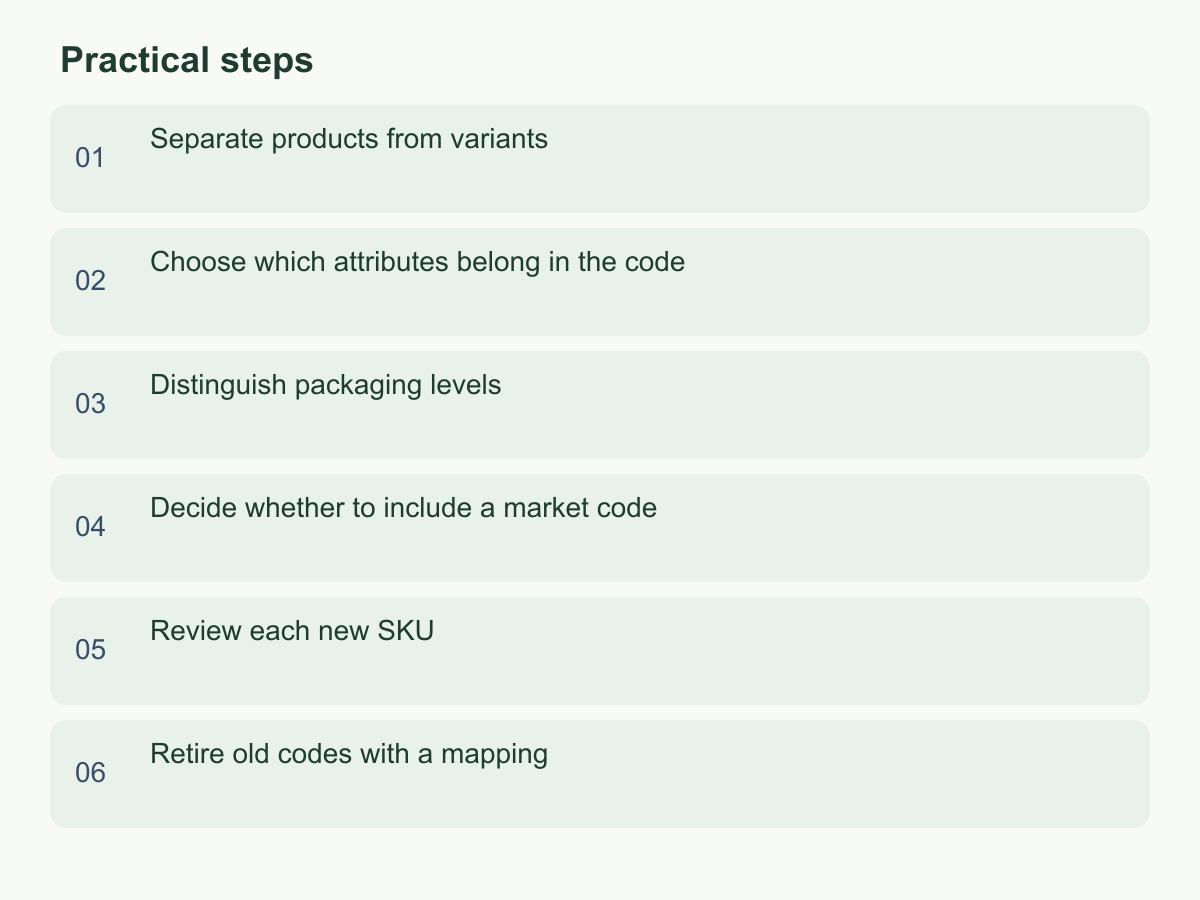
Separate products from variants
Map the product level and variant level. A product represents a style or model with shared brand, collection, or description data. Variants are combinations such as color, size, specification, or packaging. Each physical unit that must be stocked, ordered, picked, or counted separately should have its own SKU. A parent product code may be useful internally, but it is not a shippable variant code.
For example, a canvas tote comes in black and beige, each in small and medium. If all four combinations are stocked separately, create one product record and four variant SKUs linked to that parent. Prices, images, and descriptions may be inherited or set per variant. The SKU should identify the managed unit, not repeat the product copy. For a preorder-only color without separate stock, check whether ordering or fulfillment requires separate identification before creating a variant.
This hierarchy is illustrative; it is not a barcode or platform standard.
| Level | Illustrative identifier | Management |
|---|---|---|
| Product | BAG-02 | Shared style data |
| Variant | BAG-02-BK-S | Black, small; managed separately |
| Bundle | BAG-02-SET2 | Only if stock is tracked separately |
One SKU for different sizes makes picking and stock checks unreliable. Creating separate SKUs for the same variant solely because its Chinese and English names differ fragments stock and sales history. For a bundle, ask if it is an independent transaction unit that needs separate pricing and picking. Define promotional sets in promotion or bundle data; components keep their SKUs. Independently stocked regular bundles need a variant SKU and component links. Document the rule so new options are handled consistently.
Choose which attributes belong in the code
Choose stable attributes that help staff identify an item without locking changeable data into its name. Ask whether a changed value creates another independently stocked unit, whether people often need to recognize it from the code, and whether it is stable and controlled. Color, size, or capacity may qualify when they distinguish variants; a difference only in photography or copy may not.
Fix a sequence, such as “collection–style–color–size.” The illustrative code BAG-02-BK-S means collection BAG, style 02, black, size S. Maintain a dictionary and entry rule for every segment: BK must not mean black and navy, and S must not mean small in one item but short in another. Standardize master-data values and abbreviations, then use the same vocabulary in imports and manual entry.
Usually exclude prices, promotions, supplier quotations, warehouse locations, changeable copy, and current batches. They change or vary by warehouse, so including them can force new identifiers and break history. Use separate fields for lots, serial numbers, and expiry dates. Keep market wording, ingredients, and languages in product or market data. Start with the fewest attributes: if a value does not change identification, stock, or fulfillment decisions, leave it in the product record.
Keep order and separators consistent; uppercase letters and numbers scan well, while easily confused characters should be avoided. Set spreadsheet import fields to text so leading zeros are preserved. These are internal readability choices, not an external standard.
Distinguish packaging levels
Base packaging codes on transaction, receiving, and stock units, not box appearance. If an individual item is the main stock unit and an inner box is only a storage container, keep pack counts, case quantities, dimensions, and weight in packaging data. If a six-pack can be bought or sold separately and counted separately, it is another managed unit: give it an SKU and link it to the number of base units.
Suppose one piece is the base unit, a six-pack can be ordered alone, and an outer case contains four six-packs. The case represents 4×6=24 pieces. If orders and stock remain at six-pack level, keep outer-case details in packaging data. If the full case is also ordered, priced, or counted independently, it may need its own packaging unit and explicit conversion. This is a naming example, not an industry convention.
Do not rely on a suffix such as P or C to explain a package. Clear segments such as EA, PK6, or CT24 can work if each maps to one unit. Procedures should also explain how a six-pack is split, returned, and replenished. Code quantities must agree with the product record; one place must not say four packs per case while another says four pieces.
Check whether this level is separate stock, orderable, or subject to different pricing or picking. If all answers are no, one SKU with packaging conversions is usually simpler. Otherwise, code the level people actually handle. Record each package's base unit, conversion quantity, and use case so logistics, orders, and stock counts interpret it consistently.
Decide whether to include a market code
Include a market code only when the market changes stock identity or fulfillment. If product, packaging, and labeling are shared and stock is pooled, keep translated titles, currency prices, channel names, local descriptions, and market categories in market records. Do not append TW, HK, or SG to every SKU just for filtering; markets can refer to one variant and reports stay consolidated.
If a market-specific package, plug, accessory, label, or ingredient version is produced, received, stocked, or shipped separately, and staff must recognize it, treat it as a controlled variant attribute. A suffix may identify it if it accurately describes that fixed version. The code should identify the actual item, not substitute a country code for its specification. The product owner should define whether changed requirements or label language create a variant, based on stock and fulfillment.
For a hypothetical water bottle, different product-page languages with the same stock mean one SKU and separate market copy. A different voltage accessory held as separate stock means a distinguishable variant; the market is its applicability condition. Several markets selling the same physical item can reference the same SKU.
Adding market codes everywhere can duplicate inventory that is physically identical; omitting a real difference can cause the wrong version to be picked. Make a simple matrix of market, physical specification, and stock location, marking which combinations share stock and which are not interchangeable. Use controlled market values; keep tax rates, tariff classifications, and unverified regulatory judgments in relevant data or professional workflows because they vary by product and region.
Review each new SKU
Have the product owner submit complete information rather than inventing abbreviations from a name. Include the parent product, proposed variant, attribute stability, packaging level, necessary attributes, and applicable markets. A data steward checks format, uniqueness, required fields, and possible duplicates. Retired SKUs must never be reused, so search active and historical codes, including leading-zero, letter-case, and abbreviation variations.
Separate human interpretation from data checks. Have another person decode each segment using the naming rules, then compare the full code and parent-child links in the product list. Confirm that different products do not share a code and that one variant has not been created under multiple codes. If a code is unclear, fix the rule or dictionary rather than relying on the approver's memory. A retired code for another physical item is not available for reassignment.
Before approval, walk the record through search, purchasing or receiving, order selection, picking, and stock update. If a step relies on a code segment to avoid selecting the wrong item, confirm it maps to the right attribute; if the process uses master-data fields, the code can be shorter. For example, a reviewer should decode BAG-02-BK-S-PK6 as black, small, six-pack and find the six-unit conversion in the product record.
Record the proposer, approver, creation time, parent, naming-rule version, and reason. Try a new rule on several real examples in a controlled list and check that different people reach the same result. Then set one entry point and a naming owner. A small team may combine roles but should retain submitted, checked, and approved fields for repeatability.
Retire old codes with a mapping
Retirement stops new transactions but preserves history; it does not delete or overwrite the SKU. Record whether the reason is discontinuation, packaging replacement, data cleanup, or a merge, since each may need different treatment. Mark the product inactive, preserve the original SKU, parent, base unit, and relevant last-use records, then create an old-to-new SKU mapping with its reason and effective date. Never give the old code to another item, or historical orders could point to the wrong product.
Suppose BAG-02-BK-S is replaced by BAG-02-BK-S-PK6. The mapping must state that the new code is a six-piece pack, not an equivalent replacement for one piece. Count any remaining single-item stock by its actual quantity and package condition; do not multiply or divide a balance just because a mapping exists. If one old SKU splits into several specifications, record the conditions for each destination. If codes are consolidated, preserve both source codes and the reason. Determine equivalence and conversions from actual product data.
Before migration, export old codes and product, stock, and order links. Reconcile counts and units, then rehearse searches and imports with a small amount of reversible data. Historical orders should keep the SKU and description used at sale; later reports can aggregate through the mapping. Keep mappings in a shared system through record renames so returns, warranties, and support can trace the original code.
Start with one product family and list its product, variant, packaging, and market data. Try ten combinations, ask someone uninvolved in coding to interpret them, and check uniqueness, product lookup, and conversions before expanding. For more information about Chan & Chung, visit the Chan & Chung homepage.