
A request may arrive by email, support conversation or business contact while relevant records sit across several systems. Use one process to verify the requester, define scope, coordinate searches, review results, approve a response and record closure. Procedures vary by location; check current official guidance before acting. This is an internal workflow overview, not advice on a specific case.
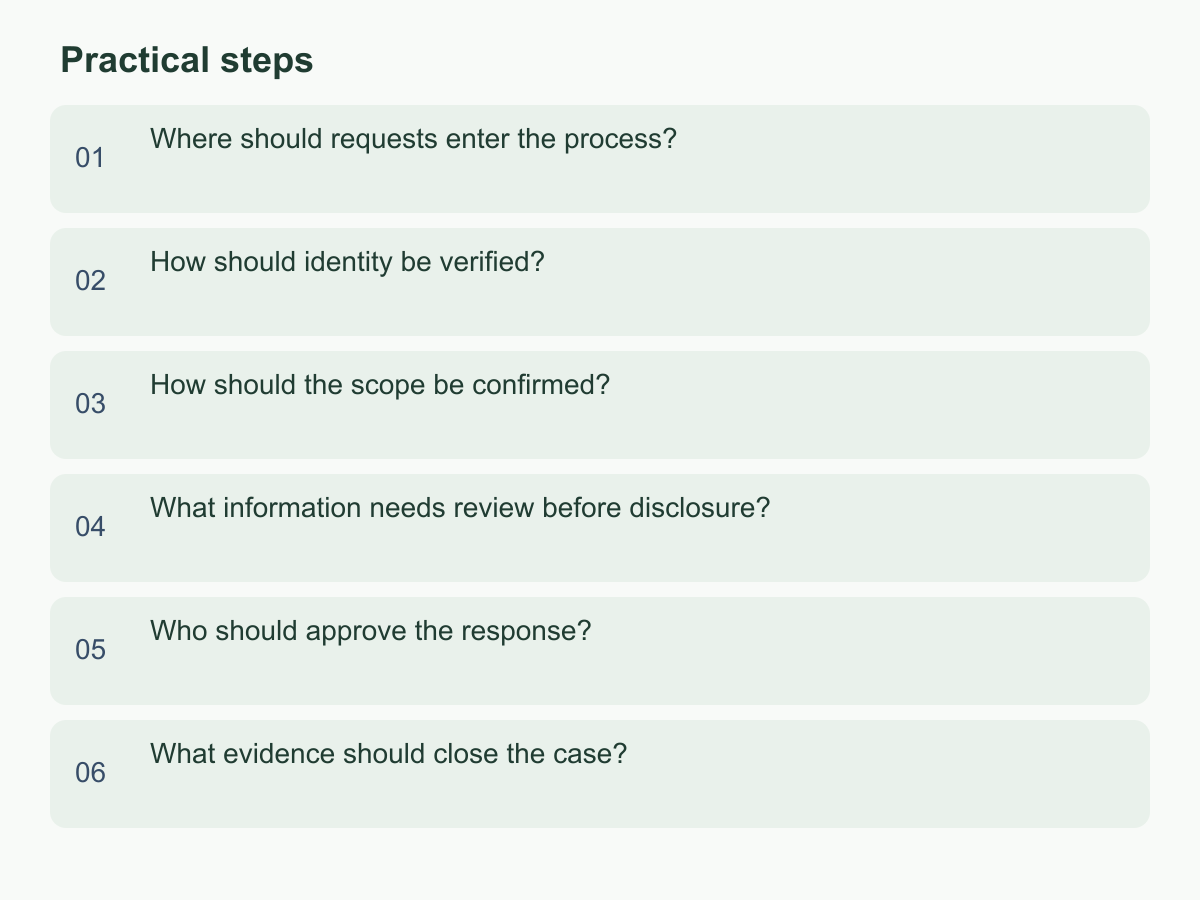
Where should requests enter the process?
A request may reach a support inbox, sales representative, website form or ordinary conversation. The recipient need not decide its legal status. Route it promptly to a designated intake channel, such as a controlled mailbox or case register. Assign an owner to acknowledge, track and coordinate the case, with access limited to staff who need it. Before forwarding identity or account details, check recipients and attachments.
Keep the original message and record when and how it arrived, the contact details provided, relevant company or account, whose information is sought, stated scope, current contact and case owner. Label it neutrally as a request that still needs verification. Do not recast it as a complaint, deletion request or routine account query. If it also asks for a refund or account closure, create and assign separate issues, linked to the access case.
For an oral request, repeat your understanding, invite confirmation through a safe, convenient channel and record it. If details are missing, acknowledge receipt and explain that identity and scope are being checked without promising a completion date. Flag multiple entities, locations or other people’s information for the designated lead. Record each handoff and use a case number, not a person’s name or identity number, in the register title.
How should identity be verified?
Verify enough to reduce the risk of disclosure to the wrong person without collecting excess proof. Compare identifiers in the request with existing records, such as a customer number, established email, recent interaction or logged-in account. Where appropriate, confirm through a previously trusted channel; a familiar name or company logo alone is not confirmation. If that method no longer works, ask the data owner to select another established method. Explain what minimum information is needed, why, and how to send it securely; avoid asking for a full identity document through ordinary email.
Record the method, checker, time and any limits. An old account record may confirm a company email without confirming authority to act for the company. For a representative, assess both the requester’s identity and the represented person’s, along with available authorization and whether its scope covers this request. If authorization is unclear, details conflict or the relationship has changed, pause disclosure and refer the assessment to the responsible person under guidance for the location. No single document should be assumed sufficient in every case.
Take care with namesakes, shared inboxes, family accounts and company accounts. Control of an account does not establish whose records are in it. Ask for the relevant account or transaction and confirm through a verified contact method. If doubt remains, keep the case open; do not send results to test identity. Verification also does not settle what to disclose: scope and third-party information need review. Restrict verification material and handle it under applicable requirements and internal retention rules.
How should the scope be confirmed?
For a broad request such as “all my data,” ask about aliases, customer or order IDs, product or account, period, possible emails and information types. Do not require a list of every system or narrow the search to one database without reason. If details are unavailable, use verified identifiers, document assumptions and ask only what is needed to distinguish similar records. Label accounts across entities or locations separately; a shared brand or login does not establish common ownership.
Give custodians the same verified identifiers, period and instructions. Ask them to report systems searched, criteria, results and inaccessible areas. Possible locations include customer management, support tickets, billing, business email and controlled shared folders. Whether backups, old exports or access logs belong in the search depends on control, searchability and the applicable process. Record the decision; do not claim to search services the organization does not control.
The hypothetical table shows example internal locations and reporting fields, not actual search results.
| Example location | Search criteria | What to report |
|---|---|---|
| Customer management system | Customer number and verified email | Record types and count |
| Support tickets | Account alias and order identifier | Search scope and attachments |
| Controlled shared folder | Project code and period | Coverage and limitations |
Replace the criteria for the case. Custodians should explain exclusions. Refine broad results or add verified aliases if criteria are too narrow. Consolidate reports into one scope list to catch missed systems and duplicate documents.
What information needs review before disclosure?
Finding a record does not make it ready to send. Sort results into practical review groups: information related to the requester; material involving other people; security credentials or payment details; and material that may include internal assessments or protected information. These are organizing groups, not automatic disclosure or withholding rules. Inspect the actual email threads, attachments, screenshots and reports. Check copied recipients, shared accounts, third-party names, private contact details, credentials, payment identifiers and embedded material; a filename or search snippet is not enough.
Ask custodians for context. A reviewer familiar with personal-data handling can assess redaction, field extraction, separate delivery or the need for further advice. Retain enough context to make disclosed information understandable. Do not remove an entire document simply because it contains one third-party name. Mark uncertain items, record the issue and potential impact, and refer them to an appropriate manager or legal professional under applicable local requirements.
Inspect delivery copies, including spreadsheets, comments, tracked changes, metadata and attachments. Use a readable format that does not carry editing information when useful. Keep originals in restricted storage and distinguish working and delivery copies by name and version. A second reviewer should compare the index with the files, confirm each result has a decision, check that redactions remain readable and verify links are not open to unrelated people. Stop delivery if a security concern appears. For example, a thread with the requester and a colleague might have the colleague’s address redacted while retaining context; escalate first if that could change the meaning.
Who should approve the response?
Use one case lead to assemble the response. Custodians should not send separate excerpts that could create duplicates, contradictions or unexplained gaps. Consolidate reports in an index marking each item found, not found, needing clarification or not provided after review. Explain the scope, files included, handling decisions and open questions in plain language. For items not found, identify the controlled systems and criteria checked. Do not turn a limited search into a claim that information does not exist anywhere.
Each custodian should confirm their search coverage and limits. The person who verified identity should confirm the recipient; the reviewer should confirm disclosure, redactions and attachments. A designated manager should approve the specific final version. If records span locations or responsible entities, involve third-party interests, raise confidentiality concerns or leave requirements unclear, obtain appropriate professional advice before approval. Any change to the approved version should be reviewed again.
Before sending, check the recipient address, attachments, password or link method, permissions and expiry settings. Use a verified channel and do not send sensitive files to an unconfirmed address. Invite the requester to report an unreadable file or clarify remaining scope without promising an unverified deadline or outcome. Confirm any required format or contact point with the relevant authority. A sign-off list can cover identity, search coverage, exceptions, version, channel and approver; record the result or follow-up, not just a tick.
What evidence should close the case?
A closure record should let authorized staff reconstruct decisions from intake through delivery. Record the original request and case number, verification method, confirmed scope, lead and custodian reports, criteria and results, unsearched or excluded areas with reasons, review and redaction decisions, approved version, delivery method and follow-up. Link entries to file versions. “Handled” alone is insufficient. Keep identity documents, full search results and sensitive attachments out of broadly visible registers.
Use a short checklist for request understanding, completed verification, replies from each controlled system, reasons for missing or unsearched material, review of third-party and security details, approval of the final version, delivery to the verified recipient, and ownership of delivery problems or clarifications. Keep unresolved items open with an owner and next action. Close under internal rules after delivery and necessary follow-up are complete and authorized staff can find the record.
Retention depends on local requirements, company policy and other duties; do not take a fixed period from an online example. Ask the data or compliance lead to confirm official guidance, restrict storage and access, set review arrangements and route exceptions for manager approval. Compare the register, delivery index and files for consistency. If the requester does not reply, record the open point and follow-up plan.
To learn more about Chan & Chung, visit the English website.