
After a buyer confirms a sales order, assess later quantity, price, or delivery-date requests against the original, obtain approval, and record one effective version. This covers buyer-confirmed sales orders; supplier purchase orders and service-project changes need separate processes. It applies to paper, spreadsheets, or order systems; use available records without assuming particular software fields. Compare the order with fulfilment records. If inventory or fulfilment figures were checked at different times, note the timestamps and align on the same version before issuing instructions.
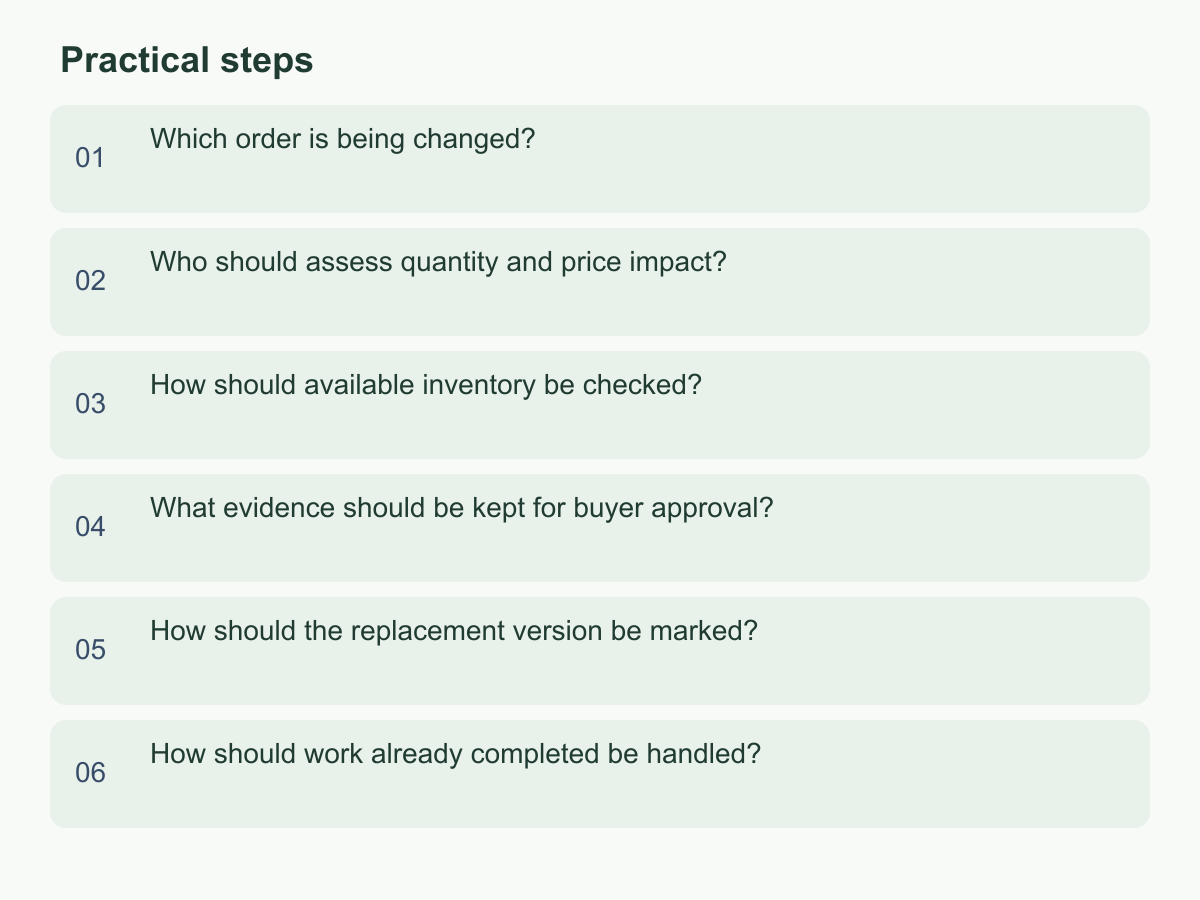
Which order is being changed?
Match the request to an accepted order; an email subject or chat screenshot alone is not enough. Check customer and seller, order number and confirmation date, currency, items, quantities, unit prices, delivery location, and original dates. Link quotations, confirmations, and earlier amendments to clarify the transaction history.
Save the original request, noting author, time, fields to change, effective date, and reason. If the contact’s authority is unclear, verify it through the existing business channel. Do not act on new payment or delivery instructions found only in forwarded material. Copy baseline values and retain the source file or link; do not overwrite them during discussion.
If the buyer says “change the next batch to 80 units” but the order has two items and three batches, ask which item and batch, and when the change takes effect. Until clarified, mark it pending, pause preparation for the affected shipment, and notify responsible people. Decide whether unaffected work can continue under the original commitment and internal authority.
Link the order, request, clarification, and approvals with an amendment number or, if none exists, the order number plus amendment date. Record who changed each field and when; verbal intent is not an effective version. Keep relevant source page numbers and enough context for a colleague to identify the order, affected items, and current step at handover.
Who should assess quantity and price impact?
Separate the commercial summary from the operational calculation. The customer contact lists old and proposed quantities, prices, discounts, delivery dates, shipping arrangements, and payment milestones, distinguishing buyer requests from company proposals. The inventory or fulfilment owner checks supply, packaging units, existing commitments, and split-delivery costs. Finance or an authorized manager reviews totals, tax basis, and credit terms under existing approval limits. If roles overlap, record estimates, approvals, and customer notices separately; review is not approval.
The example assumes one currency and excludes other discounts and fees:
| Version | Quantity | Unit price | Subtotal |
|---|---|---|---|
| Original | 100 | 20 | 2,000 |
| Proposal | 120 | 19.5 | 2,340 |
| Difference | +20 | — | +340 |
The subtotal rises by 340 (2,340 − 2,000), but the lower unit price reduces revenue per unit. Record old and new quantities, prices, and subtotals per item, with currency, discount method, and scope. Recalculate under written terms for split deliveries, order-level discounts, or volume thresholds; do not merely change the quotation’s grand total.
List open assumptions: whether quantity changes the unit price, delivery is split, or a discount applies only to added units. Options include keeping the original price and splitting shipment, re-quoting the total, or retaining the original order and adding quantity. Explain impacts on amount, supply, and timing. Match the tax basis to the documents; do not assume a rate. If cost or discount data is incomplete, state the estimate’s assumptions and validity period, then obtain support before approval.
How should available inventory be checked?
Define “available”: quantity that can be committed now, shipped by a stated date, or the order’s unfulfilled balance. Ask the inventory or fulfilment owner for the check time, warehouse, item specification, and unit. Retain the system report timestamp or note when a manual ledger was updated. Total stock may include goods promised elsewhere.
Use the company’s actual availability method. Exclude reserved, allocated, damaged, or inspection-pending goods that cannot ship. List in-transit goods, uninspected receipts, and expected returns separately, not as current stock. Confirm whether warehouses, lots, expiry dates, or packaging can be substituted or transferred. Each figure needs a source and timestamp.
Assume a ledger shows 120 units: 15 reserved, 70 allocated to other confirmed orders, and 10 awaiting inspection. Available to promise now is 120 − 15 − 70 − 10 = 25 units. A request for 30 is short by 5. Check split delivery, transfer, or replenishment dates internally; expected arrival is not a guarantee. Show available, incoming-to-be-confirmed, and inspection-pending quantities separately.
Compare requested batches and dates with committed shipments, picking, and goods in transit. If only part is available, state the amount and shortfall, then ask whether the buyer accepts a split and revised dates. Conflicting figures call for a pause and reconciliation. The stock check informs price and timing; it does not approve the change.
What evidence should be kept for buyer approval?
Evidence should show what the buyer accepted, who accepted it, and when it takes effect. Prepare a summary with order number, item, old and new quantities and prices, total difference, delivery batches or dates, payment-term changes, and unresolved points. Ask the buyer to accept a clearly identified version through traceable email, a signed document, or a formal channel both parties use. For verbal confirmation, record the time and participants and request written confirmation.
Verify that the respondent is an authorized customer contact. Retain the complete exchange, original attachments, sent and received times, and contact details under company data-access rules. If procurement, finance, or an end user must approve separate terms, list each responsibility and outstanding approval. One person’s agreement does not approve every term; record internal price and inventory approvals separately.
Suppose the summary says Order A was for 100 units, 40 shipped, and the total will change to 70 at the existing unit price, with 30 remaining by an agreed date and the other 30 unfulfilled units cancelled. A reply of “OK” may only acknowledge receipt. Ask whether the buyer accepts the reduction and cancellation; mark unclear items unapproved. Attach clear acceptance of the amendment identifier, revised values, and effective date to that version.
Keep the change pending until required buyer and internal approvals are complete; do not update formal fulfilment instructions early. An authorized manager may pause affected work in an urgent situation, but schedule pressure is not buyer consent. Retain the approver and source message so reconciliation can compare approval with execution.
How should the replacement version be marked?
After approval, create an identifiable amendment or order summary and retain the original as history. Mark the order number, version, creation time, effective status, and version replaced. Show changed fields with old and new values, terms that carry forward, and the approval source, buyer reply time, and attachment location.
Label the original V1 and an approved amendment V2. State that V2 replaces V1’s quantity and delivery terms while other terms carry forward, then list the new batches. A later approved change becomes V3, replacing V2. Mark unapproved quotations “proposal” or “pending.” Without system version controls, use consistent filenames, read-only prior files, and an index.
Before release, have another responsible person compare approval with the new figures: quantity times unit price, batch totals, dates, currency, and replacement scope. Give the effective version to order, warehouse, shipping, and reconciliation owners, with its start time. Mark old copies as superseded and identify one current source. Keep history and approval evidence; a version number alone does not make a change effective.
How should work already completed be handled?
Verify fulfilment before changing the total. By item and batch, record quantities picked, packed, shipped, in transit, received, and not started, checking shipping evidence or buyer receipt confirmation. List invoiced or paid amounts separately for reconciliation. Packed goods and shipped goods may have different adjustment options.
Assume the original order is 100 units and 40 have verifiable shipping records. If the buyer approves a total of 70, the balance is 70 − 40 = 30 units; check whether more are packed or in transit. If the proposal raises the total to 120, the balance is 120 − 40 = 80 units. Confirm supply and whether the proposed price applies to delivered units or only to the balance.
Keep fulfilled quantities under the version originally approved. For the balance, agree additions, cancellations, or delays, including new quantities, dates, pricing basis, and split deliveries. Do not silently rewrite delivery or invoice history. Have the relevant owner confirm any reconciliation or document adjustment and link it to the amendment. Address changes, shipment interception, or returns need a separate feasibility and responsibility check; editing the order does not complete them.
Maintain a batch comparison of planned, actual, and remaining quantities with evidence locations. While approval is pending, continue unaffected work under the effective version, pause work that could cause an irreversible mismatch, and alert the responsible owner. Share the comparison with the new version so both parties can confirm completed and outstanding quantities. An amendment log can record original value, new value, impact, owner, approval evidence, and version. For information about Chan & Chung, visit the English homepage.