
After a buyer places an order, gaps often arise because the buyer, sales team, and fulfillment staff are working from different messages about the same transaction. An order confirmation should bring together what can be accepted, what remains open, delivery arrangements, and later changes in one traceable record. Each detail should be checkable against a source and an owner.
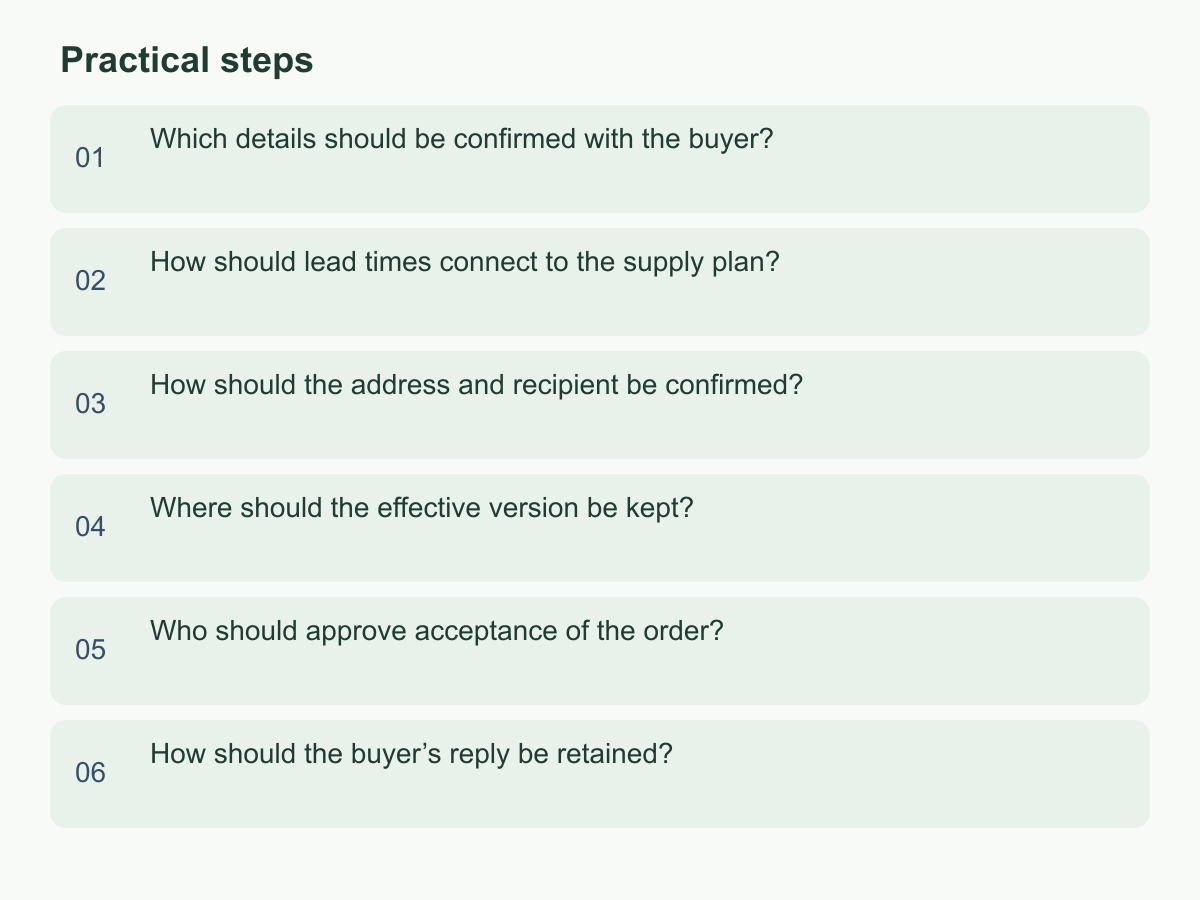
Which details should be confirmed with the buyer?
Use the buyer’s original purchase order (PO), correspondence, and relevant internal quotation version as the source material. List the buyer’s name and PO number; item names and specifications; quantities and units; unit prices and currency; payment terms; delivery method, lead time, and destination; validity period; and main contacts on both sides. For anything unresolved, write “pending,” identify who will provide it, and set a due date. A blank field is not agreement.
Use product codes or complete specifications that both sides can recognize, including differences such as color, size, packaging, or service scope. Avoid vague references such as “same as above” or “as quoted.” Show quantity units and any split delivery, explain each amount, and state whether discounts are included rather than giving only a total. The fictional example below shows the arithmetic, not a real order:
| Field | Fictional entry | Check before replying |
|---|---|---|
| Item and quantity | Model A, 24 cartons × 12 pieces = 288 pieces | Units and multiplication agree |
| Lead time | Two planned batches of 12 cartons each | Confirm dates and batches separately |
Before sending, compare each line with the PO and internal acceptance information; list mismatches and ask the buyer to resolve them. Identify attachment versions and include the buyer name, PO number, and version in the subject. Ask the buyer to confirm a specific version and list exceptions; “received” alone is unclear. Label dates as firm or estimated, state remaining conditions and the next update point, and keep material payment, delivery, and packaging terms in the summary. Check currency and unit basis throughout.
How should lead times connect to the supply plan?
Base the stated lead time on the supply plan the team can support. Do not copy the buyer’s requested arrival date and present it as a commitment. Ask the scheduler what is in stock, what is awaiting purchase or production, and when each quantity can be ready. Account for packaging, inspection, consolidation, shipping, and receipt. Define whether a date means dispatch, pickup availability, or buyer receipt, and clarify business days, time windows, or time zones where relevant.
List prerequisites such as upstream supply, payment, sample approval, or confirmed address, with an owner for each. Until they are met, label the date an estimate and set the next update point. For split deliveries, show each batch’s quantity and target date, and verify the batches add up to the order total. State what must be reconfirmed if supply falls short, a delay occurs, or the buyer requests a change.
| Fictional schedule | Quantity | Buyer-facing wording |
|---|---|---|
| First batch | 12 cartons | Expected to ship in week 3 after confirmation |
| Second batch | 12 cartons | Expected to ship in week 5 after confirmation |
These fictional batches total 24 cartons; they do not indicate actual capacity or transit times. The scheduler must verify quantities and dates before external confirmation. If timing starts from an event such as a deposit, specify which payment counts, who verifies it, and when the clock starts. If the plan changes, update internal records and affected batches, notify the buyer, and obtain confirmation on the revised version. Distinguish internal readiness from buyer receipt. For a date range, state remaining conditions; track internal milestones as updateable tasks with owners.
How should the address and recipient be confirmed?
Confirm place and recipient separately. List the receiving company; complete delivery address; floor or department; recipient’s name, role, and contact; and necessary receiving instructions such as hours, access, unloading, or appointment requirements. Ask which destination applies if there are several. Keep billing and delivery addresses separate. Retain the buyer’s original cross-border format, or ask them to verify company, region, street, postal details, and phone country code after transcription.
Separate shipping-label data from internal notes. Collect only contact details needed for this delivery and limit access to fulfillment staff. For changes, check feasibility and timing or cost with the logistics or supply owner, then issue a new version for buyer review.
If the buyer says “deliver to the branch,” ask for the branch name, street address, receiving contact, hours, and on-site phone. Return the full address as copyable text for confirmation. Do not rely on “same address” where there may be multiple entrances or receiving desks. Mark missing details pending with an owner; do not treat them as approved instructions. Put the address in one block for a final check. State who will arrange an appointment or another department’s signature and how.
Where should the effective version be kept?
Give each summary an identifier, such as “PO-buyer-code-date-v01,” and put the order reference, version, and status in its filename. Keep original buyer documents, issued summaries, attachments, and replies in a shared order folder, with one designated location for the effective version. Do not silently overwrite a file. Mark older copies withdrawn or superseded and move them out of the ordinary working view, while retaining who proposed each change, when, and which items it affected.
For each revision, record the old and new content, requester, reason, impact, and follow-up. If the destination changes, update the address, receiving contact, and affected schedule, and make the difference visible. State the version, status, and main changes in the message; keep the attachment name consistent. Where details are spread across a quotation, PO, and confirmation, identify the relevant filename, date, or version instead of saying “latest.” Give colleagues needed access without creating competing copies.
Link the buyer’s reply to the exact version it confirms. Any later change needs a new version and the relevant checks; an earlier confirmation does not approve new terms. Use one numbering method and never reuse a withdrawn number. Keep a readable change summary even if the document platform tracks revisions. Mark the effective version, approval status, and confirmation time on the first page so printed or downloaded copies remain identifiable.
Who should approve acceptance of the order?
Sending a summary is not itself an acceptance decision. People familiar with the fields should check them, then an authorized person should release the order. Depending on the team, sales can organize the buyer’s request and discrepancies; purchasing, production, or scheduling can confirm quantities and feasible dates; logistics can check destination and constraints; and the person responsible for commercial terms can review price, payment, and exceptions. A designated manager or approver makes the final decision.
A small team may assign several checks to one person, but each check should still show a name or role and date. Use a short checklist to assign field reviews and show where to escalate shortages, special packaging, urgent orders, or inconsistent terms. Before approval, tell the buyer the order is received and under review, and list missing information. Avoid a vague “no problem” that could sound like acceptance.
The approver should see the complete summary, differences from the PO, open items, lead-time basis, and likely effects. Record a clear result: accept as listed, revise and confirm again, or unable to accept. If only some items or quantities are approved, state the scope; partial agreement is not acceptance of the entire order. At handoff, give fulfillment staff the effective version, buyer confirmation, committed dates, delivery information, and open tasks, then ask them to acknowledge receipt. Where there is no dedicated department, use role names such as “supply owner” or “commercial approver.” Record a delegate’s authority. Reassess affected terms if the order changes after approval.
How should the buyer’s reply be retained?
Save the buyer’s reply with the exact version it confirms. Keep the original email, message, or purchasing-platform export and the attachment that was sent. In the order record, note when it arrived, who replied and in what role, the version, and the scope accepted or reserved. If the buyer only says “received” but you need confirmation of items, quantities, timing, or address, ask about the unanswered fields in a short list.
After verbal confirmation, send a written summary for the buyer to check. Retain it and any corrections; internal call notes alone are not buyer confirmation. If the reply includes a new PO, change sheet, or address document, keep it with the original and note the order received. Decide whether it changes the order before issuing another version. Record partially agreed terms and open items rather than filling gaps by assumption.
Organize files by order reference, version, and status. Restrict access to sensitive contact details and follow the company’s existing document-retention rules rather than inventing a universal period. Before handoff, compare the effective summary with the buyer’s reply and fulfillment information field by field. Keep context and attachments, but summarize only order-related confirmations; do not turn them into broader promises. Mark multiple requests as updated, pending clarification, or not affecting the order, and identify the applicable version. A colleague should be able to find the original reply by order reference and verify that it matches the effective summary.
For background, visit the Chan & Chung homepage.