
Employee advances are easier to settle when applications, expenses, unused cash, and missing receipts are tracked separately. This adaptable workflow links each amount to its purpose, evidence, balance, and reviewer. All figures and dates below are hypothetical.
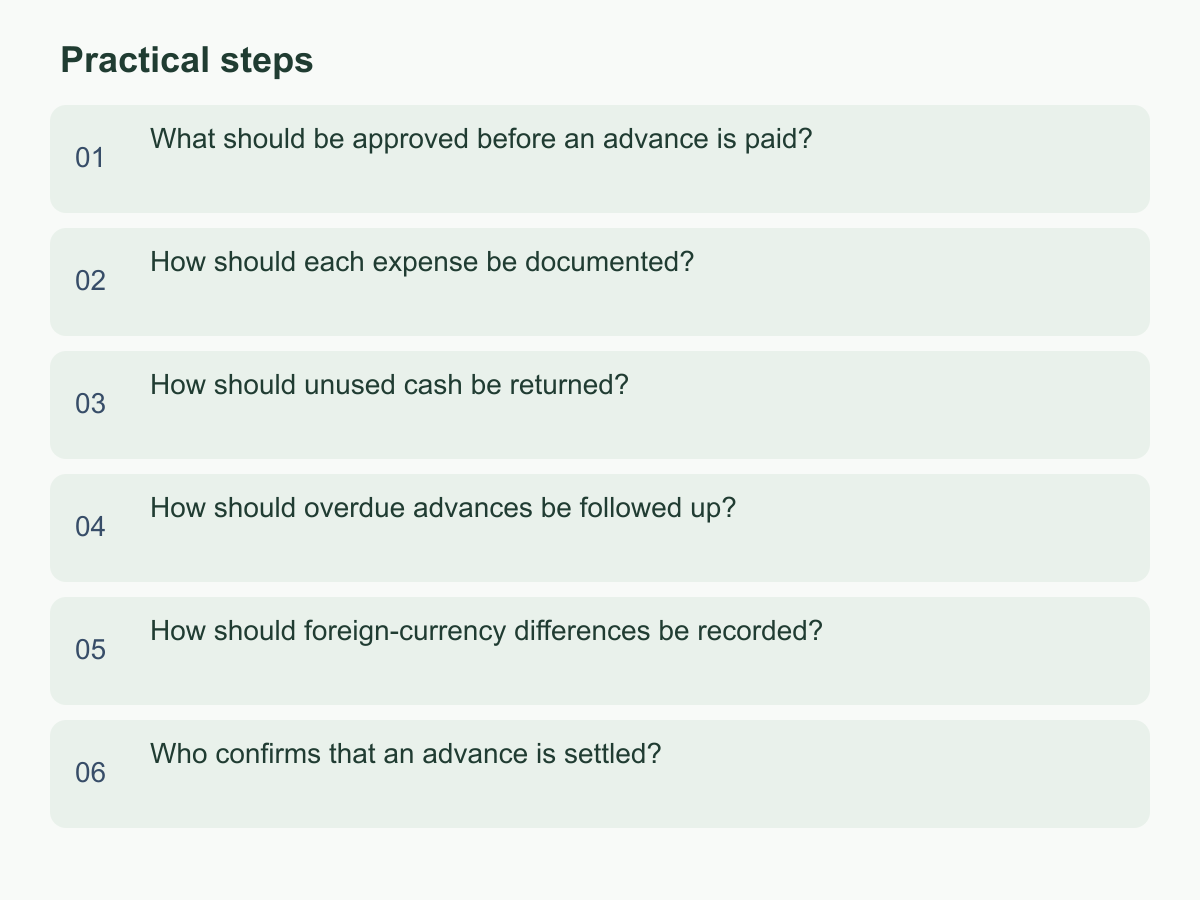
What should be approved before an advance is paid?
Record the purpose, limit, and person responsible before paying. An application can include the applicant and actual user, department or project, purpose, expected spending date, currency, cap, settlement date, payment method, and approver. If a colleague will shop, name who will collect receipts and report the balance. Replace vague labels such as “miscellaneous” with a business purpose, such as client-visit transport or exhibition supplies.
Check the estimate, payment method, and possible duplicate advances against internal procedures. Break the estimate into likely items and unit costs, using a quote, itinerary, or event list where available. If no quote is available, explain the estimate and identify what needs follow-up approval. Approve a cap, not a commitment to spend it all; settle only supported actual expenses.
Keep payment, expected-use, and settlement dates distinct: paying an advance does not mean an expense has occurred. If a task is cancelled, notify the person holding the funds and arrange their return promptly. Record the approved amount, date, approver, and exceptions, including verbal approvals. If the purpose, payee, or cap changes, obtain approval first and preserve the change reason and approver; do not rewrite the original request as if it had always been approved. For example, a request for exhibition supplies changed to temporary storage should show why and who reconfirmed it. Keep the form proportionate, but give every advance a unique ID linking payment, receipts, and returns.
How should each expense be documented?
Give each expense its own line, rather than combining different days, merchants, or purposes. Record the date, merchant or payee, item or service, purpose, original currency and amount, payment method, receipt filename, and advance ID. Add context if a receipt’s item description is unclear.
Photograph paper receipts legibly and in full; retain originals under company procedures. Keep electronic receipts or retrievable messages, checking that date, amount, and merchant are visible. Name files with the advance ID, date, merchant, and sequence, such as ADV-024_1018_station-shop_01. If one receipt covers multiple purposes, identify the items and amount charged to this advance. For split payments, record each date and amount and the total; never attach the full receipt amount to multiple advances.
Mark each receipt attached, pending, or not applicable. When returning an item for correction, identify missing fields and add the correction date without overwriting the initial submission date. For shared purchases, record who received or used the items, but avoid unrelated personal data. If a receipt is lost, mark it pending, describe the transaction, payee, item, amount, and reason, then follow internal rules for substitute evidence or manager confirmation. A bank or card record may prove payment without showing what was bought. For a mixed receipt, such as stationery and personal items, identify and allocate only the company items. Upload receipts after each purchase or day while details are easy to recall.
How should unused cash be returned?
Separate verified expenses, paid expenses awaiting evidence, and unused cash still held. Missing evidence does not mean the money was unspent. Count and return or transfer unused cash, recording the recipient, date, amount, currency, and receipt or transfer evidence.
A reconciliation can subtract verified expenses from the approved advance, then compare the balance with cash returned and pending receipts. Keep differences open rather than guessing or clearing them with a verbal promise. For an in-person handover, record the amount and currency confirmed by both people. If the recipient cannot sign immediately, retain traceable transfer evidence and have them confirm receipt later.
For a company card or e-wallet, unused purchasing capacity is not employee-held cash; use refund or cancellation records to reconcile it. Preserve the original amounts and calculation, not only the net balance. Link any partial refund to the original expense, noting its date and method, and update the actual spend rather than entering an unlinked negative expense.
Example: assume an NT$8,000 advance, NT$5,200 in verified receipts, NT$600 already spent with a receipt pending, and NT$2,200 unused cash. Record the NT$2,200 return and keep NT$600 pending, not as unused cash. The arithmetic is 5,200 + 600 + 2,200 = 8,000. When the receipt arrives, reclassify NT$600 as verified spending. Do not retain a balance for next time, offset another advance, or change its purpose without company approval and a traceable record.
How should overdue advances be followed up?
Track each advance from its agreed settlement date. A register can show its ID, user, cap, due date, submitted receipt amount, cash returned, missing evidence, contact history, and next owner. Distinguish expenses needing receipts, money still held, and submitted documents awaiting review. Ask for missing evidence in the first case, arrange a return in the second, and have the reviewer identify open questions in the third; these are not all unpaid balances.
Set reminder timing under company policy, such as before the due date, on that date, and afterward. These are internal checkpoints, not statutory deadlines. Each message should state the advance ID, amount, required action, reply method, and next review date. Keep the time sent, recipient, response, and promised completion date for handoffs. For a lost receipt, explain the substitute-evidence process and any manager confirmation needed.
Review recurring delays for unclear instructions, missing form fields, or a review queue. If one team repeatedly submits late, check whether receipts are collected only after a task or held by someone else; adjust collection or assign a backup. Escalate an open-amount and action summary only to people who need it. Date every status change and name its owner. An advance with returned cash but missing receipts remains on the tracker until resolved.
How should foreign-currency differences be recorded?
When the advance and purchase currencies differ, keep the original transaction amount and converted settlement amount. Follow one consistent conversion basis under company procedure: for example, the bank debit, card statement posting, or a reference rate from a named source and date. Record the transaction date, spending currency and amount, conversion basis and date, settlement-currency amount, fee treatment, supporting evidence, and reviewer.
Link a card statement’s final posted amount to the original-currency receipt, and record the rate or difference as required internally. Do not leave a conversion figure without a source. For cash purchases, retain an exchange slip or use the company’s designated rate source for that date. If sources differ, show the variance for review rather than replacing the original figure. If no conversion is needed, mark that explicitly instead of leaving a blank.
Show totals in the settlement currency while retaining original-currency details. Example: assume an HKD 3,000 advance and an SGD 180 purchase, using a hypothetical rate of HKD 5.8 per Singapore dollar. The expense converts to HKD 1,044, leaving HKD 1,956 if there are no other expenses. List supported card or exchange fees separately under company rules; do not hide them in the purchase amount. Keep conversion differences separate from unused cash, which is unspent money to return. If the source is unknown or a card charge has not posted, mark it for confirmation rather than inventing a rate.
Who confirms that an advance is settled?
The user submits itemized expenses, receipts, and return evidence, linking each line to the original request and purpose. The approver handles exceptions such as overspending, changed purpose, or missing documents. The cash recipient confirms what was received; a reviewer checks amounts and attachments. Small teams may combine roles, but retain the reviewer’s identity.
If amounts do not reconcile, leave the case open. Identify the unmatched payment, receipt, or cash amount, then assign an owner and follow-up date. Check more than the total: compare entries with the request and payment evidence, looking for duplicate receipts, omitted refunds, or incorrect currencies. Store the request, changes, expenses, returns, and review together under the advance ID, with access limited under internal rules.
Close only when verified expenses, pending evidence, returned cash, and conversion differences each have an amount, status, and owner, with no unexplained variance. A missing receipt means the advance remains pending even if all cash is back. Record the confirmation date, user, reviewer, summary, and evidence location without overwriting the original request or later changes.
Example: for an NT$5,000 advance, NT$4,400 in verified expenses, and NT$600 returned, with no missing receipts or differences, match the receipts, return evidence, and payment record, then record the settlement date and names. Try a shared settlement form on one open advance and check that pending receipts are not mistaken for unused cash.
If you are organizing information about operating internationally from Hong Kong, visit the Chan & Chung website.