
Supplier onboarding questionnaires often combine company, operations, information security, and payment questions in one form. The work is finding the right evidence and making sure each answer is verified. A question-by-question tracker shows the source, owner, reviewer, and deadline. Keep unverified items open rather than turning assumptions into claims. These six steps make the work easier to hand off and review.
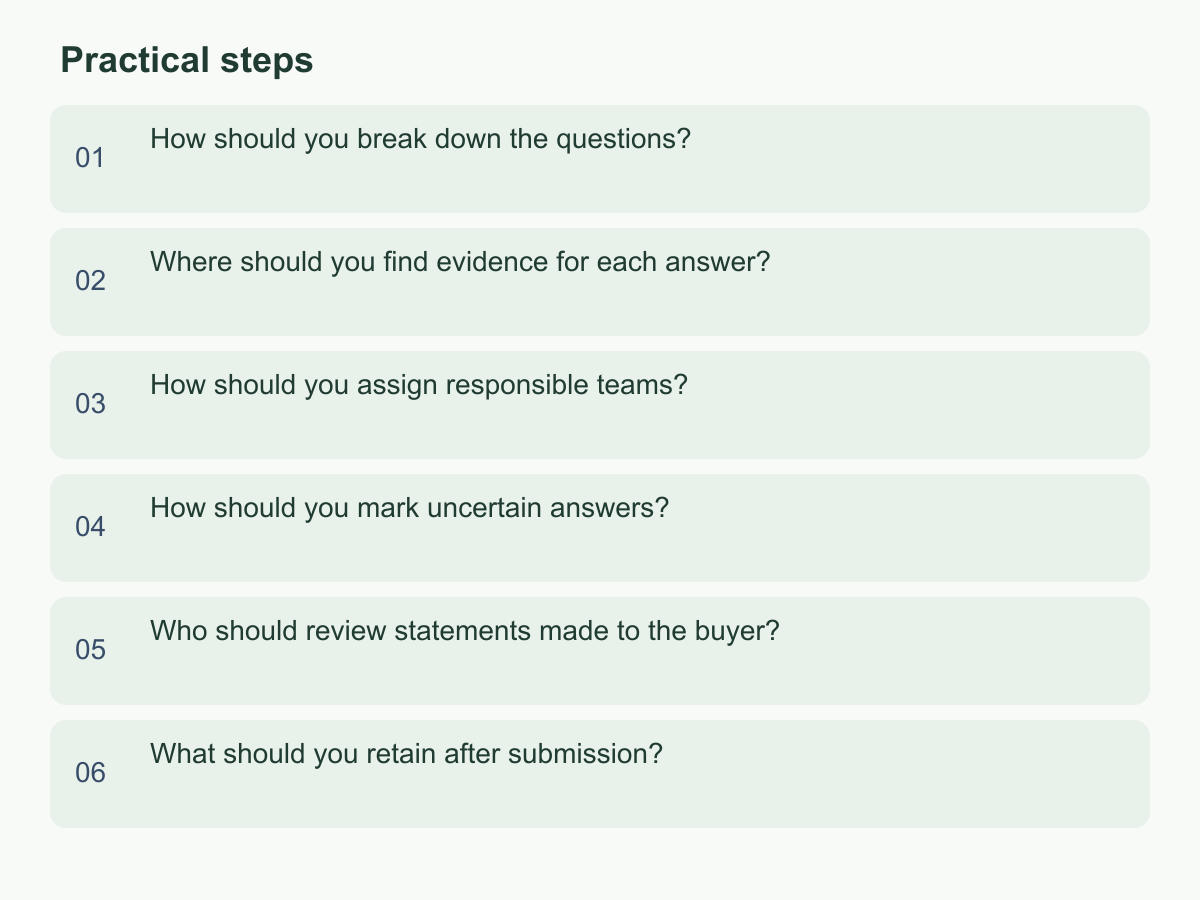
How should you break down the questions?
Preserve the buyer’s original wording, question number, and required-field marker; internal labels should not replace the source fields. If one item asks whether a policy exists, how often it is reviewed, and who approves it, make three rows: policy existence; review frequency and the latest review record; and approving role with its basis. Each row should require one clear answer, one main evidence source, and one assignable owner. If it still asks whether, how, and when, split it again.
For multiple-choice items, keep the buyer’s options and definitions, and note whether “Not applicable” is allowed. Do not add a plausible-sounding option. Repeated questions may share evidence, but retain a separate row for each question number, original wording, response field, attachment requirement, and shared file location. Internal labels such as company information, contracts and payments, people processes, or system security can help route work; they do not replace buyer fields. Record dependencies and conditional follow-ups, such as a system name requested only after “Yes,” so no one works on an irrelevant sub-question or misses one triggered by an answer. Pilot one item and ask another coordinator to trace each row back to the form. Fix any mismatch, and separately confirm which entity, affiliate, or contractor a question covers.
Where should you find evidence for each answer?
First list the evidence types a question could accept, then connect each row to a storage location and version. Depending on the question, look for an approved policy, procedure, contract, or internal record. For a description of current practice, use an operational record or system screen, and ask the data holder to confirm its date and scope. Evidence must support the specific answer: an organization chart may not show that a control was performed, and a policy is not a record of every execution.
For example, if the buyer asks how accounts are disabled after an employee leaves, locate the current process and ask the system administrator to verify execution records. If you find only the process, describe that process; do not claim it was followed on time every time. For each item, record the file name or link, version date, holder, questions it supports, and whether it contains confidential or personal information. If there are multiple versions, ask the document owner which one is current rather than relying on a “latest” label. Indirect evidence can be listed with its limitations for the reviewer to assess. If it is insufficient, identify what is missing or ask the buyer about acceptable alternatives. Every figure, period, control description, and attachment name should trace to a source. If no source is available, record the gap and next step; do not fill it with common practice, a template, or an unverified verbal claim. Note any file-format, redaction, or access requirements, and confirm that screenshots identify the system and period they represent.
How should you assign responsible teams?
Give each question one directly responsible owner to find the information, explain the actual process, and respond by the internal deadline. Add collaborators who hold related records so a shared inbox does not become the only point of accountability. Assign work according to who has the evidence: people who manage company records or contracts confirm those items; the people who manage payment and finance processes provide their sources; system administrators verify system and access controls; and process leads confirm employee procedures. This is evidence-based routing, not permission for a department to make an unapproved company-wide commitment.
Record a named role or on-duty person, not just “IT” or “Administration,” and note a backup and the evidence location in case someone is away or changes roles. Start with the buyer’s deadline, then confirm the time zone, submission method, and attachment requirements. Work backward to set internal handoff and review dates, leaving room for corrections. When the buyer gives only one deadline for the full questionnaire, set internal dates based on responsibility and risk; do not present an invented number of days as a fixed rule. Start early on questions that depend on other teams. If an owner lacks an input, record what is missing, whom they contacted, and when they expect to update the tracker. Alert the coordinator as soon as a deadline is at risk. Update the tracker when ownership changes, with the handoff items still outstanding. Keep the buyer’s deadline visible, schedule brief checks for blockers, and identify who will consolidate the final answer so departments do not send conflicting versions.
How should you mark uncertain answers?
Do not treat a blank, a guess, and “No” as the same status. The tracker might use statuses such as Draft, Awaiting Evidence, Awaiting Review, Confirmed, Awaiting Buyer Clarification, and Not Applicable. Define when each status applies: an answer must exist before it is a draft; missing sources mean it is awaiting evidence; and it is confirmed only after the reviewer approves it. These are internal labels and should not be entered in the buyer’s form unless it provides matching fields.
For an uncertain answer, name the specific unknown, who can check it, and when it will be revisited. If the question is unclear, preserve its original wording, draft a neutral clarification question, and pause any choice that would create an external commitment. Mark an item Not Applicable only after verifying that it does not apply and confirming the buyer’s form allows that answer; record the reason for review. Separate current practice from future plans. A planned control is not an existing one, and terms such as “compliant” or “certified” should not conceal a gap in the evidence. For instance, if a question asks whether reviews happen quarterly but the only process document has no date, mark the item as awaiting evidence and ask the owner to check review records. If the form offers only Yes or No, keep the internal status open instead of guessing. If submission requires an answer, an authorized decision-maker should decide based on available information. Date each status update and record who made it, so the coordinator can distinguish a new gap from a stalled one.
Who should review statements made to the buyer?
Choose a reviewer who understands the subject and did not draft the answer. For each item, compare the buyer’s wording, the draft, and the evidence. Confirm that the answer stays within what the source proves, that the source is still valid, and that names, dates, figures, and attachments agree. Look closely at absolute terms such as “all,” “never,” or “guaranteed,” and at claims about certifications, audits, encryption, backups, or timeframes. If the evidence covers only part of the organization or process, limit the answer to that scope, even if the form offers a simple checkbox.
Have the reviewer accept the answer, return it for more evidence, or request a rewrite, and record their name, the time, the version reviewed, and the reason. Escalate high-risk commitments, contract terms, regulatory classifications, or professional judgments to an internal lead with the relevant responsibility or an appropriate external professional. A person coordinating the form should not substitute for that judgment. If management must sign, confirm the signer can represent the company and is reviewing the same version that will be submitted; do not send an unfinished attachment for signature. If the buyer requests a statement that internal evidence cannot support, escalate it to the coordinator and decision-maker for a response or clarification. Once approved, lock the version. Any change to wording, evidence, or attachments must go back to the relevant reviewer. Check the scope of negative statements too: “not collected” does not necessarily mean “not processed,” and having a procedure does not prove that execution records exist. If reviewers disagree, record the disagreement and the decision-maker’s conclusion rather than resolving it by majority vote.
What should you retain after submission?
Before submitting, compare each buyer question with the final answer, attachments, and required fields. Confirm that every external statement has a supporting source and approval record. If the form cannot accept a pending answer, the coordinator should decide whether to ask the buyer for clarification, defer the affected field, or use an option the buyer allows. Do not quietly remove the question. Retain a copy of the submitted questionnaire, answer version, attachment list, submission time, submitter, and review records. For a portal submission, keep its receipt or other reference that identifies the submission instead of relying only on an email sent folder.
Store the files in an approved company location and limit access to people who need it. Before sharing a link, confirm the recipient, permissions, and whether it exposes personal or confidential information. Follow internal retention rules for source evidence; do not invent a legal retention period. If evidence changes, record which version supported the submitted answer so a later document is not mistaken for the original source. Link buyer follow-up questions and requests for additional material to the relevant tracker rows, with a new owner and deadline. For corrections, preserve the original and revised versions with the reason for the change. Before closing the questionnaire, check that unanswered items, commitments, and any internal documents due for update have an owner. Test shared links from a recipient’s perspective: verify that they open the right version without exposing unrelated supplier or internal files. Remove temporary access when it is no longer needed under company procedures, and send only the evidence needed to support the answer.
Start with the original questionnaire and create a tracker with question number, evidence, owner, reviewer, deadline, and status. Then assign the rows and follow them through review. Visit Chan & Chung for brand information.