
External information requests often combine background, questions, proof requirements, and deadlines in one message. A direct reply can miss an item or present unverified details as settled. First turn each request into trackable tasks that can be assigned, checked, and reviewed; then connect every answer to its supporting evidence.
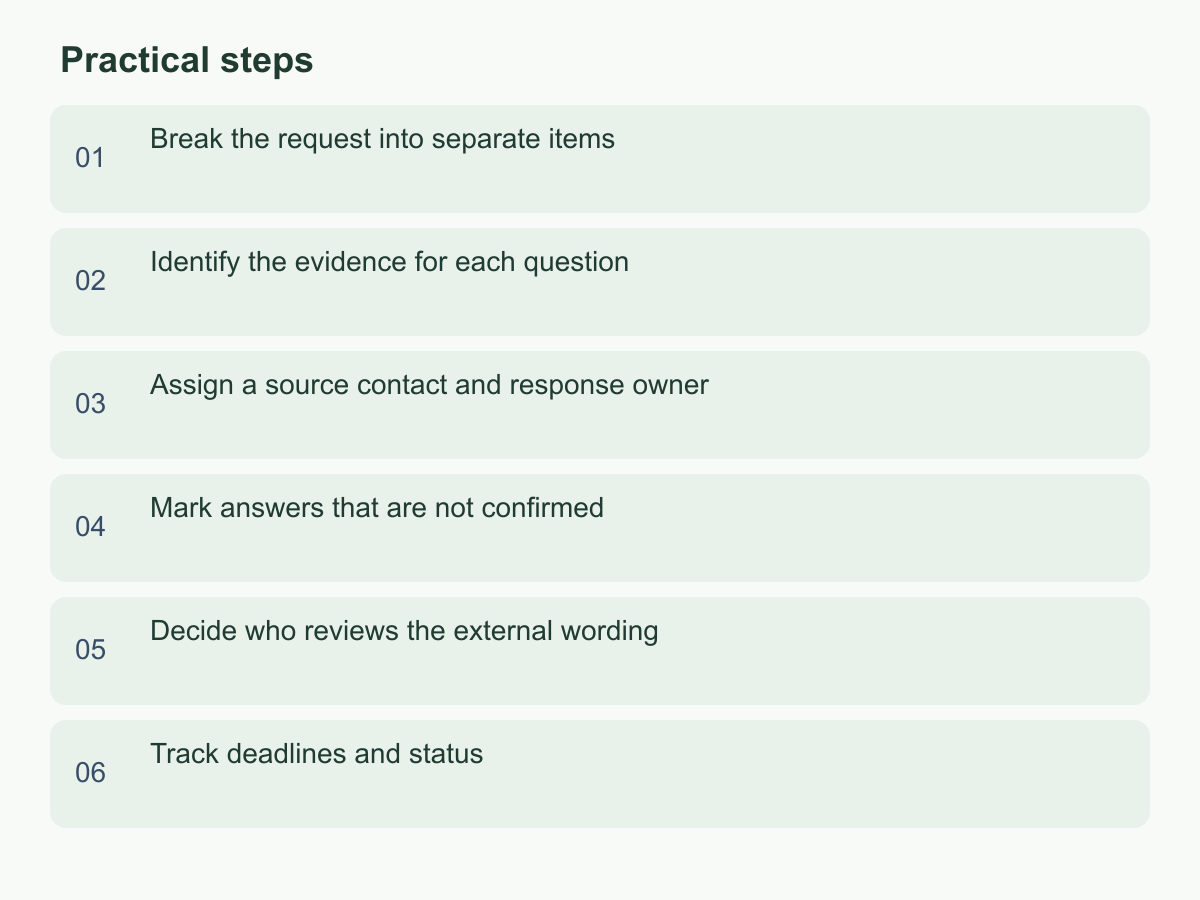
Break the request into separate items
Treat the incoming message as a list of tasks to unpack before drafting answers. Create one row for each independently answerable request. Keep its original item number and wording, then record the scope, time period, requested format, recipient, and deadline. Each row should point back to the original question so colleagues can check it. If one question contains several parts, split them into separate rows and carry over any background they share.
Turn each row into a deliverable with, at minimum, the question, evidence needed, source contact, response owner, reviewer, status, and next action. Keep the original wording alongside an internal summary; a summary alone might reduce “explain the process” to a paragraph while overlooking a request for supporting records or a specified period.
For example, “What process is currently used, who approves it, and how are records kept?” can become three linked rows: process, approval role, and record retention. Assign evidence and an owner to each. If the approval record is missing, mark that row for follow-up while continuing work on the other two.
Flag undefined terms such as “latest,” “complete,” or “relevant.” Record whether the uncertainty concerns scope, period, or format, and decide whether clarification is needed. If asked for changes during a particular period, capture the original item number, date range, format, evidence, and answer owner. If “changes” is not defined, leave a clarification field open instead of presenting an assumed list as complete.
Identify the evidence for each question
Start by deciding what kind of answer the row needs: a description of internal practice, records from a specified period, or information that can be checked against an external source. Ask the person who performs or maintains a process about current practice. For records, locate the original source and its custodian. For public or regulatory information, state the applicable scope and use a formal source that can be checked. Define what the answer must establish before searching.
For each candidate item, check its title, version or date, covered subject, applicable period, and whether its content directly supports the answer. Similar evidence is not a substitute for what was requested. If material includes personal or commercial information that should not be shared externally, ask an authorized internal contact to confirm what may be disclosed, then decide whether to redact it or use a summary. Record where the source is stored so a reviewer can retrieve it.
Suppose a request asks how a process operated during a specified period. One person finds a process description and a separate execution record. The matrix can state that the description supports the process and the record supports activity during the period, while noting that their coverage still needs comparison. Finding one document does not establish every part of a multi-part question.
If evidence is missing, log the source types searched, contacts asked, and remaining gap to prevent duplicate work. If versions conflict, pause their use and ask the document maintainer or process owner to confirm which is current and explain the difference. A candidate record might be listed as “Monthly operations log; date: year and month; location: restricted folder; supports: execution date and role; limitation: does not cover other months.” This makes its limits visible.
Assign a source contact and response owner
A source contact should be able to locate a record, explain how information was produced, or confirm the current process. That person does not have to draft the final answer. Record an identifiable person or role, the information they own, the evidence requested, and the response time. If a question crosses teams, assign a source contact for each relevant part instead of handing the entire request to one general contact.
Also name one response owner to collect material, compare each item with the original wording, draft answers, and update the matrix. Every row should show its next action and who will take it, so a handoff makes clear who still owes information and who is organizing it. Source contacts provide checkable inputs; the response owner checks whether those inputs answer the request completely.
For three items about a process, system records, and external contact details, assign a knowledgeable source contact to each and one response owner to coordinate. If one person fills both roles, mark source confirmation and answer preparation separately. Reviewers can then see whether that person verified the underlying information, checked the complete external response, or did both.
A name in a cell is not a complete assignment if the person is away, lacks authority, or cannot confirm the information. Record a delegate or an owner still to be appointed, any approval needed, and the blocker. Escalate unowned fields to a manager or process owner. When responsibility changes, hand over source locations, confirmed scope, and open questions, not just the email thread.
For a system export, the source field might say “system records maintainer,” with a task to confirm date range, field definitions, and response time. A process manager can verify business meaning; a delegate can remain “to be assigned.” If the person exporting data cannot interpret it, assign the export and scope confirmation to different contacts and track each separately.
Mark answers that are not confirmed
Turn “unknown” into a specific, actionable gap: evidence not found, source contact not confirmed, scope unclear, conflicting evidence, or approval still needed. Record what is known, what cannot yet be confirmed, the next verification step, and an expected response time for each gap. Status should describe progress, not imply that an answer is correct.
Use a small, consistent set of labels, such as To assign, To verify, Awaiting material, In review, Ready to respond, and Closed. When a status changes, note the basis: who supplied what, when it was confirmed, and what remains outstanding. If only part of an answer has evidence, distinguish confirmed wording from fields still being checked. This prevents a copied draft from turning an open gap into a definite statement.
If a request asks for process records over a period and the source contact finds only some months, mark those months as received and the rest as pending. The response owner can ask the records custodian to search further. Keep the unsupported field blank or marked internally until evidence arrives. If the requester allows a staged explanation, the response owner can confirm that approach and state which period remains outstanding.
If a deadline is near, tell the internal decision-maker what is missing, which parts are affected, what has been searched, and what can happen next. Then decide whether to seek clarification or arrange a response. Do not disguise uncertainty with vague wording or turn “no record found” into “nothing happened.” Before closing, resolve every open marker with evidence, a clear exclusion, or an authorized decision. For an unconfirmed approver, record that the document names a role but not a person, and ask the process maintainer to check the current roster; leave the name open until confirmed.
Decide who reviews the external wording
Match reviewers to the content. A person familiar with the subject checks whether facts match the evidence. The response owner checks that every question is answered and the scope is complete. The external communications contact checks tone, format, recipient, and attachments. Record each reviewer’s responsibility in the matrix so a smooth read does not replace a check of the underlying facts.
Before review, link each sentence to its evidence or mark it as unconfirmed. Check terminology, date ranges, attachment versions, and whether personal or commercial information is appropriate to share. Reviewers should leave a confirmation or comment; the response owner records who will address it and by when. After an answer changes, compare the affected wording with the source and original question again. Earlier approval does not cover a later edit.
If a draft sentence summarizes several sources, the process contact can check that it stays within what they support. The external contact can check that it answers the question and that the attachment matches its description. If either identifies an unresolved point, separate it as a gap and hold that passage for finalization. Other reviewed items can proceed with their own versions and statuses clearly marked.
Route content involving contractual commitments, personal data, sensitive information, or specialized judgment to an authorized organizational contact and any adviser they designate. Record what was submitted for review, the open question, and the result; do not describe advice not yet received as approval. A five-column log can capture sentence number, supporting evidence, fact checker, wording contact, and status. If an edit changes the period or people covered, send that row back for factual review before relying on the earlier sign-off.
Track deadlines and status
The tracking fields should show the current stage, owner, next action, and due time. Record internal evidence-gathering and review milestones as well as the external deadline. Give each open task an owner and handoff time. If a key source is late, show which question is affected; a single “in progress” status for the whole request hides where work has stopped.
For each update, record the date, status change, new evidence or reason for a gap, and next owner. Set check-ins based on the time remaining and work still open. Alert the response owner early if an item affects other answers or the full response. A status without a next action and an owner describes a stall but does not move the work forward.
If the external deadline is Friday and one source is still missing, mark that row as pending, log who was contacted and the expected reply time, and send the other rows for review. If there is still no progress at the team’s internal checkpoint, notify the decision-maker and consider another source, clarification, or an adjusted response arrangement. Set actual timings from the request and the team’s agreement.
After sending, confirm row by row that answers, evidence, reviews, and the external version match. Keep follow-up items open with an owner and next check-in, even if the email has gone out. If one row depends on another, record the prerequisite, work that can proceed meanwhile, and the condition that releases the dependent task. For example, draft the answer while waiting for material; if it is late, update only the dependent row’s expected date. Start by placing each request in a matrix and assigning its source contact, reviewer, and status. Learn more about Chan & Chung at our website.