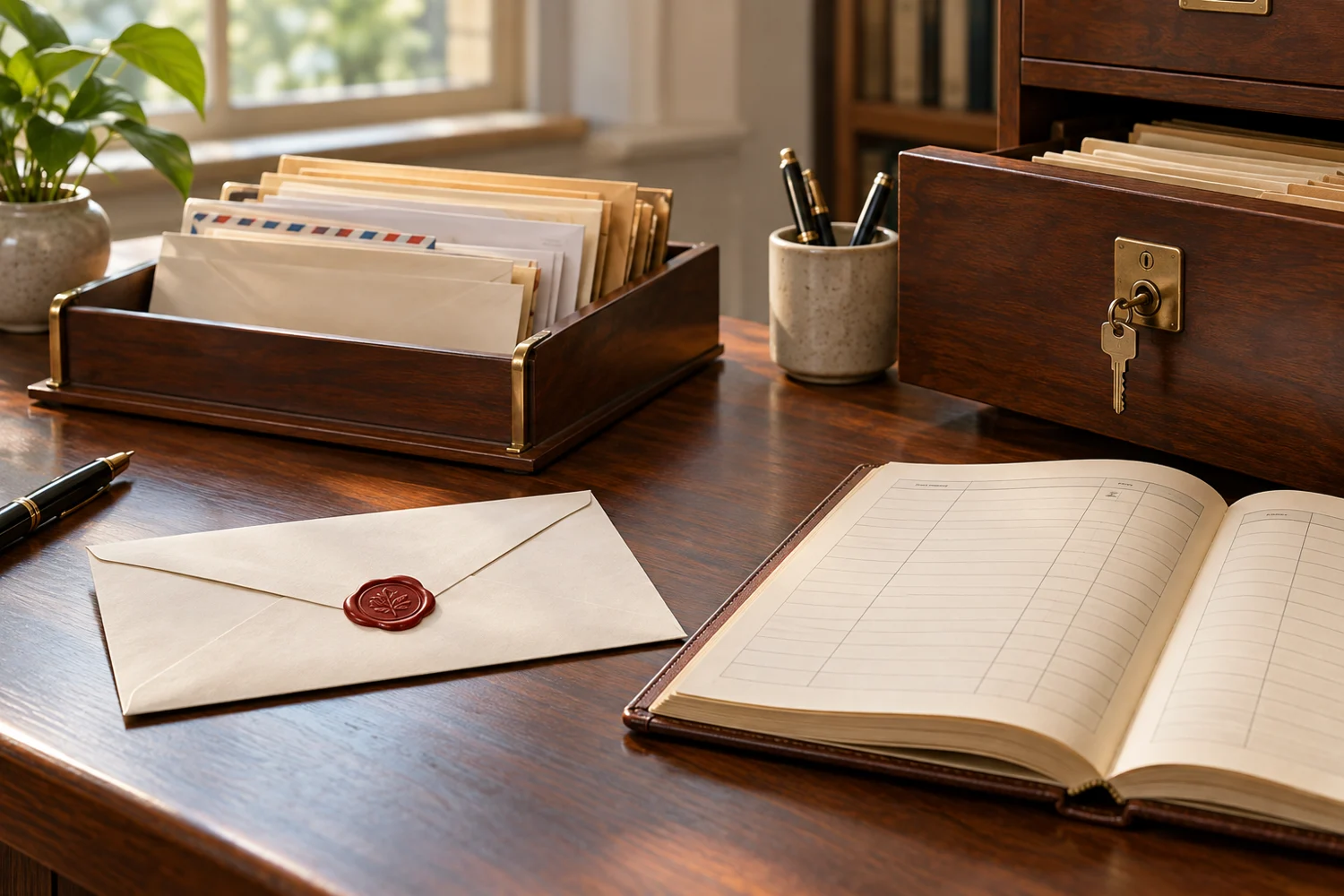
When a formal letter arrives from a bank, customer, supplier or public authority, record where it came from, when it arrived, who received it and where the original is kept. This intake record preserves facts colleagues can check and supports a clear handover. It does not replace legal judgment or establish a response deadline. Use the same fields consistently.
Identifying the Sender and Source
Record the sender or organization visible on the letter and how it arrived. Check its letterhead, sender field, envelope, email address or forwarding note. These are tracing clues, not proof of identity or authenticity.
For paper, retain the envelope and note whether it came by post, hand delivery or internal transfer. For electronic files, keep the original email and attachments; record the sender address, receiving inbox and forwarding person. List a colleague who accepted it as an internal handover, not the sender.
If a supplier sends a file to a shared inbox and an administrator passes it on, record the supplier and sender address as shown in the original email, the shared inbox as the channel and the administrator as the handover contact. This lets a colleague trace the original message without confusing external and internal contacts.
When letterhead or sender details are missing, forwarded content is incomplete, or a display name differs from the address, separate known facts from items still to check. Keep the envelope, email headers or transfer note; mark the source “pending verification” for the appropriate recipient. Do not record a guess as fact.
If building management first receives paper mail, list the sender and collection point separately and record the transfer path. If the envelope and signature differ, preserve both details and add who checked them and when rather than overwriting either.
Who Records the Receipt Date?
Enter the date the organization actually received the letter, with the first handler or designated clerk recording it. Keep the document date, postmark, email sent time and actual receipt time in separate fields; record the time too when known. They may differ, and none should silently replace another.
The person accepting the letter passes it with its envelope or original email to the clerk. The clerk checks the channel and visible date, then records the handler and internal recipient. Use one clear format, such as year-month-day. If a date or time is uncertain, preserve the original timestamp or other evidence for comparison.
Example entries: document date 2026-10-12, from its signature; received 2026-10-15, signed for at reception; Wang records it and hands it to Lin in Finance. These dates describe the record only, not a deadline.
If an attachment is forwarded later and the original arrival time is unavailable, record the internal forwarding receipt and mark the original date unknown. For after-hours arrival, distinguish it from entry time: email arrived 2026-10-18 at 21:00; registered 2026-10-19 at 09:00. If a time zone or system clock is later found to be wrong, keep the initial entry and append the correction reason, checking evidence and handler. Refer possible response deadlines to the responsible person; intake staff do not decide them.
Writing a Clear Subject Summary
Write a neutral summary so someone unfamiliar with the letter can identify its topic, related party or matter, and locate it in the original. Prefer its title, email subject, reference number or named business matter. Do not add an unverified cause, responsibility or conclusion.
Check the heading, opening, attachments, dates and reference numbers. In one or two sentences, state what the sender raised and who or what it concerns. Replace a vague subject such as “Notice” with the specific document or arrangement. Keep internal tasks and opinions in a separate action field.
If a customer email titled “Please confirm October information” includes two reconciliation files, write: “Customer asks us to confirm October reconciliation data; two files attached.” Do not call it an immediate payment demand unless the sender does. Put internal follow-up elsewhere.
For unrelated issues, use semicolon-separated phrases or link the main entry to an attachment list. If handwriting is unclear, the body conflicts with an attachment, or a reference number is unreadable, mark it pending and retain the original wording and page number for a knowledgeable recipient to check.
If the subject says only “Materials” but the body asks to check the March supplier list’s page 2 quantity column, record the original subject and explicit request. Mark an informational second file “reference attachment” and leave any unspecified reply method blank.
Where to Keep the Original and Attachments
Point the register to the unchanged original so a colleague can retrieve it. Name a cabinet and folder, controlled path, or identifiable document-system location; “cloud” or “Administration” is too vague. Include the intake ID, file name and number of attachments.
Preserve the original email with its attachments and sender details; do not keep only renamed files. For paper, retain the letter and envelope and record their location. Label scans as copies and state where the paper original remains.
Example: ID “Intake-20261015-03”; email original in restricted “Incoming/2026/10”; two attachments; no paper; scan for internal reference. This shows one naming approach, not a required system.
If a file is too large, will not open, a link fails or an attachment is missing, retain the email and usable files and mark the issue. For an external download, preserve the sender message and access clues, follow internal security steps, and never put login credentials in the general log. Once resolved, add the actual location and handler.
List each attachment’s original name, receipt status, whether it opens and storage location. If three are mentioned but two arrived, mark the third “not received” and link the email. When it arrives, add its arrival time and new file name without deleting the gap; verify each file at handover and preserve any original-to-new name mapping.
Who Can View Sensitive Correspondence?
Intake logs can expose personal, account or non-public business information. Identify sensitive material and choose storage with suitable permissions under the organization’s existing arrangements. Do not put complete attachments in a shared log that anyone can read.
Keep general index fields to subject, handler and restricted location; store originals in a folder or cabinet with suitable access. Follow assigned owner or approval steps and record handovers. Separate view and edit rights to reduce overwriting or deletion.
For a bank letter with sensitive data, the index might say “Bank letter; sensitive attachment; original in restricted folder” and name the responsible recipient. Others may see receipt and handover status, while approval is needed to view the attachment. This example does not prescribe a permission model.
If a letter is misdirected to a public inbox, forwarded too widely or given incorrect permissions, report it internally, limit access and record affected items, action and handler. Do not copy sensitive details into the log or rely on a “confidential” label; after a change, check the actual viewers.
For one-person review, name who may view the attachment and the request route; limit access to that person and an approved alternate. At handover, confirm the next recipient can open it, log the change and remove unneeded access. If the audience is unclear, ask a manager before including contents in general notices or minutes.
Marking Duplicate Copies
Letters may arrive by post, email or repeated forwards. Compare sender, document date, subject, reference number, page count and attachment names before classifying a duplicate. Matching file names alone are insufficient; versions may differ by one page or attachment.
If content matches, keep a main record and list each copy’s channel, arrival time and location, linked to its ID. If paper and email each have value as originals, record both locations. This preserves each item’s route without discarding either.
For example, a supplier emails a three-page letter, then posts the same pages the next day. Mark the latter as a copy only after comparing pages and attachments. If it adds a signature page, record a separate linked version with its own receipt date and location.
If uncertain, mark “possible duplicate, pending comparison”; do not delete, overwrite or merge. Record the result, checker and linked ID. Add later revisions as timestamped versions instead of silently replacing earlier files, and confirm each remains traceable from the main record.
Identical attachments arriving in different inboxes or through different colleagues are still separate receipt events. Keep each time, channel and handover contact linked to one record—for example, “Main: Intake-20261019-01; copy channel: department inbox; arrived: 2026-10-20.” They may share storage, but preserve both dates and routes.
Start a register with source, date, subject, recipient, storage location and copy links, then use it for the next letter. For information about Chan & Chung, visit the official website.