
Receiving discrepancies are easy to misread when the purchase order version is unclear, package units differ, or cartons remain unopened. This guide covers a line-by-line check against the valid purchase order for each delivery, not a periodic stocktake. Mark shortages, overdeliveries, unopened cartons awaiting count, and goods pending inspection separately. Keep the actual quantity, evidence, and reviewer for each item; do not offset one line’s shortage against another’s surplus. Record the basis and the physical goods before deciding whether to adjust the receipt.
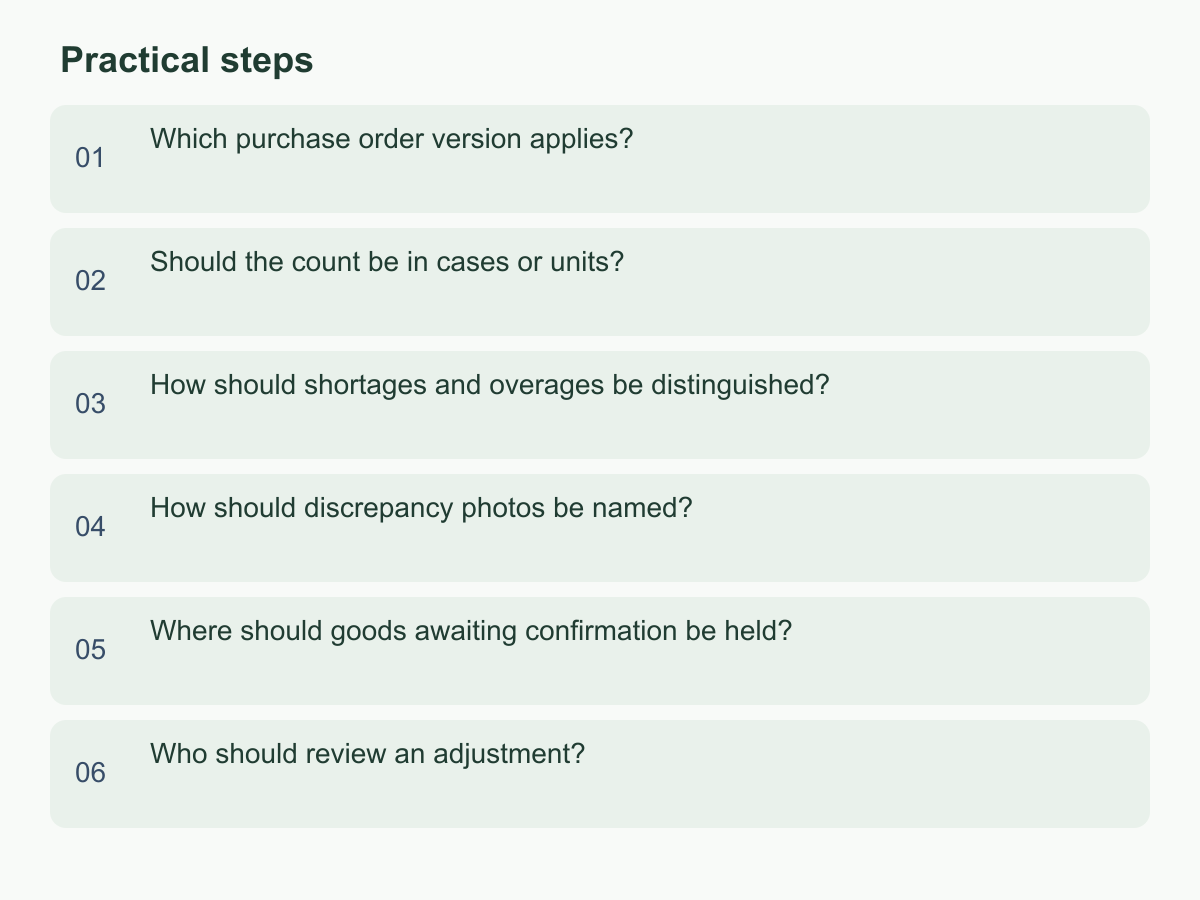
Which purchase order version applies?
Before recording a receipt, match the purchase order (PO) number, supplier, receiving location, and delivery date. Confirm that your copy is the latest approved version sent to the supplier. Check the revision date, item code, specification, ordered quantity and unit, cancellations, and split-delivery records. If emails or attachments show different figures, do not choose by filename or send time. Find approval evidence and retain the original, revision, correspondence, and sending record. Mark one copy “receiving basis”; keep older versions separately rather than overwriting them.
Hypothetical example: 100 units were approved on Monday; on Thursday, both parties confirmed a change to 96, but the delivery note still shows 100. Count against 96 and record 100 as the supplier’s dispatch figure. Mark the extra 4 as pending confirmation until purchasing finds valid approval or evidence that they belong to another order. If there is only an unapproved draft, write “version pending verification” instead of using the larger number.
For split deliveries, record received, outstanding, and cancelled quantities separately, then reconcile each batch to the balance. If the PO has no version field, note the filename, date, and confirmation source on the receiving sheet. Keep supplier confirmations, change orders, and internal approvals together, with their relationships clear. Where approval is uncertain, purchasing resolves it; receiving staff record the documents and physical goods without changing the order quantity. Record the version used so the next shift and reconciliation staff use the same basis.
Should the count be in cases or units?
Check the PO unit—pieces, boxes, cases, or kilograms—and confirm the packaging conversion. Outer-carton counts are not unit counts, especially when cartons contain inner packs or mixed goods. Follow the same sequence: record sealed cartons, check item labels and units per carton, count loose units from opened cartons, then calculate the total received. Mark unopened cartons “unopened—count pending”; a label is not a physical count. If the pack size is unknown, labels are missing, or batches are mixed, leave that quantity pending confirmation.
Hypothetical calculation: the PO calls for 10 cases × 12 units, or 120 units. The delivery has 9 sealed cases and 1 opened case containing 10 units. The verified receipt is 9 × 12 + 10 = 118 units, 2 short. Record “9 sealed cases, 10 units in opened case, total 118” so a reviewer can recalculate. “9 cases received” omits the opened case; “2 short” alone hides the calculation.
Keep the PO unit, packaging unit, conversion basis, physical count, seal status, and counter on the same row. If a carton label conflicts with supplier paperwork, photograph it and pause the conversion until purchasing or the supplier confirms it. For goods ordered by weight, record the reading in the ordered unit and identify the scale; if the PO lists only cartons, confirm the weight per carton instead of estimating. With variable case quantities, record each carton separately. Set aside goods that may be mislabeled. For divided counts, record carton ranges; if counts differ, recount together rather than averaging them.
How should shortages and overages be distinguished?
Assess each item line separately. Do not offset one item’s shortage against another’s overage, or close the receipt because the total units happen to match. Subtract verified receipt from the quantity on the valid PO. Check outer and inner packaging, the packing list, split-shipment notices, and other receiving areas for missed goods. A shortage may be unshipped, underpacked, or still in transit; mark the cause “under investigation” until evidence confirms it.
For an overage, check whether the goods belong to another PO, an approved increase, a substitute, or an unlisted free item. A delivery note does not mean purchasing accepted the goods. Do not reclassify extras as free goods or a price discount without a decision. Record the physical quantity and difference, then ask purchasing to obtain the supplier’s explanation and the internal acceptance decision.
Hypothetical example: item A is ordered at 40 and received at 38; item B is ordered at 20 and received at 22. Keep two records: A short by 2 and B over by 2. If A’s missing units arrive on another trip, record the new date and evidence against that PO line. Keep B pending if no one approved it. Compare only the same PO line, unit, and verified version.
Record ordered, received, and difference quantities, discrepancy type, evidence reference, owner, and reply status. Log an investigation even if the cause turns out to be a conversion error; have a reviewer approve any correction. For split shipments, record each receipt date and quantity under the same PO line and update the balance. If the supplier acknowledges a shortage but gives no replacement date, preserve the commitment and follow-up owner without guessing when it will be resolved.
How should discrepancy photos be named?
Start with a wide shot that identifies the PO or delivery batch, then photograph the item label, seal, opened contents, and count. For a shortage, show the packaging, label, and counted quantity in one frame or a sequence. For an overage, show the full quantity and label. For damage or inspection, add a close-up with a scale reference. Avoid isolated close-ups that cannot identify the item. Link photos to the same discrepancy row; images support, but do not replace, the written count.
Use a consistent filename with the date, PO number, item code, discrepancy type, and sequence, for example: “YYYYMMDD_PO123_SKU-A_SHORT_01.jpg”. This is a naming pattern, not a real PO number. Number related images 01, 02, 03; avoid vague names such as “photo1.” Do not put personal details, phone numbers, or unrelated prices in filenames. For sensitive scan codes, use a controlled attachment index instead.
Keep the original file and record its location, photographer, and time. Check that chat apps have not compressed the image or removed a key label. If a photo cannot be taken, document why and use alternative evidence, such as a count witnessed by two people or a seal number; ask the reviewer whether it supports an adjustment. Never make a later photo appear to have been taken at receipt. Organize files by PO or batch, keep each focused on one purpose, and restrict access when people, addresses, or documents are identifiable.
Where should goods awaiting confirmation be held?
Move discrepant or uninspected goods to a recognizable holding area separate from available stock, even if the system has not recorded them yet. If there is no dedicated area, use a bounded shelf, cage, cart, or marked section. Label each group with the PO, item, quantity, delivery batch, reason for the hold, and custodian. Keep confirmed stock separate from items awaiting count, missing labels, damaged goods, or a quality decision so another shift does not issue them as normal stock.
Each hold record should say where the goods are, who is responsible, and what decision allows them to move or be released. Use clear labels such as “shortage follow-up,” “overage awaiting purchasing,” “inspection pending,” or “damage under review.” Record the label time, receiver, reviewer, and next contact. These are work labels; a system does not need identical fields. If goods must move, verify the quantity and seal together, confirm the new location, and record both locations.
Do not open, use, return, scrap, or add goods to available stock without an authorized decision. If the area is full, ask a supervisor for another location and update the label rather than leaving cartons in an aisle. At shift change, check that the label remains, the quantity is unchanged, and the evidence can be found. Log any movement, opening, or sampling with who handled it, when, and why. A hold preserves room to decide; it does not establish supplier fault. At day-end, reconcile the hold list with the physical goods.
Who should review an adjustment?
Where possible, separate the person recording the discrepancy from the person approving a stock adjustment. The recorder attaches the valid PO, quantity and unit, conversion basis, physical count, photo index, holding location, and preliminary cause. Purchasing records the supplier’s reply or lack of reply; the stock owner decides whether to receive, top up, return, or keep goods pending inspection. Make clear who describes the goods, who confirms the purchasing commitment, and who approves inventory changes. If the team is small, have another manager or designated colleague recalculate and document any exception.
Review each line: recalculate ordered, received, and outstanding quantities; confirm that photos support the description and that the same goods are not duplicated across lines. Keep a shortage outstanding until replenished. Do not include an unapproved overage in available stock, and wait for a quality decision before updating goods pending inspection. Preserve the before-and-after quantities, reason, source documents, operator, approver, and time. If a decision was wrong, add a correction entry instead of overwriting the original count.
Before closing, confirm every open item has an owner and next follow-up point, and that the receiving sheet, holding label, and stock record agree. If the supplier has not replied, leave the item open; “notified” is not resolution. If a discrepancy affects a later purchase or payment reconciliation, route it to the relevant colleague without drawing a conclusion for them. The reviewer should confirm each specific line, not just sign at the bottom of the receipt; mark which lines were reviewed and which still need evidence.
Before the next delivery, adapt these line-by-line fields to the current receiving sheet and assign a counter and reviewer. For information about Chan & Chung, visit the homepage.