Published · Updated

There is no single “seven-year” period that applies to every record, so do not start deleting files based on that figure alone. Company-law and tax rules use different starting points, and the company’s status matters: it may still be trading, have ceased business, be applying for deregistration, or already be dissolved. If you manage a Hong Kong company from Taiwan or another market, first confirm the entity type and its Hong Kong business status. Then organise records by transaction and financial year so each entry can be traced to its supporting evidence. For broader background, see the Hong Kong company accounting and tax filing guide.
Separate company-law and tax record-retention duties
First identify whether the entity is a Hong Kong company, sole proprietorship or partnership, and whether it carries on a trade, profession or business in Hong Kong. A company must keep accounting records under the Companies Ordinance. Sole proprietorships and partnerships do not automatically follow the company-law retention period, but a person carrying on business in Hong Kong must keep sufficient records under section 51C of the Inland Revenue Ordinance to establish assessable profits. Living in Taiwan or elsewhere does not, by itself, change which Hong Kong rules apply; the entity and its activities matter. See the Companies Registry’s Companies Ordinance materials and the IRD’s record-keeping guidance.
The starting points differ. Section 377 of the Companies Ordinance sets a seven-year period after the end of the financial year to which the last entry or matter recorded relates. The IRD says business records should generally be kept for at least seven years after the relevant transactions. The BIR51 notes also describe an earlier end point where a corporation is dissolved. Treat these as separate rules; do not use one period as a universal answer.
Stopping business is not the same as dissolution. A company applying for deregistration still has business-record duties before deregistration takes effect. For dissolutions covered by section 758, former directors must ensure that the company’s books and papers are kept for at least six years after dissolution, unless another law places the duty on someone else. Check the IRD’s deregistration FAQ and the relevant dissolution route before deciding when records can be destroyed.
Link source documents to each transaction and accounting entry
For each item of income, expense, asset or liability, check that the ledger can be traced to an original document and reconciled to a bank or payment-platform record. Give each transaction a reference number. Record its date, counterparty, purpose, currency, amount, file location and account code, then link the contract or order, invoice or receipt, delivery or service evidence, payment details and ledger entry under that reference. The IRD’s record-keeping guidance lists examples such as books, vouchers, bank statements, invoices, asset and liability records, and sales, purchase and stocktaking records.
Consider a cross-border e-commerce business whose platform combines customer payments, deducts fees and settles in another currency. Do not record only the net bank deposit as sales. Link the orders and refunds to the platform settlement report, fee evidence, exchange information, bank statement and accounting entry. If the platform’s settlement date differs from the bank’s deposit date, record both and explain the timing difference so someone else can reproduce the reconciliation.
At month-end, if the settlement report and bank deposit do not match, compare the order period first, then check refunds, fees, reserves and exchange dates. Record matched items, the unmatched difference and the next action separately. Do not place an unexplained difference in miscellaneous expenses or estimate sales from the bank’s net deposit. Keep the reconciliation linked to both the report and bank record, with an owner and outcome for each difference. If a voucher is missing, log the gap, responsible person and follow-up status; a note explains the gap but does not replace the original evidence. For related context, see the Hong Kong company audit guide.
Keep electronic records accessible, traceable and backed up
Section 376 of the Companies Ordinance requires accounting information to be recorded for future reference. Records may be electronic, but they must be capable of being reproduced in hard copy. Where records are kept outside bound books, the company must take adequate precautions against falsification and steps that help detect it. For tax records, the IRD’s PAM 60 pamphlet, dated May 2024, says an electronic record should remain accessible for later use, be kept in its original format or one that accurately represents the original, and retain information identifying its origin, destination, and send or receipt date and time. See the Companies Ordinance, Part 9 and PAM 60.
Maintain an index with each document’s reference number, date, format, source, storage location and responsible person. Sample files to check that they open, remain legible and include their attachments. If you convert a file, retain the original and converted versions, the conversion date and the person who performed it. Keep original email messages and attachments, platform exports and report-generation details where available; a screenshot alone may omit the context needed to trace a transaction.
Set access rights alongside custody responsibilities: who may read, edit, export or delete records, which account holds them, and how control transfers when an administrator leaves. Backup frequency and recovery tests are sensible operational controls, not fixed intervals or cloud-provider requirements in the cited guidance. Choose a frequency that reflects transaction volume and interruption risk, and record the results of recovery tests.
Classify inventory, cross-border receipts and related-party transactions separately
Check whether the company trades in goods, holds closing inventory, receives cross-border platform payments or settles in foreign currency. Identify related parties as well. For goods, the IRD lists records such as purchase and sales documents, evidence of quantities and values, year-end trading-stock statements and stocktaking records. Keep a separate index by product or warehouse, covering receipts, sales, returns, dispatches and count differences, then compare it with the inventory balance in the books.
For cross-border receipts, organise original-currency transactions, platform settlements, refunds, fees, exchange information and bank deposits by platform or account. Where one settlement covers several orders, retain the detail and a reconciliation to the summary report. If currency is exchanged more than once, show how each amount connects to the final deposit and accounting entry. When preparing tax information in Hong Kong dollars, record the exchange rate and calculation basis used.
For a stocktake difference, log the count date, product or warehouse, quantity difference, investigation and any resulting adjustment. Keep the approval or supporting evidence with the relevant stock record. For related-party transactions, retain agreements, invoices, account details and pricing support. If transfer-pricing documents may apply, check the transaction type, amounts and applicable conditions before deciding whether a master file or local file is required; do not assume every related-party transaction is exempt or every one requires those files. These are possible business situations, not services offered by the brand. See cross-border funds and transfer pricing and the IRD’s transfer-pricing documentation guidance.
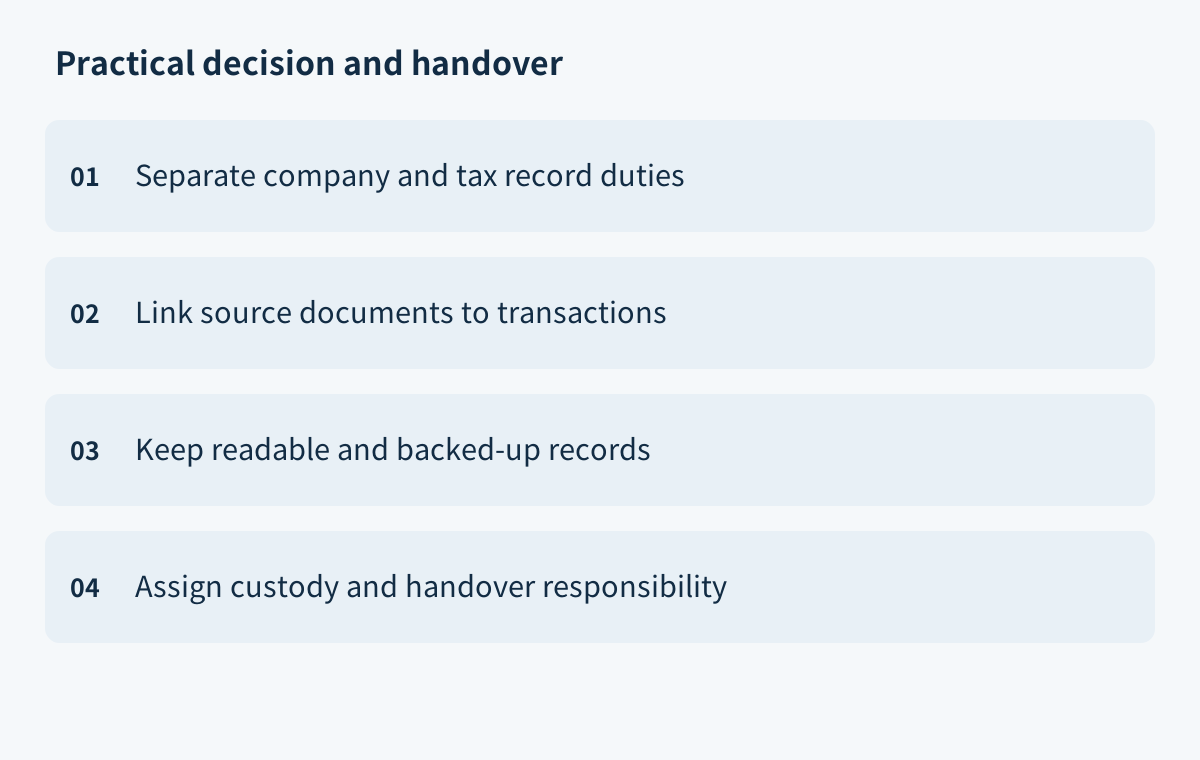
Hand over records when changing providers or closing a business
Confirm whether the company is changing providers, ceasing business, applying for deregistration or already formally dissolved. Ceasing operations does not itself dissolve a company. If tax filings, bank items or IRD enquiries remain open, include the records and outstanding actions in the handover. The IRD says business-record requirements continue while a company’s deregistration application is being processed. Check its deregistration FAQ against the company’s actual status. The company should be able to access and manage its records without relying solely on a former provider’s account; record the old and new custodians and the handover date.
A handover pack should include source documents, ledgers and entries, bank and platform reconciliations, asset and inventory records, the electronic-file index, access rights, unmatched payments, a missing-document list and unresolved enquiries. Sample transactions across a period: trace each from order or contract to ledger and bank statement, then from the statement back to its supporting evidence. If an export is incomplete, retrieve the missing files while the old account is still available. Explain the folder structure, naming conventions and which reports are final.
If the business is closing, identify which records remain within their retention periods, who will keep them and when destruction can be reviewed. Section 758 requires at least six years of post-dissolution custody for the dissolutions it covers; other applicable duties may continue. Do not use cessation, a deregistration application or account closure alone as a reason to destroy records. Keep company registers separate from transaction records. For related context, see this Hong Kong company formation and secretary guide.
Set owners, access rights and a retention schedule
A useful schedule lets the next custodian find a document, understand its retention basis and know what to do without asking the former provider. For each record type, list its name, transaction date, financial year, legal basis, retention starting point, custodian, storage location, file format, access rights, and export and backup status. If the company has ceased business or been dissolved, add the status date, successor custodian and handover reference. Mark missing records or unconfirmed periods with an owner and next action.
Use clear statuses such as checked, awaiting documents and retention period to confirm. Record the last sample-check date, who performed it and the result. Select a few transactions from different categories and confirm that files open, index links work and exported information is readable. These checks are operational practices; they do not mean the cited laws prescribe a particular cloud product, backup interval or file format.
Assign who can read, edit, export or delete records. Make sure someone under the company’s control holds the administrator account and knows where to find the secure recovery process and provider contact details. Do not put passwords in the schedule; record the account name and custodian instead. When staff or systems change, update the access and custody entries and check that former staff no longer have unnecessary administrator rights.
Before closing a handover, confirm that files were delivered, sample tracing works, open items have owners and follow-up dates, and retention periods will be reviewed when due. Before authorising destruction, check for other applicable duties and unresolved matters, then record the scope and date. If you need a case-specific assessment, use the website’s contact details to ask a question. This article is not legal or tax advice and promises no outcome.