Published · Updated

When planning to use a Hong Kong company to expand into overseas markets, its articles of association can affect how ownership arrangements are recorded, how company decisions are made and which documents need attention after an amendment. They are not relevant only at incorporation. A new shareholder, a change to share arrangements or a revised governance process may all be reasons to check them again.
This article is for business owners and decision-makers who need to review a Hong Kong company’s records. It focuses on practical document checks. The company’s articles, applicable law and circumstances can affect the procedure. No general voting threshold, interpretation of a particular company’s articles or legal outcome should be assumed here.
What Do the Articles of Association and Shareholders’ Agreement Each Cover?
The articles of association and a shareholders’ agreement may address similar subjects. Before comparing their terms, identify each document and the people or entities to whom it applies. The articles are an important company governance document; a shareholders’ agreement generally records arrangements between its parties. The fact that both mention shares, decisions or exit arrangements does not mean they have the same legal effect or that one necessarily takes priority over the other.
Before reviewing them, confirm the company type, incorporation date, current version of the articles, shareholder list and whether there is a shareholders’ agreement, investment document or other relevant arrangement. Then define the situation you are addressing, such as a share transfer, a proposed share issue, a significant decision or a shareholder exit. If the question concerns a person’s specific rights, the effect of an agreement or a conflict between documents, ask a legal professional to interpret it.
Use an index to identify issues that need further checking:
| Issue | Articles of association | Shareholders’ agreement or other document | Check to make |
|---|---|---|---|
| Shares or shareholder arrangements | Record the relevant clauses and share classes | Record the arrangements and parties | Does the term apply to this situation? |
| Decisions or approvals | Record the decision-maker and procedure | Record the procedure agreed by the parties | Is professional interpretation needed? |
| Transfer or exit | Record any express restriction or procedure | Record any agreed notice, consent or other term | Are the documents consistent? |
For each item, note the document name, version date, clause number, people involved and status of the question. If you cannot find a relevant clause, mark it as not found or needing confirmation. Do not fill the gap with a clause that is merely common in the market. The index helps the next person locate the issue; it does not replace legal advice.
Find the Articles Version Actually in Force
Collect the articles used at incorporation and the resolutions, filing documents and internal records for each later amendment. Record the company type, incorporation date, document dates and sources. A set of model articles adopted by a new company may not be the full version currently in force after later amendments. Nor do model articles automatically become the current articles of every existing company.
For an older company, also check how conditions in the former memorandum of association carried over into the articles and whether a statutory exception applies. The Companies Registry’s frequently asked questions on articles of association explains how to check older documents, model articles and relevant exceptions. The page lists a review date of 2 July 2026. If an older document uses unfamiliar wording or an exception may apply, retain the original text and its source, then confirm how it should be understood. Do not reconstruct the wording from a model template alone.
Create a version timeline that includes at least:
- Each version or document name, its date and source.
- The corresponding resolution date and text, and the clauses affected.
- Relevant filing records, acknowledgements or processing status.
- Documents not yet located and any differences between company files and registry information.
If the company has only an undated copy, or different sources do not agree, record the discrepancy and investigate it. Do not infer the complete current version from a template, a copy held by one shareholder or a single amendment resolution. Linking each document to its corresponding resolution makes it possible for a later reader to understand why the version changed.
Review Share Rights and Transfer Restrictions
Share rights may differ by share class or by the wording of particular clauses. Check the company’s records for the share classes and holders, then read the corresponding provisions in the articles. Look for terms about voting, dividend distributions or other rights, but do not infer a shareholder’s rights from the number of shares, a share label or past practice alone.
For a transfer, check whether the articles expressly set out notice, approval, pre-emption or another procedure. These are examples of terms worth looking for; they are not default rules that necessarily apply to every company. If the wording is unclear, or the articles, shareholders’ agreement and company records appear inconsistent, record the text and mark the issue for confirmation. Do not treat an arrangement that is common in the market as a rule for this company.
Summarise the result in a checklist: share class, clause number, stated right or restriction, required procedure, relevant company record and any outstanding question. If the issue concerns class rights or a change to them, check the applicable resolution and filing requirements as well. The Companies Registry’s filing guidance is a starting point for checking documents. Which documents must actually be filed depends on the company and the change, and needs to be confirmed for the specific case.
How Are Board Decisions and Members’ Resolutions Distinguished?
Before acting on a company decision, write down the issue and intended outcome. Obtain the current articles, relevant statutory requirements and details of the directors and members. Then determine whether the matter should be handled by the board, the members or another applicable procedure. Do not assume that because a particular person or meeting handled a past decision, the same process applies to a different issue.
Check the directors’ authority to manage the company’s affairs and the members’ rights against the specific issue and relevant documents. The articles may set requirements for notice, quorum, voting or other steps, and different matters may have different conditions. This article does not give a general quorum or voting threshold: applying a single number before confirming the company type, applicable clauses and decision could lead to an incorrect conclusion.
Before a meeting, record each of the following:
- The matter being decided and the proposed action.
- Whether directors or members are expected to decide it, and the statutory provision or article supporting that conclusion.
- Who must receive notice, how it must be given and how much time is required.
- Any quorum, voting threshold or other procedural requirement; mark anything not verified for interpretation.
- The resolution text, minutes and company records to retain afterwards.
If the decision-maker, meeting format or threshold is still unclear, do not put an assumption into the resolution as though it were confirmed. Gather the relevant clauses and documents, have a legal professional interpret the issue, then record the confirmed procedure in the handover notes.
Check Amendment Procedures and Filing Documents Item by Item
Before amending the articles, state which clauses are proposed to change and why. Confirm the company type, current version, intended effective date and any share classes or people who may be affected. Then check the resolution and filing category that apply to the nature of the change. Section 88 of the Companies Ordinance and its exceptions must be considered in light of the case; the subject of an amendment alone does not establish a single procedure.
The Companies Registry FAQ on articles of association identifies notice forms for different situations: NAA1 for general provisions of the articles, NAA2 for company objects, NAA3 for specified provisions of an existing company and NAA4 for a change in company status. These categories are not interchangeable. Confirm what the change actually concerns, then prepare documents according to the applicable instructions. Requirements and deadlines may differ by situation, so do not carry the requirements for one form over to another filing.
For example, the NAA1 notes for completion require notice to be filed within 15 days from the effective date of the amendment, together with a certified copy of the amended articles. This deadline applies to the circumstances described in the NAA1 instructions; it should not be applied automatically to other forms. The form is marked Specification 1/2023 (December 2023). Before filing, recheck the then-applicable forms and filing guidance to confirm the version, attachments and submission method.
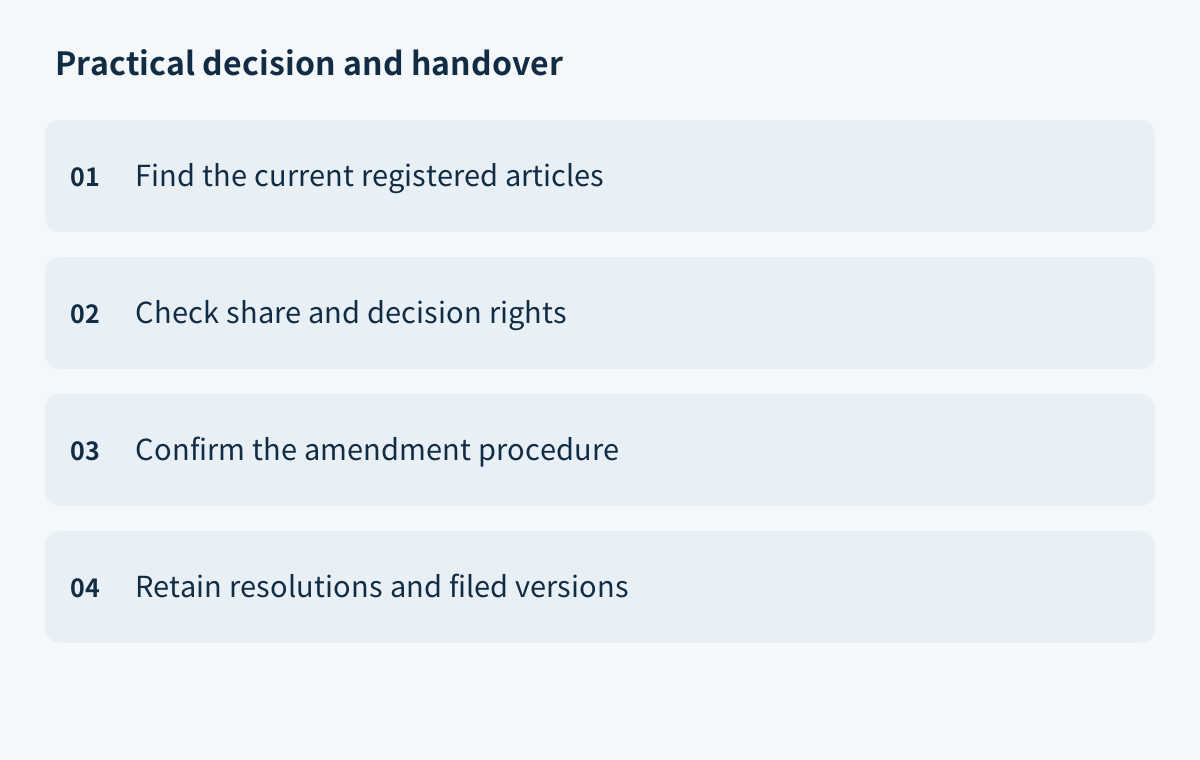
Before handover, check the resolution text, notice, applicable form, certified amended articles and any other required attachments item by item. Keep dated final copies and record who confirmed the contents, who is responsible for filing and what information is still missing. If the correct form, deadline or resolution procedure is uncertain, obtain a case-specific assessment before arranging signatures and submission. Having the documents ready does not mean the filing is complete.
Connect Articles Amendments to Company Records and Professional Coordination
When the amendment work is complete, organise the previous and amended versions, resolutions, filing documents and correspondence on one traceable timeline. First check that the amended text matches the resolution. Then record the filing date, acknowledgement and subsequent status. If no outcome has been received, mark it as pending confirmation; do not leave only a note saying submitted or processed.
Next, check which company records or related agreements may need to be brought up to date. These might include the articles version index, resolution records, shareholder or share information and governance documents used by the team. This does not mean every amendment requires changes to every item listed; assess each one against the actual change. Keep questions about legal interpretation, document completeness and filing status as separate tasks so each collaborator can see what needs confirmation.
A useful handover can include the old and new versions with a comparison, the resolution approving the change, filing documents and attachments, receipt or processing evidence, the status of company record updates, and an owner and follow-up action for each unresolved issue. Keep dates, versions and sources with the files so the decision history does not have to be reconstructed from memory. For broader reading on company-secretarial and compliance topics, see the site’s Company Secretary and Compliance page. It is provided here as further reading; its inclusion does not mean that every related topic discussed in this article is an offering of the brand.
For a case-specific assessment, you may submit a question through the website’s contact channel. This article is not legal or tax advice and does not guarantee any outcome.