Published · Updated

A Hong Kong company may be asked to update its company details, ownership structure, or account activity years after opening a bank account. The request may be part of periodic customer due diligence, follow a change in company information, or concern a particular transaction. Before gathering documents, identify what the bank wants to verify and prepare evidence that answers those questions.
This article focuses on Hong Kong banks and company records for business owners expanding from Taiwan and other Chinese-speaking markets. Banks differ in their notification channels, document requirements, deadlines, and account measures. Follow the request made for your specific case. If notices concern different accounts or banks, track them separately so evidence for different entities, accounts, or periods does not get mixed together.
Periodic KYC Is Different from Opening an Account
When a company first applies for an account, the bank assesses the applicant, its controllers, its business, and the account’s intended use. After the account is opened, the bank may still request updated customer information or ask about account activity. The Hong Kong Monetary Authority (HKMA) revised its “Opening and Maintaining Bank Accounts” information on July 10, 2025. It says banks must conduct due diligence and ongoing monitoring for both new and existing customers. The HKMA’s separate “Updating Account Information” page says the review’s frequency and scope depend on customer risk. That page was last revised on August 26, 2019, so it does not establish a common schedule or document list for all banks. HKMA: Opening and Maintaining Bank Accounts; HKMA: Updating Account Information
Compare the notice with the information previously submitted. Check whether the company name, registered address, directors, shareholders, beneficial owners, business model, or major counterparties have changed. The bank may only ask you to confirm existing details, or it may ask about recent receipts or payments. Do not treat an update as a new account application, or assume that the bank will only review one type of company document.
Create a checklist showing the current information, last update date, supporting evidence, owner, and open questions. Separate confirmed items from matters to clarify with the bank and items you cannot yet provide. A comparison table can show the previous submission, current details, differences, effective dates, and evidence sources. Even if nothing has changed, confirm the bank’s required declaration, signatory, and submission method. Have a colleague check names, dates, and attachment numbers before submission.
Confirm the Bank’s Notification Channel and Deadline
Confirm which company and account the notice concerns, along with its case or reference number, requested information, submission channel, document format, and deadline. Identify whether the bank wants updated company or controller details, proof of business activity, or an explanation of specific account transactions. If the notice does not specify documents or a deadline, ask the bank for a complete list and a confirmed due date. Do not rely on timeframes mentioned by another bank or in an online article.
Verify the notice through a bank contact channel you already trust, such as your usual online banking service or established contact records. Avoid relying only on links in an email or text message, and never provide your login password or one-time verification code. Record when and how you contacted the bank, the case number, and its instructions for submitting documents. For a phone call, use contact details from the bank’s official website or existing bank documents.
Track each question, required document, format, owner, deadline, clarification request, submission status, and receipt confirmation. If a document will take time to obtain, or directors, shareholders, and operations staff must contribute, contact the bank early to ask whether it will accept alternative evidence or adjust the deadline. The HKMA’s guidance says customers who have difficulty meeting information requests can discuss the matter with their bank; it does not set a deadline shared by all banks. Confirm in writing whether the deadline means sending or receipt, and whether originals or an authorized signature are required. Clarify any references to business days, time zones, or platforms instead of converting them to a general rule. Attach the bank’s replies to the tracker so colleagues can distinguish confirmed requirements from internal estimates.
Check the Beneficial Owners and Control Structure
First identify the company’s legal status: is it incorporated in Hong Kong, registered in Hong Kong as a non-Hong Kong company, or organized under another legal structure? The Companies Registry’s significant controllers register FAQ explains that Hong Kong-incorporated companies, except listed companies, must identify significant controllers and keep a register. Registered non-Hong Kong companies are outside that same register requirement. Being registered in Hong Kong does not mean the same rules apply to every company. Companies Registry: FAQ on the Significant Controllers Register
Start with the company’s direct shareholders and trace each corporate shareholder through every level to the ultimate natural persons. Record ownership percentages, voting rights, director appointment or removal arrangements, relevant agreements, and effective dates at each level. For a Hong Kong-incorporated company, significant controller conditions include directly or indirectly holding 25% or more of issued shares or voting rights, having the right to appoint or remove a majority of the board, or exercising significant influence or control. The threshold is “25% or more,” and control may arise through agreements or practical rights. Do not rely only on direct shareholdings in the register of members. Include a holding of exactly 25%, and record each corporate shareholder’s name, place of registration, ownership percentage, and verification date. Check voting rights and other control rights as well. Mark unavailable information as unverified rather than guessing who the ultimate natural person is.
Compare the ownership chart with company records, shareholder agreements, and the information previously given to the bank. Flag unresolved points, especially where there are multiple corporate layers, nominee arrangements, different voting rights, or recent transfers. Do not present an estimate as a confirmed fact. The bank may have its own KYC forms and evidence requirements; a significant controllers register does not replace them. Clarify the company’s status and control relationships before preparing the response.
Use Contracts, Orders, and Statements to Explain Real Business Activity
If the bank asks about business activity, select a set of transactions that shows how the company actually operates. Check the counterparty, goods or services, amount, currency, date, and direction of funds for each transaction. Then connect the relevant contract or order, invoice, delivery or service record, platform settlement information, and company bank statement. This helps explain the transaction trail, but does not mean every bank requires the same documents. Follow the items in the notice.
For example, imagine a Hong Kong SaaS company collecting subscription fees through an external payment platform. The amount settled into the company’s bank account may differ from the total invoiced. A reconciliation table could link the order or contract, invoice, service period, platform settlement batch, fees or refunds, and the date and amount actually credited to the bank account. If the platform combines payments, provide records that trace the batch total back to individual transactions, and explain timing differences, exchange-rate movements, or deductions. This hypothetical example illustrates how to reconcile records; it is not a bank document checklist. If a platform statement only shows batch references, preserve the original export and create an index using transaction, invoice, or settlement numbers. List refunds, fees, and exchange-rate differences separately instead of combining them as unexplained “other” amounts. Use the period specified by the bank, and ask what alternative evidence it accepts if your records are incomplete.
Before submitting, check that company names, counterparties, and amounts reconcile. Explain discrepancies and attach supporting records rather than sending screenshots that the reviewer must piece together. If documents contain unrelated personal information or commercial secrets, ask whether irrelevant fields may be redacted and use the bank’s specified secure channel. Do not remove information the bank needs to verify. A colleague should be able to trace a bank statement entry back to the order, invoice, and delivery or service record.
Follow Up on Additional Requests and Account Restrictions
A request for more documents does not necessarily mean that the account is restricted. First classify the bank’s question: does it concern inconsistent company details, insufficient ownership evidence, an unclear business description, or missing records for a particular receipt? If an account function is restricted, ask the bank which functions are affected, when the restriction began, what remains to be completed, and how it will communicate next steps after receiving the documents. Keep the original notice so colleagues are not relying on a verbal summary.
Respond to each question in turn. Record what the bank asked, which document answers it, where the supporting information appears, and what remains outstanding. If a document is temporarily unavailable, explain why, give an expected date, and ask whether the bank accepts substitute evidence. Do not state assumptions as facts or promise a processing time you cannot control. After submission, record the time, channel, case number, and receipt confirmation, then track any unresolved questions. Assign one contact person to coordinate questions and attachments; colleagues in accounting, sales, and management can provide their source records for that person to organize. If the bank gives instructions by phone, send a written summary through a verified channel and ask it to confirm. Keep previous and updated requirements together so an obsolete checklist is not reused.
If the bank has not explained the restriction or how to address it, ask through a verified channel and retain the response. The company can also review upcoming payments and cash needs, using accounts according to the bank’s confirmed restrictions and available options. Do not use a third party’s account to conceal transactions or bypass the bank’s requirements. Whether a restriction is lifted, and when functions resume, depends on the bank’s handling of the case and cannot be guaranteed in advance.
Keep the Submitted Version and Update Records for Next Time
Before each submission, store the final form, attachment list, document versions, submitter, submission time, and channel in one case folder. Keep the bank’s receipt confirmation and related correspondence there too. Mark each file with its information date, version, editor, and purpose so drafts and final documents are easy to distinguish. If the bank requests a correction, retain both versions and note why the change was made. This creates a record of exactly what was submitted.
For handover, list completed items, questions awaiting the bank’s reply, the next follow-up date, and the owner. If shareholders, directors, the address, business model, or main transaction flows change, update the company’s internal information pack and check whether the bank needs a separate notification. Company registration details, significant controller records, bank KYC information, and transaction evidence are related but serve different purposes; updating one does not update the others. Do not assume every company has the same statutory retention period or next KYC date. Follow applicable requirements, company record policies, and the bank’s instructions.
For background on company information and annual compliance, see the Hong Kong Company Secretary Guide and the Hong Kong Annual Compliance Calendar. These articles provide background information; they do not represent a bank KYC handling or banking service. After completing an update, keep the bank’s requirements, final submitted version, and open follow-up items in a handover-ready record. The next time a notice arrives, you can compare changes first and focus on evidence that is missing.
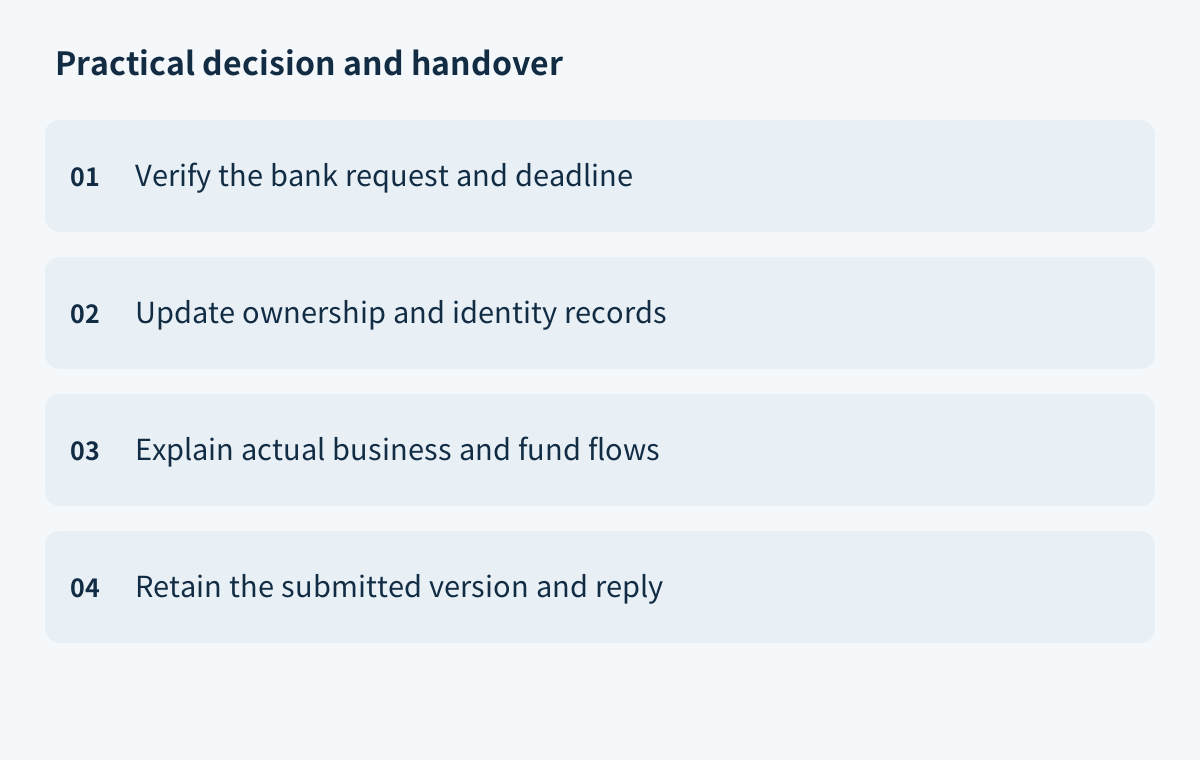
For a KYC update, confirm the notice and deadline, check the control structure and transaction evidence, then preserve the submitted version and the bank’s replies. Requirements, deadlines, and account arrangements vary by bank and case, so use information confirmed by the bank. For case-specific assessment, you may send a question through the website’s contact channel. This article is not legal or tax advice and does not guarantee an outcome.