Published · Updated

For business owners operating from Taiwan and planning to expand through a Hong Kong company, an AGM, financial statements and Form NAR1 may appear on the same annual checklist. They are separate obligations, with different triggers, deadlines and documents. Operating from Taiwan does not change the law that applies to a Hong Kong company. Before scheduling work, confirm the company type, incorporation or re-domiciliation date, accounting reference period and articles of association. Then calculate the AGM and NAR1 deadlines separately and confirm which documents members must receive. The financial year-end alone does not establish whether a meeting is required.
AGMs and annual returns are separate obligations
An AGM deals with matters for members in each financial year. Form NAR1 is an annual return filed with the Companies Registry to report specified company details. A private company generally files NAR1 within 42 days after its incorporation anniversary; a re-domiciled private company calculates from its re-domiciliation anniversary. For a public company or a company limited by guarantee, the annual return date is six or nine months after the accounting reference period ends, respectively, and the form is due within 42 days after that date. Holding an AGM does not file NAR1, and a filing receipt does not prove that the AGM or an alternative procedure was completed.
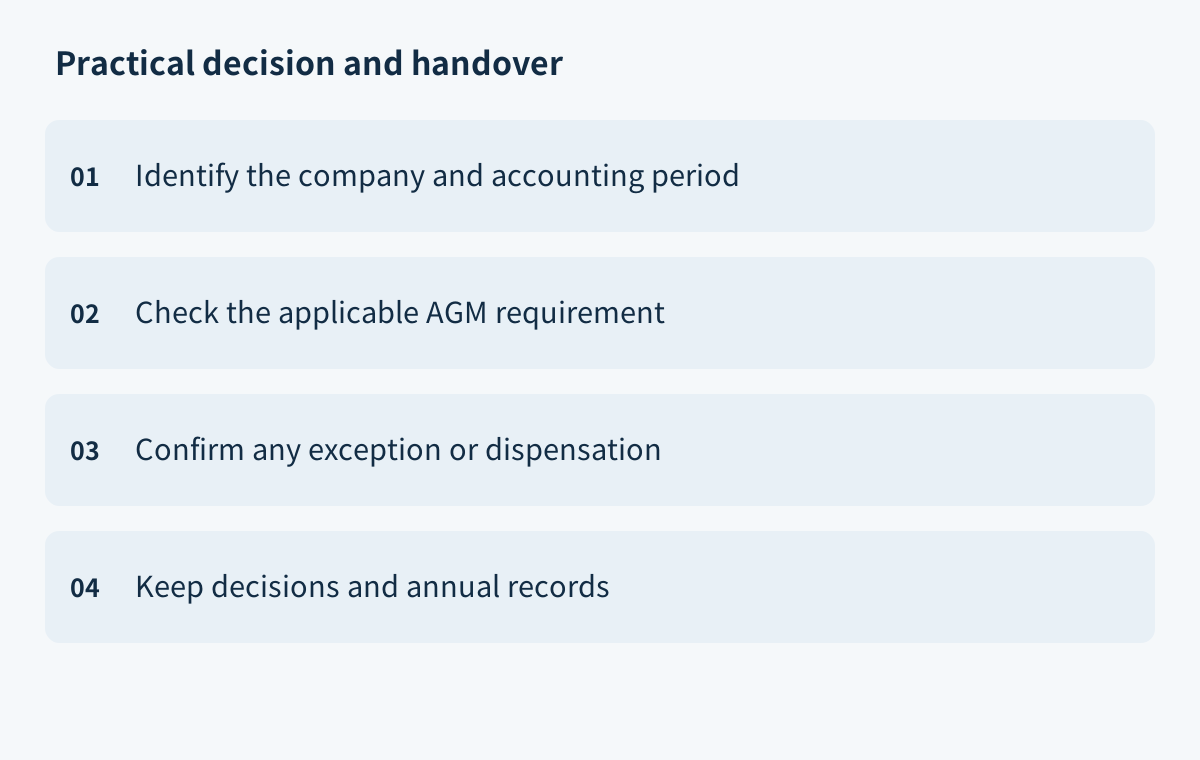
Check the certificate of incorporation, latest company search, articles and latest financial statements. Record the AGM notice, meeting or alternative resolution separately from the NAR1 due date, signatory and filing proof. Note the calculation basis so another director or adviser can reproduce it. Before filing, confirm that NAR1 details—such as the registered address, directors, company secretary and members—match the company’s particulars as at the relevant date. List any unreported changes as separate filings with their own owners, deadlines and receipts.
For example, if a private company’s incorporation anniversary is 12 November, its NAR1 is generally due within 42 days after that date; calculate its AGM deadline separately from its accounting reference period. For the filing rules, see the Registry’s meetings, resolutions and company records FAQ, local company annual return guidance and private company annual return guidance. Public companies and companies limited by guarantee must also submit certified financial statements, the directors’ report and auditor’s report with NAR1 where required.
Set deadlines by company type and accounting period
The usual AGM deadline depends on company type and the accounting reference period. A private company that is not a subsidiary of a public company, and a company limited by guarantee, generally holds its AGM within nine months after the period ends. Other companies generally have six months. These deadlines do not automatically follow the incorporation anniversary or the calendar year-end. If the company changed its accounting reference date, confirm that the change took effect before recalculating.
A different calculation applies when the first accounting reference period is longer than 12 months. For a company subject to the nine-month deadline, compare nine months after the incorporation anniversary with three months after the first period ends, and use the later date. For other companies, compare six months after the anniversary with three months after the period ends, again using the later date. Re-domiciled companies have special starting rules: check the registration date and applicable provisions instead of applying the ordinary new-company calculation.
Distinguish the accounting reference period from a calendar or tax period used in bookkeeping. Check the Registry’s reference-period record and the approved financial statements for the start and end dates. If they conflict, confirm whether a change took effect before adding the deadline to the annual schedule. For example, if the accounting reference period of a private company that is not a subsidiary of a public company ends on 31 December 2026, the usual nine-month deadline puts its AGM on or before 30 September 2027. NAR1 remains a separate calculation based on the relevant anniversary. See the Companies Registry FAQ for deadline guidance.
Check dormancy and other exceptions against their conditions
Having no business activity does not by itself make a company legally dormant. A private company must pass a special resolution declaring dormancy and deliver it to the Companies Registry for registration. Dormancy takes effect on delivery or on a later date specified in the resolution. Whether an accounting transaction has occurred depends on the Companies Ordinance definition, including whether it must be entered in the company’s accounting records. An inactive bank account, paused sales or no income alone does not confirm dormant status. An accounting transaction or a special resolution to resume business, passed and delivered as required, may end dormancy.
A qualifying dormant company is excepted from the AGM requirement under section 611 and may be exempt from filing an annual return during dormancy under section 663. If dormancy begins or ends during the year, check the effective date and whether NAR1 is still due for that year. Keep the special resolution, Registry receipt or registration details, effective date and evidence used to check for accounting transactions. If the transaction definition is unclear, confirm how it applies to the company’s facts. See the Registry’s dormant company FAQ.
Other exceptions have different conditions. A single-member company need not hold an AGM under section 612(2)(a), without a separate exemption resolution. A company using section 612(1) must complete all business that would have been dealt with at the AGM by written resolution and provide each member, on or before the circulation date, with the documents that would have been laid or produced at the meeting. Under section 613, all members may pass a resolution to dispense with the AGM. Keep the records supporting the specific route used. A single-member company is not automatically exempt from NAR1.
How to confirm the decision and procedure when no meeting is held
Before deciding not to hold an AGM, identify the statutory route and check the articles, register of members, voting rights and business for that year. Under section 612(1), agreement simply to skip the meeting is not enough: complete every item of AGM business by written resolution and give every member the relevant meeting documents on or before the circulation date. Compare each planned agenda item with its resolution and attachments, and retain the circulated version, delivery dates and member responses.
For a section 613 exemption, all members must pass the resolution, either in writing or at a general meeting. Deliver a copy to the Companies Registry for registration within 15 days after it is passed. Before voting, confirm who is entitled to participate and whether the articles require an AGM or restrict the exemption. The statutory route does not automatically remove a restriction in the articles; check whether an amendment is needed. Record the resolution date, financial year, membership check and filing proof.
For handover, keep separate records for each route: single-member status and decision; under section 612(1), each AGM item, its written resolution and proof of delivery; or under section 613, the unanimous exemption resolution and Registry receipt. If written resolutions cover only some AGM business, do not record the whole meeting as dispensed with; confirm how the remaining matters must be handled. General written resolutions usually have a 28-day agreement period, unless the articles set another period. Within 15 days after passage, notify every member and the auditor. These general rules do not replace section 613’s exemption conditions. See the Registry FAQ on meetings and resolutions.
Financial statements and member consent still require attention
Dispensing with an AGM does not remove the annual financial reporting work. A company relying on the single-member rule or a section 613 exemption must still send each member the reports for that financial year. Depending on company type and applicable rules, these may include financial statements, a directors’ report and an auditor’s report. Confirm each document’s version and recipients, then retain approval details, delivery dates and proof. For director appointments, auditor arrangements or a final dividend, check the articles and use the appropriate meeting or resolution procedure; an AGM exemption does not automatically approve those matters.
A reporting exemption is different from an audit exemption. The Companies Registry says a company qualifying for a reporting exemption is generally still required to have its financial statements audited. Dormant companies have a statutory exception, subject to confirmation of dormant status and the applicable conditions. Small size, no income or member agreement alone does not establish an audit exemption. Track separately whether reports must be prepared or sent, whether a reporting exemption applies and whether an audit is required. Keep the basis, supporting information and review date for each decision.
Use separate columns for preparation and audit, delivery to members, and documents filed with NAR1. Record the reporting year, requirements, document version, reviewer, recipient and date. These are separate delivery steps. An AGM generally requires at least 21 days’ notice. To shorten it, obtain consent from all members entitled to attend and vote, and check whether the articles require longer notice. Retain the consent and delivery record. Consult the Registry’s meetings and resolutions FAQ and accounting and auditing FAQ, then file final reports, audit documents, resolutions and proof of delivery together.
Build an annual review and company records checklist
At the start of each financial year, update a company information sheet with the company type, incorporation or re-domiciliation date, accounting reference period, current articles, member register, prior-year AGM route, reporting arrangements and NAR1 deadline. Compare it with the company search, director and member records, and latest annual return. If directors, members, address or reference date changed, update the information before recalculating. Recheck dormancy or unanimous member consent each year; last year’s exception does not establish this year’s eligibility.
Schedule the work: confirm the AGM deadline and notice date; prepare business and reports; obtain required member consent; complete the meeting or written resolutions; and file resolution copies where required. Track NAR1 separately. Keep the deadline calculation, notices, consents, minutes, resolutions, reports, NAR1 copy and filing receipts in a dated annual folder. Meeting and resolution records must be retained for at least 10 years. Label the calculation start point, statutory route, owner, outstanding items and evidence location so a successor can reproduce the decision and see what remains open.
Before filing NAR1, check the applicable form and notes on the Companies Registry specified forms page. Save the filed copy and receipt, and set the next review date. For related background on company secretary and compliance, see this related page; the link does not establish that the statutory procedures described here are brand offerings.
AGMs, annual returns, financial reporting and audits each need their own deadline, owner and completion evidence. Confirm the company type, accounting reference period and articles before choosing a meeting or statutory alternative. If relying on dormancy or another exception, retain the records supporting that decision. This gives the next annual review a clear, reproducible starting point.
For case-specific questions, use the website’s contact details. This article is not legal or tax advice and does not guarantee an outcome.