Published · Updated

A positive bank balance is not enough to justify a dividend. Confirm that the financial records support a distribution, check the company’s articles and share-class rights, and follow the applicable decision process before payment. Retain the records, and assess the recipient’s personal tax position separately according to their circumstances and tax residence.
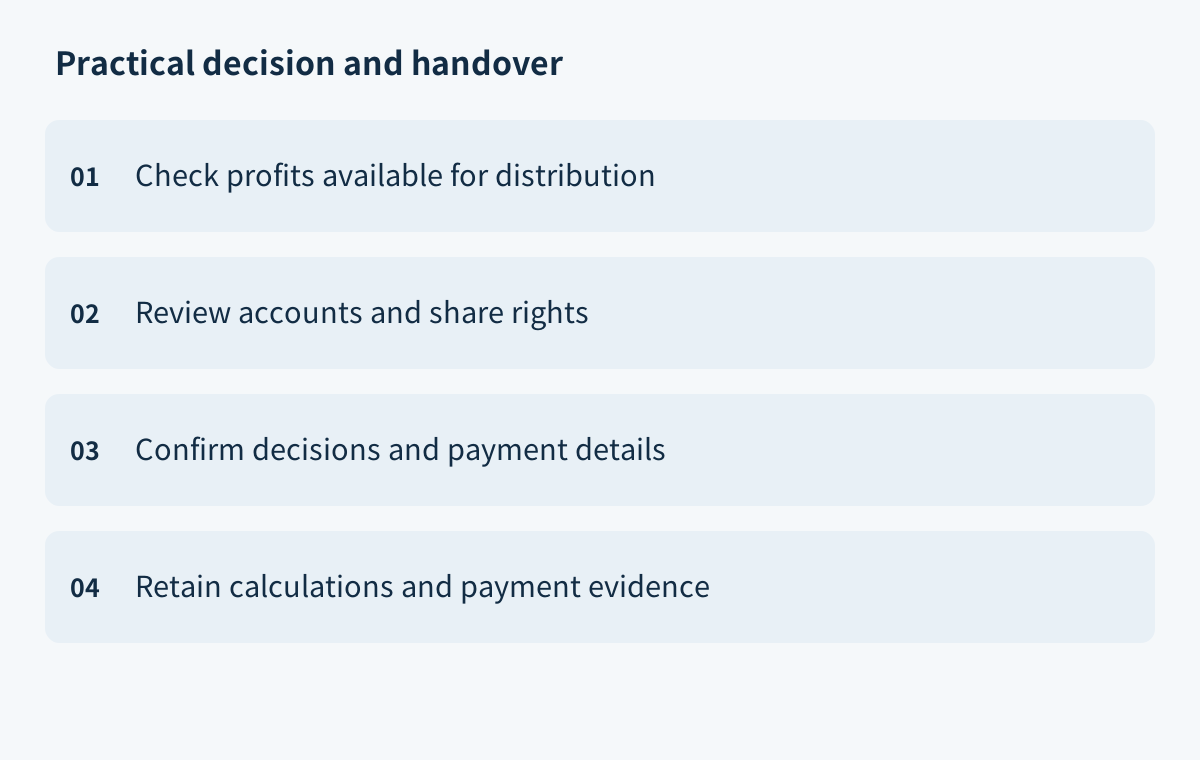
Cash in the Bank Does Not Mean a Dividend Can Be Paid
A bank balance shows current cash, not the amount distributable to members. Cash may come from a shareholder loan, share capital, customer prepayments or borrowing; reported profits may also exist without enough cash for near-term bills.
Section 297 of Hong Kong’s Companies Ordinance bases distributions on accumulated realised profits, less amounts previously used for distributions or capitalisation and accumulated realised losses not eliminated by a reduction or reorganisation of capital. The articles may impose further limits, and listed companies also face section 298’s net-assets restriction. Review the relevant statements, accumulated losses, prior distributions or capitalisations, and reserve types. A bank statement or one profitable month is not enough. Companies Ordinance (Cap. 622)
Separately list expected payroll, tax, rent, supplier payments, loan repayments, refunds and committed investment. Can the company continue operating and meet obligations after payment? Profit eligibility and cash flow answer different questions; if either is unclear, pause for better records.
For illustration, HKD 500,000 in verified accumulated realised profits, less HKD 120,000 in accumulated realised losses and HKD 80,000 in previous distributions or capitalisations, leaves HKD 300,000 by simplified arithmetic. This is neither a completed statutory calculation nor approval to pay that amount. Keep cash, operating reserves and the profit calculation separate.
Check Distributable Profits and Financial Records First
Set a cut-off date and collect the latest annual statements, subsequent management accounts or interim figures, general ledger, key schedules, bank records, receivables and payables, accumulated losses, reserve explanations, and prior distribution or capitalisation records. List material later events, such as a major transaction, asset disposal, impairment or litigation. Mark figures as closed, estimated or awaiting confirmation.
Sections 302–306 require the amount to be assessed against specified financial statements. Section 304 generally refers to the previous financial year’s statements; section 305 provides for interim statements if that basis would make the distribution breach a restriction; section 306 concerns initial statements when a distribution is proposed before statements have been laid before or sent to members. Applicable statement and preparation requirements depend on the company. Reconcile changes since the reporting date instead of copying an old retained-earnings figure. Companies Ordinance, Part 6
Use a schedule showing each item, amount, source, date, verification status, effect and follow-up owner. For an unpaid receivable, separate the accounting entry from cash collected and have an appropriate accountant assess its treatment. If you have only a bank balance, accounts are old, losses are unadjusted or prior payments unexplained, do not enter a precise-looking distributable amount. Show conflicting figures and sources; hand over the cut-off date, adjustments and unresolved items so another person can repeat the calculation.
How to Review the Articles, Decision-Making Authority and Shareholder Rights
Obtain the current articles and amendments. Compare them with the register of members, share classes, issue terms and change records. Check who may recommend or declare interim and final dividends, whether reserves may be set aside or profits carried forward, and which shareholding date and rights govern allocation. A formation template may omit amendments or class-specific terms.
Different classes can have different dividend rights or priorities. Check transfers not reflected in the register, joint holdings and waived dividends. Record each class, share count, rights source, proposed recipients, register date and open questions. Resolve inconsistencies among the register, issue documents and articles before relying on an oral instruction; update the recipient list if shareholdings change near the relevant date.
Article 73 of the Companies Registry’s Sample B model articles illustrates one route: members declare dividends at a general meeting up to the directors’ recommendation, while directors may pay interim dividends justified by profits. It also addresses reserves and the shareholding date. This private-company model does not prove that every company adopted those terms. Compare it with the company’s own articles. Companies Registry Sample B model articles
For handover, note the articles’ version and amendment date, relevant provisions, class rights, register cut-off, decision-makers and unresolved points. Use the same basis for the resolution and payment list; explain any difference from past allocations.
Directors’ and Members’ Resolutions Depend on the Circumstances
Identify whether the proposal is an interim or final dividend, then check the articles for authority and procedure. Do not assume every payment requires both board and member resolutions or reuse an old process without checking current articles and share classes. Confirm who may recommend or declare it, whether a meeting or written resolution is available, and the notice, voting, quorum and signature rules.
The Companies Registry FAQ says that if a company is not required to hold, or has dispensed with, an annual general meeting, its articles should be checked for matters such as a final dividend. A meeting may be called or a written resolution used where appropriate. Sample B illustrates possible arrangements; neither source establishes one route for every company. Companies Registry FAQ: meetings, resolutions and company records
Prepare a one-page summary of the period, amount and currency, financial cut-off, calculation by share class, recipients, payment plan and operating cash retained. Attach the articles provision and reconciliation for authorised decision-makers. Keep the actual approval date, participants, decision, attachments and written-process agreements or notices. Never backdate minutes or pay before authority is clear; state the amount, recipients, allocation basis and intended payment date.
If objections, differing class rights, director conflicts or unclear wording arise, pause for legal or corporate-governance review. Record the route, authority, approver and effective date for the person making payment.
Cross-Border Payment and Personal Tax Need Separate Assessment
A cross-border transfer does not determine where the shareholder reports income or prove tax exemption. Check recipient type, shareholder status and class, tax residence, account holder, currency, route and destination. If account and register names differ, obtain entitlement or authority evidence and check what the bank accepts. Do not relabel a dividend for convenience.
Match the recipient, class or holding, amount, currency, date, fees and status to the approved allocation. Reconcile the instruction, bank receipt and accounting entry. Confirm document requirements with the handling bank; if requested, prepare the resolution, calculation, shareholder details and account evidence.
The Inland Revenue Department’s treaty-rate table concerns maximum rates treaty partners may charge on relevant income paid to Hong Kong residents. It is not a personal tax table for a Taiwan, Mainland China or Malaysia resident receiving a Hong Kong company dividend. Treaty treatment depends on residence, recipient status, payment character and treaty conditions. Check the recipient’s tax treatment in their tax-residence jurisdiction rather than infer an individual result from the Hong Kong table. IRD tax-rate table and notes to the table
Identify who may be taxable, where tax may arise, filing duties and required evidence; consult a tax professional in that jurisdiction. Document the recipient structure and relevant facts, especially for an entity shareholder or multi-tier structure.
Keep the Resolutions, Calculations and Proof of Receipt
For each dividend, retain statements and calculations, the articles version, rights schedule, resolutions or minutes, allocation, payment instruction, bank receipt and accounting entry. Date, version and link each record to the distribution; retain reasons and approval for changed figures. Use one reference across the set to identify the final amount.
After payment, reconcile each recipient and amount against actual receipt. Track partial payments, returned transfers, name mismatches and exchange-rate or fee differences as open items with an owner and next step. Keep “declared,” “paid” and “receipt confirmed” separate so another person can trace entitlement from the resolution to the financial basis and bank record.
The Companies Registry says records of members’ resolutions and meetings, and written decisions in a single-member company, must be kept for at least 10 years. Former-member records have a separate period running from when a person ceases to be a member. Do not apply that minimum to every calculation, payment or tax document; follow requirements applicable to those records. Companies Registry FAQ: company-record retention periods
For related reading on company-secretarial and compliance topics, see the company secretary and compliance information page. If you need a case-specific view, you may submit a question through the contact details on the Chan & Chung website. This article is not legal or tax advice and does not promise an outcome.