Published · Updated

“Hong Kong company dormancy” is often used informally to describe a business that has stopped operating. But having no revenue, customers or shipments does not, by itself, make a company dormant under the Companies Ordinance. Statutory dormancy requires a specific procedure and has a defined effective date. Tax, business-registration and bank records must also be checked separately. If a company has merely paused orders, first confirm its Companies Registry status and review its accounting activity.
For shareholders in Taiwan or elsewhere, their place of residence and the company’s place of incorporation are different questions. This guide covers the statutory procedure for Hong Kong companies. Start by listing what must be checked with the Companies Registry, the Inland Revenue Department (IRD), the Business Registration Office and the bank. Do not use a single “dormant” label to describe all of these records. If the company also has tax, banking or registration arrangements in other markets, check those under the relevant local rules.
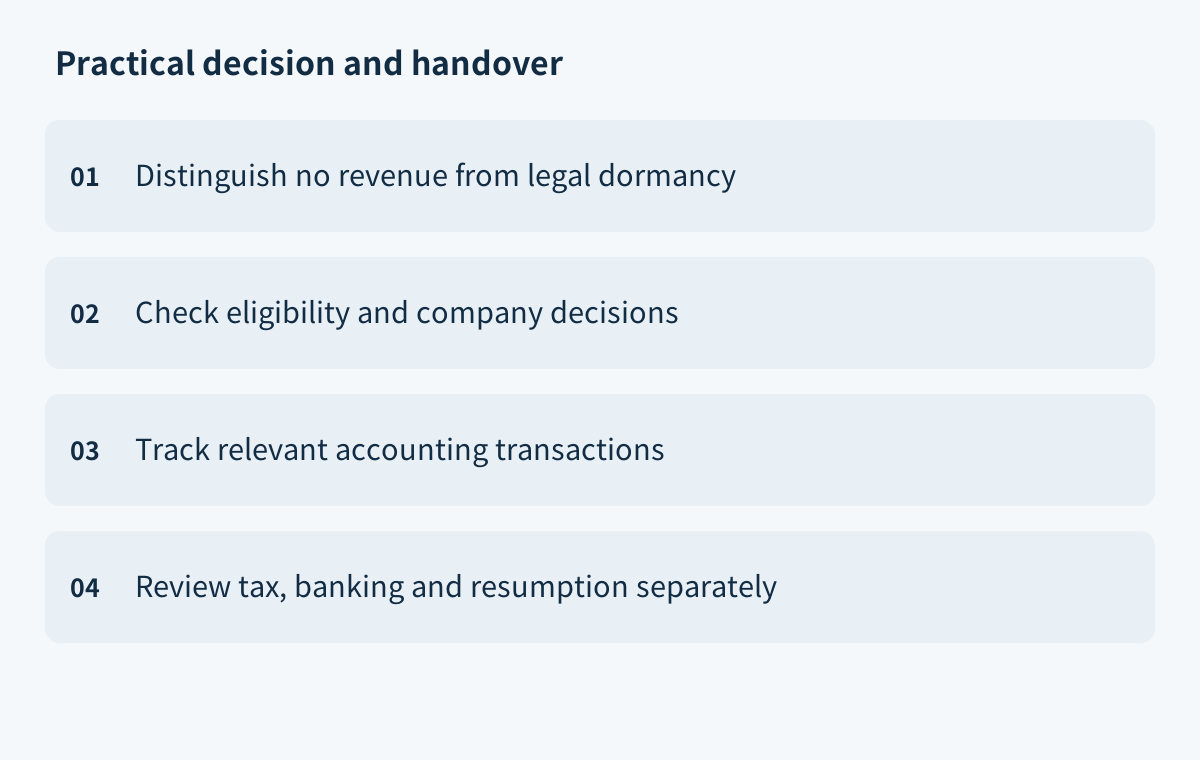
Distinguish statutory dormancy from zero revenue
Keep two records separate: the company’s operating activity and its legal status. For operating activity, note whether it made sales, provided services, had employees, or received or made payments. For legal status, record whether it passed a special resolution declaring itself dormant, when that resolution was delivered to the Companies Registry, and whether it specifies a later effective date. The Registry says dormancy takes effect on the date the resolution is delivered or on a later date stated in it. A bank balance or income statement alone cannot establish that a company is legally dormant.
To check the status, compare the latest company search with the signed resolution or meeting minutes, the version delivered, and proof of delivery or registration. Check the company name, resolution date, delivery date and effective date. If you cannot find evidence of delivery, do not mark the company as statutorily dormant without confirmation. If the resolution names a future date, do not treat the date it was passed as the effective date. Your handover record should separately list the last operating date, last possible accounting transaction, date the resolution was delivered, and statutory effective date. Keep the supporting evidence with each date; flag discrepancies and unresolved items for the next person to verify. See the Companies Registry’s Dormant Companies FAQ.
Check the company type and exclusions
The dormancy procedure is not available to every business entity. Section 5 of the Companies Ordinance applies to a qualified private company. The Companies Registry’s specimen resolutions state that it does not apply to a company that is not a private company or to a private company specified in section 5(7). First confirm the company’s type and status in its Registry records, then check the relevant section and the company’s articles. Its name, shareholders’ locations, lack of revenue or informal description as a “small company” do not establish eligibility.
Save the company particulars, company number and relevant constitutional documents, then compare the company’s category with the statutory conditions. If an exclusion may apply, the structure is complex, or you cannot determine whether the company qualifies, record the issue as unresolved rather than relying on a specimen or submitting a resolution. A prior restructuring, shareholding change or unusual provision in the articles may also need review. For handover, write down the company type you have confirmed, the documents used, any conditions still to check, and who will follow up. The Registry’s dormancy resolution specimens explain the restrictions. For the governing text, refer to the Companies Ordinance (Cap. 622); seek independent Hong Kong legal or company-compliance advice if eligibility remains unclear.
Follow official procedures for special resolutions and delivery
Once eligibility is confirmed, arrange the special resolution. The Companies Registry provides two specimen formats: A1 is a written resolution signed by all members; A2 is a resolution passed at a duly convened general meeting. They are reference specimens, not forms that can simply be dated and treated as a completed filing. Choose the format that matches how the company actually passes the resolution. Check the company name, resolution wording and date, and remove options that do not apply. Follow the company’s articles and applicable procedure.
If the resolution specifies a later date for dormancy to begin, that date must be later than the date the resolution is delivered to the Registry. Keep the final signed resolution and, if the company uses a meeting, the relevant meeting record. Also retain the delivery record and evidence of receipt or registration. For a written resolution, check that all members’ signatures appear on the same final version. For a meeting resolution, retain the meeting and approval records alongside the text that was passed. In your handover, identify which version was delivered, who handled delivery, when it was delivered, and the stated effective date. This lets the next person compare a transaction date with the legal timeline. See the Companies Registry’s A1 and A2 resolution specimens.
Which accounting transactions affect dormancy status?
Under section 2 of the Companies Ordinance, an “accounting transaction” is a transaction that must be entered in the company’s accounting records under section 373. The definition excludes a transaction arising from payment of a fee that the company is required to pay under an Ordinance. The test is whether the transaction must be recorded under the law, not how management describes it or whether it generated sales income. The Companies Registry advises seeking independent professional advice on whether a particular transaction meets the definition.
For example, after a company stops taking orders, its bank account might still show a monthly charge, interest, repayment of an old balance or another receipt or payment. Do not assume these entries always end dormancy; nor should you conclude that a small amount, an automatic bank debit or the absence of customer payments has no effect. This is a hypothetical scenario to illustrate the assessment, not a conclusion about any particular type of bank transaction. Keep the statement, agreement, receipt and transaction date, along with the counterparty, purpose and accounting entry. In a handover table, note the amount, supporting document, whether it has been entered in the books, and the assessment status. Mark unresolved transactions as pending rather than recording a guess as a confirmed legal position. The Registry’s Dormant Companies FAQ sets out the definition and recommends independent advice.
Check tax, banking and business registration obligations separately
Statutory dormancy under the Companies Ordinance does not automatically settle the company’s profits tax, business registration, bank account or other filing position. Review records from the Companies Registry, IRD, Business Registration Office and bank separately. List returns, certificates, due dates, annual returns and bank notices, with a named owner for each item and any documents still to locate.
A dormant company is generally exempt from delivering annual returns while dormant, but timing matters. If the effective date on which a private company becomes dormant falls after the 42nd day following its incorporation anniversary, it must still deliver that year’s annual return. If the effective date on which it ceases to be dormant falls on or before the 42nd day after the anniversary, it must also deliver that year’s return. If an accounting transaction ends dormancy, the annual-return exemption stops on and after the transaction date. Dormancy also does not remove the requirement to report changes to the registered office address, directors or company secretary. Check the relevant dates and filing position against the Companies Registry guidance.
For Profits Tax Returns issued on or after 1 April 2026, the IRD’s FAQ says a company that has delivered a dormancy resolution under section 5 may be exempt from preparing audited financial statements under section 447. The IRD is prepared to accept a return from a dormant company within the Companies Ordinance’s terms without those statements. This is an arrangement about audited financial statements; it does not, by itself, mean the company is exempt from filing a return, tax or other reporting duties. Follow any return, assessment or request for further information that the IRD sends. See the IRD’s Profits Tax Return FAQ.
Check the business registration certificate, renewal demand note and business address separately. The IRD says the renewal demand note is normally sent around the middle of the month before the renewal certificate’s commencement month. If it does not arrive, the Commissioner should be notified in writing within one month after the current certificate expires. Confirm the company’s position directly with the Business Registration Office; do not assume that a dormancy resolution changes its registration status. Check bank account and KYC requirements with the bank. For general background on accounts and tax filing, see Hong Kong Company Accounting & Tax Filing: A Complete Guide.
Prepare records and notices before resuming operations
Before resuming activity, record the planned first transaction: its nature, amount, date, counterparty and payment or receipt method. Identify the contract and supporting documents to retain. Compare the plan with the dormancy resolution and effective date recorded at the Companies Registry. If the company intends to end dormancy by passing a resolution before the transaction, it may use specimen B1 for a written resolution signed by all members or B2 for a resolution passed at a general meeting. The resolution states that the company intends to enter into an accounting transaction; according to the Registry’s specimen, dormancy ends when the resolution is delivered for registration. B1 and B2 are references, and the company must follow its own procedures.
A company may also cease to be dormant when an accounting transaction in relation to it occurs. Do not proceed with a transaction on the assumption that the resolution can be filed afterwards. Put the planned transaction date and expected delivery date on the same timeline. Before authorising the transaction, confirm whether it may be an accounting transaction and what procedure applies; obtain independent advice if needed. Use the Registry’s B1 and B2 cessation specimens and Dormant Companies FAQ.
Prepare a handover pack containing the dormancy resolution and delivery evidence, the date of the latest status check, recent accounting records and bank statements, outstanding annual returns or tax correspondence, business-registration expiry information, and bank notices. Name who will keep the vouchers and track deadlines after activity resumes. Notify the incoming directors, accounting staff and relevant external professionals, and list any unresolved legal, tax or banking questions. This gives the next person traceable records to work from instead of treating past dormancy as proof that every statutory or commercial obligation has ended.
For case-specific consideration, you may submit a question through the contact details on the website. This article is not legal or tax advice and does not promise a result.