Published · Updated

Filing tax for a Hong Kong company involves separate work. The Profits Tax Return concerns business profits; the employer's return reports remuneration for employees, directors and other people in scope. Both go to the Inland Revenue Department (IRD), but use different forms, records and deadlines. Cross-border businesses should identify the legal employer and payer for each person and organize remuneration by person and period to track annual and event-driven notices.
This guide explains employer reporting steps; it does not determine a person's status or benefit treatment. Confirm forms and deadlines from the notice and relevant-year IRD instructions. Work location and payment currency affect reconciliation, but alone do not settle the reporting requirement.
Keep Company Tax and Employer Reporting Separate
Start by identifying which obligation a notice relates to. A corporation's Profits Tax Return is BIR51; the annual employer's return is BIR56A with an IR56B for each person in scope. Filing one does not complete the other. For broader company-tax context, see Hong Kong Company Accounting & Tax Filing: Complete Guide; this article focuses on employer reporting.
Check the legal name and employer file details, the year and issue date on BIR56A, then identify people who may need an IR56B. Current instructions consider the applicable income threshold, marital status and part-time employment; director status also matters. Do not rely on a payroll label such as full-time alone. If nobody is reportable, tick NO, sign and return BIR56A by its deadline, even if the company has no staff.
Keep separate trackers for profits tax and employer reporting. The employer reporting year is 1 April to 31 March, regardless of accounting year. Record the responsible person, documents, notice and deadline for each task. See the IRD's employer guidance and BIR51 specimen page.
Start with Employee, Director and Remuneration Records
Build the people list by legal employer, not by combining staff from different group companies. Record each person's name, Hong Kong identity card or passport details, address, marital status, full-time or part-time status, position, and employment start and end dates. Include directors. IRD's employee guidance also covers people working inside or outside Hong Kong, those assigned to a Hong Kong company by an overseas parent or subsidiary, and certain individuals providing personal services through their own service companies under employment-like conditions. A job title or contract label alone does not settle the question; see the IRD definition of employee.
Reconcile contracts and amendments against payroll, commissions, bonuses, allowances, termination payments, accommodation or rent arrangements, share awards, holiday benefits, and MPF or retirement-scheme contributions. For each item, record the period, gross amount, payer, source document and provisional reporting category. IR56B reports gross income before employee retirement-scheme deductions, so do not enter only net pay. For foreign-currency pay, keep the original amount, payment date and exchange-rate source to check the HKD figure. The IRD employer record requirements provide a checklist.
Collect regularly: HR updates personal details and terms, payroll records changes, and finance reconciles payments by period. Assign an owner to every missing item before final classification.
Distinguish Annual Returns from Joiner and Leaver Notifications
The annual return covers remuneration for the year. After receiving BIR56A, submit an IR56B for each person in scope. Event notices have separate triggers: IR56E is due within three months of hiring someone likely to be chargeable to Salaries Tax; IR56F is due one month before employment ends; IR56G is due at least one month before an employee is expected to leave Hong Kong permanently or for a substantial period. Paper IR56G requires two copies. Do not defer event notices until the next annual return. If IR56F or IR56G has already been filed for the same person and year, do not file a duplicate IR56B for the same income. See IRD employer obligations and deadlines.
IR56G triggers a payment-control requirement. From its filing date until the employee completes tax clearance and produces an IRD letter of release, the employer must withhold amounts due, including salary, commission, bonuses, rent or expense reimbursements, and money or money's worth. Do not assume an exception for an advance or other payment without checking the instructions.
IRD's example: an employee likely to be chargeable to Salaries Tax, hired on 3 April 2025, has an IR56E due by 3 July. If still employed on 31 March 2026, check annual IR56B when the 2025/26 BIR56A arrives. Record the event, form, due date, filing evidence and employee-copy delivery; provide the employee with a copy of each completed form.
Check the Actual Filing Deadline Against the Notice and IRD Guidance
When BIR56A arrives, record its issue date and the deadline stated on the notice. The annual BIR56A and applicable IR56B are generally due within one month of issue. IRD issued the 2025/26 return on 1 April 2026; that is the date for that year, not a standing date for future returns or a deadline for the company's Profits Tax Return.
If the company has reportable people but has not received BIR56A by mid-April, follow IRD's instructions to request it rather than waiting for the books to close. An extension request must be in writing and include the employer file number, company name, year of assessment, extra time requested and detailed reasons. IRD considers the request; approval is not automatic. Keep the notice, internal due date, assigned signer and extension correspondence together. Recheck the current form notes each year instead of carrying forward an old staff list or assumption.
Before filing, confirm the employer identity, year and form counts in IRD's employer e-services. Online and mixed filing have different signing steps. In mixed mode, uploading a data file is not enough: the authorized signer must submit the signed Control List and, for an annual return, the required signed BIR56A. Reconcile expected and submitted form counts, then keep the transaction reference, acknowledgement or posting evidence and any status readback. A prepared file or upload alone does not prove completion. See the IRD employer e-services guide.
Assess Overseas Work, Benefits and Contractors Case by Case
An employee's overseas work location does not by itself remove the Hong Kong employer's reporting obligation. Subject to the applicable scope conditions, IRD says employers may need to report employees whether duties are performed inside or outside Hong Kong, and must report full remuneration even if the employee may personally claim a full or partial Salaries Tax exemption. If a non-Hong Kong group company pays part of the remuneration, reconcile the combined amount and identify that payer in the relevant IR56B items. Report pay in HKD, using IRD's published average rates or a reasonable, consistently applied external average rate for other currencies. See the IRD overseas income guidance.
For housing benefits, record the accommodation type, address, period, providing employer or associated company, rent paid by the employee and any reimbursement. Apply IRD's specific instructions; a label such as company-paid housing does not determine the entry. See the housing benefits guide.
For consultants and contractors, an outsourcing label or invoice alone does not settle the reporting route. Record the work arrangement, control, period, payer and any service-company arrangement. Depending on the facts, IRD's employee rules or IR56M and IR6036B rules for some local non-employee payments may apply. Check current instructions and thresholds; this is not a contractor-classification test.
Build a Payroll Handover Trail and Keep Submission Evidence
IRD requires payroll records to be kept for at least seven years. An internal handover sheet can record who supplied the data, classified and signed it, when it was filed, and who received a copy. It is an internal control, not an extra IRD form. Restrict access to personal information and identify the final version.
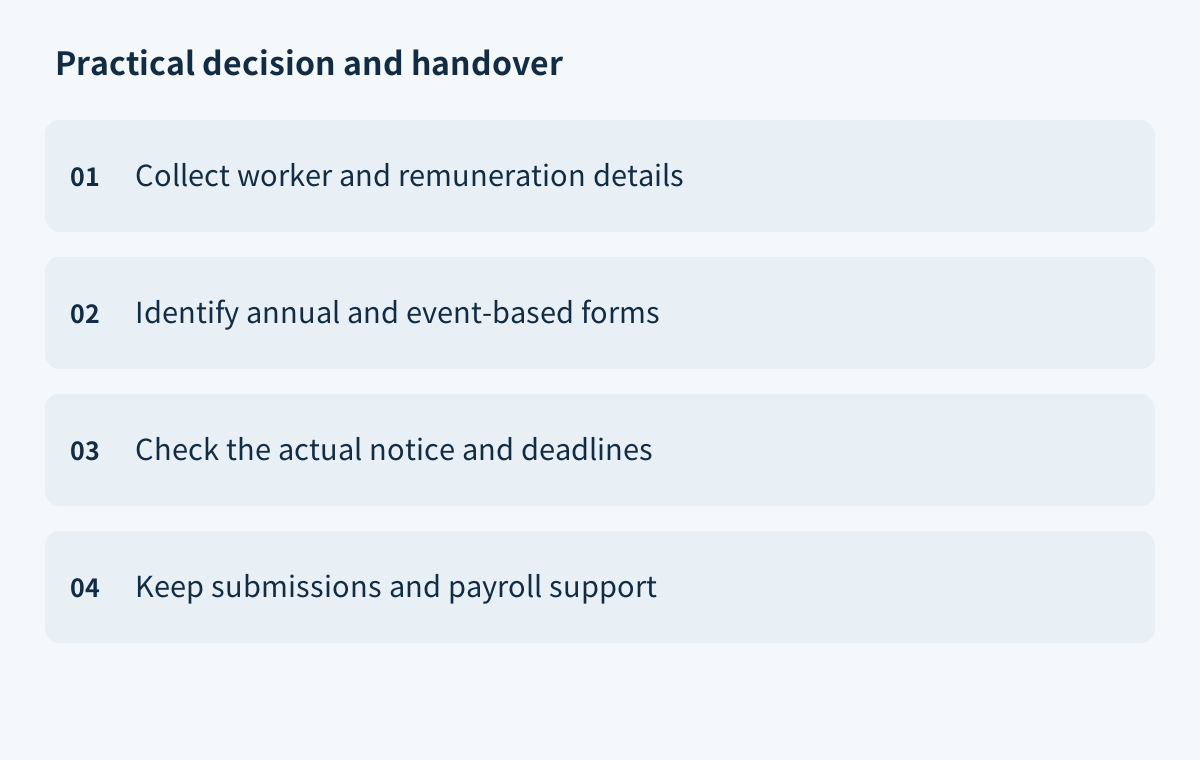
A practical sequence is: data supplied → identity and period checked → remuneration categorized → missing items chased → authorized signer confirms → return submitted → receipt retained → employee copy delivered. For each step, record the owner, date, source evidence, result and open issues. Store BIR56A, IR56B and event notices with the transaction reference, acknowledgement or posting proof, and evidence that employee copies were provided. For mixed filing, retain the upload count and signed Control List.
Before handover, reconcile people and forms, periods crossing year-end, termination or departure notices, and evidence for overseas pay and non-cash benefits. Assign an owner and follow-up date to every open item. If an amount or identity detail conflicts with its source, pause and trace it instead of estimating so the next person can see the status, evidence and remaining work.
Separate the two filing duties, organize people and pay, choose forms by event, check deadlines against IRD notices and keep filing proof. For a case-specific assessment, send a question through the website contact channel. This article is not legal or tax advice and promises no outcome.