Published · Updated

In Hong Kong, a company’s year-end usually means the closing date of the period covered by its financial statements. It is not the incorporation anniversary, and it does not by itself determine annual-return, profits-tax or audit deadlines. When planning a Hong Kong entity for cross-border operations, put the group close, document collection and adviser delivery dates on one calendar. Record why each date applies and who is responsible.
This guide is for business owners and decision-makers in China, Taiwan, Malaysia and other overseas Chinese-speaking markets. Before choosing a date, confirm the company type, incorporation date, directors’ records and previous financial statements. Rules and procedures can vary with company type and status. The examples illustrate how to check the records; they do not replace company documents or case-specific advice.
A Financial Year-End Is Not the Incorporation Anniversary
In everyday use, year-end is a broad term. Under Hong Kong’s Companies Ordinance, distinguish the primary accounting reference date, later accounting reference dates and the accounting reference period between them. The first period sets the first financial year. Later periods are generally 12 months, but may be shortened or extended following a valid change. See the Companies Registry’s Accounts and Audit FAQs.
Annual-return dates follow a separate rule. In later years, a local private company generally delivers its annual return within 42 days after its incorporation anniversary. Public companies and companies limited by guarantee use return dates tied to the financial year and accounting reference period. Check the company type in its registry records, then list the incorporation anniversary and accounting reference date separately. The Registry’s Annual Return FAQ explains the different rules.
For example, assume a private company formed under the Ordinance was incorporated on 15 April 2026 and its directors did not specify a date. Its default primary accounting reference date is 30 April 2027, the last day of the month in which its first incorporation anniversary falls. The anniversary itself remains 15 April. This illustrates the default only; follow the actual resolution and registry record if they show another date.
Check the First Accounting Reference Period First
First establish whether the company is newly formed, long established, or resuming activity after being dormant. Retrieve its registry details, incorporation record, board resolutions, first financial statements and historic accounts. If it belongs to a group, also obtain the parent’s reporting period and delivery deadlines. Check that each date refers to the same period: the date selected by directors, the actual closing date and the date statements were signed are not interchangeable. An existing company should not infer its first reference period from its current year-end; earlier accounts and company history may determine it.
For a company formed under the Ordinance, its first accounting reference period starts on the incorporation date and ends on the primary accounting reference date. The directors may specify a date within 18 months after incorporation. If they specify none, the default is the last day of the month in which the first anniversary falls. Later periods are normally 12 months unless the reference date is changed under the rules. Initial selection and a later change are separate steps.
Create a date-basis table showing the company type, incorporation date, primary reference date, first-period start and end, recurring date, supporting resolution or accounts, and open questions. If the original resolution is missing or records conflict, log the discrepancy and ask the person responsible for company records or an appropriate professional to confirm it. Save the result, evidence location and checker in the compliance calendar for handover.
Compare Group Seasonality and Document Preparation Workload
Choose a month by checking the operating cycle and when records will actually be ready, not by picking a neat month-end. After a peak campaign, a cross-border e-commerce business may need time for returns, platform settlements and stock counts. A trading company may be waiting on customer reconciliations, goods in transit and supplier documents. A SaaS or technology business may need to assemble subscription revenue, refunds, cloud costs, foreign-currency receipts and related-party transaction details. These are workload examples, not industry rules. For overseas teams, allow time for different time zones, holidays, file conversion and access approvals.
If a parent or affiliate closes on another date, ask group finance which period the consolidation covers, when subsidiary figures are due, and whether adjustments or supplementary statements will be needed. Consolidation duties and exceptions depend on the company’s status; choosing a convenient month does not resolve them. The Registry’s financial-statement guidance gives general information. Confirm the group’s actual process with its reporting accountant.
Compare candidate months against operating peaks and inventory counts, bank and platform reconciliations, group deadlines, and staff and adviser capacity. Record when each data set will first be available, outside dependencies, an owner and a fallback. Mark dates where stock counts, staff leave and consolidation collide as high workload. Then assess earlier collection, staged reconciliations or another date. Keep the chosen date, trade-offs and decision-maker in writing.
What Procedural Limits Apply When Changing an Accounting Reference Date?
Before changing a date, identify whether the resolution concerns the current or immediately preceding accounting reference period. Confirm the company type, whether an earlier period was extended, and whether the statutory deadlines for sending reporting documents to members or laying them before a general meeting have passed. A change can apply to the current and later periods, or the previous and later periods. The directors’ resolution, and any required notice, must state whether the affected period will be shortened or extended. A previous period cannot be changed after either relevant reporting-document deadline has expired.
An extension cannot make the period longer than 18 months. A further extension is generally barred if the directors extended an earlier period and that period ended within five years before the new date is specified. This restriction does not apply if the new date matches the holding company’s accounting reference date or members approve it by resolution. Public companies and companies limited by guarantee must deliver notice in the specified form to the Registrar within 15 days after the directors’ resolution. Do not automatically apply those filing steps to a private company; confirm its own requirements.
Before deciding, map the current and previous periods’ start and end dates, proposed date, whether the period shortens or extends, the five-year look-back and any approval. Check current section 371 of the Companies Ordinance and the Registry’s specified forms. File the calculation, resolutions, form and receipt together, and confirm the applicable law and form before submission.
Do Not Assume Tax Extensions or Audit Timelines
Check the issue date of the profits-tax return, year of assessment, accounting-date code, filing method, and whether a tax representative is appointed and authorized. A year-end alone does not establish a filing deadline. Record the due date on the notice separately from any extension confirmed by the representative, and keep the written confirmation or system acknowledgement. If the accounting date changes, ask whether the Inland Revenue Department’s code or record needs updating.
As a dated example, the IRD’s circular of 19 March 2026 for represented 2025/26 Profits Tax Returns gave no extension for N-code accounts, 17 August 2026 for paper D-code returns, and 16 November 2026 for paper M-code returns. Eligible e-filed returns could receive a further month on application. An M-code case with an allowable loss for that year could request an additional extension to 1 February 2027, normally by 2 November 2026; exceptional individual requests could be made by 16 November. These dates applied to that year and representative scheme, not automatically to every company or future year. Check the 2025/26 circular and the electronic Block Extension Scheme. From 1 April 2026, representatives must use the online service for applications and notifications.
Set a separate audit and financial-statement schedule. The Companies Registry says financial statements must be audited even when a company qualifies for reporting exemption, except when it is dormant. Simplified reporting is not audit exemption, and no revenue or paused orders alone establish statutory dormancy. Ask the accountant, auditor and tax representative separately for the records cut-off, document list, expected delivery date and statutory deadlines. Record each confirmation in the calendar.
Coordinate the Accountant, Company Secretary and Internal Handover
Assign an owner to each task: bookkeeping, audit coordination, profits-tax filing, annual-return filing, and internal approval of figures and documents. Confirm each adviser’s appointment, authority and contact details. Accountants, auditors, tax representatives and company secretaries have different roles; do not assume one will manage every deadline.
A handover pack can include incorporation and registry records, board resolutions, prior financial statements and audit reports, date-change documents, bank and payment-platform reconciliations, customer and supplier balances, cross-border and foreign-currency records, IRD notices, submitted documents and upcoming deadlines. File by company, year and category, and keep sensitive files in an approved, access-controlled location. For missing material, record the item, owner and expected delivery date rather than inserting estimates into formal accounts.
Use a tracker with the task, owner, required records, internal deadline, statutory deadline and completion evidence. For example, after the accounts owner supplies bank reconciliations and revenue detail, the audit coordinator confirms receipt. The tax owner records the return notice, extension basis and filing receipt. When a date changes, update the compliance calendar, group reporting schedule and task list. For broader context on company-secretarial compliance, see this English annual-compliance overview; the link does not assign accounting, audit or tax work to the same party.
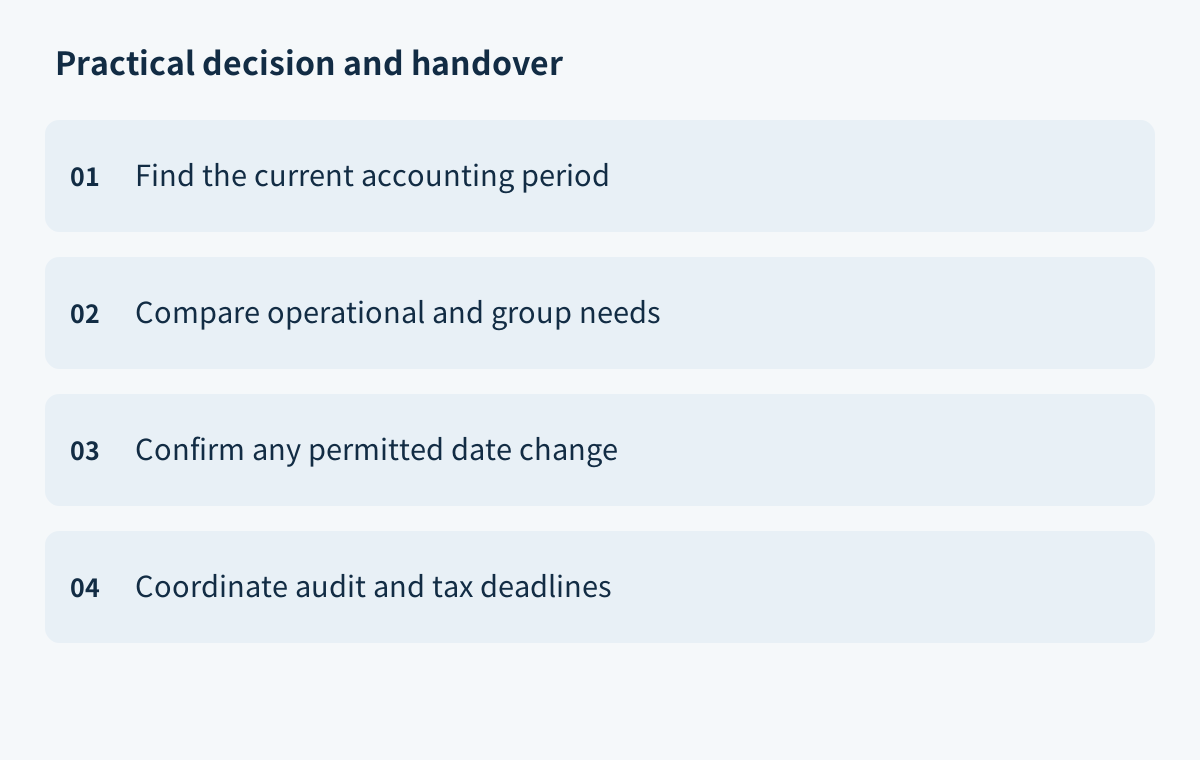
Use a consistent order: separate the incorporation anniversary from the accounting reference date, verify the first period and company type, then compare document readiness and group needs. Before changing a date, check the statutory limits and manage tax, audit and annual-return deadlines separately. A record of evidence, owners and completion proof lets the next person distinguish confirmed dates from open questions. For a case-specific question, use the website contact channel. This article is not legal or tax advice and promises no outcome.