Published · Updated

When preparing a commercial invoice, the questions are often about more than what to enter. Does the document show that money has been received? Which version should be kept after a refund? How can the records be handed to the person handling bookkeeping or tax filing? Identifying each document’s purpose and linking it to the transaction makes it easier to reconcile receivables, deposits, and delivery records later.
This article uses Hong Kong as its tax context and is for business owners in Taiwan and other Chinese-speaking markets who plan to trade through a Hong Kong company. The suggested fields and workflow are operational practices. They are not a statutory invoice format and do not determine the tax rules where a customer is located.
Distinguish Invoices, Receipts, and Payment Requests
First decide what the document needs to record: an amount owed, a reminder that payment is due, or proof that payment has arrived. For internal administration, it can help to keep invoices, payment notices, and receipts distinct. Their names should still fit the contract, transaction process, and customer requirements; this article is not defining them as legal document categories.
Check the payment terms before issuing a document. An advance payment, annual fee, instalment, milestone claim, or partial refund can mean that the request for payment and the receipt of funds happen at different times. An invoice or payment request records an amount due; it does not prove that the money has reached the account. A payment reminder is not proof of receipt either.
Keep a record for each step: save the relevant request when an amount becomes due, send and retain a separate reminder if needed, and save proof of receipt after the bank or payment platform confirms settlement. Label each file with a transaction ID, date, document type, and status, and link it to the contract or order. Mark disputes, cancellations, and refunds as pending until verified.
For example, assume a SaaS company bills an overseas customer an annual fee. It keeps the original request, sends a reminder after the due date, then files the platform settlement and bank deposit details under the same transaction ID. A system status of paid still needs to be checked against settlement records. A customer’s payment screenshot can help with that check, but may not prove that funds arrived. For weekend or cross-time-zone payments, distinguish the transaction date, platform settlement date, and bank deposit date.
Organise the Parties and Delivery Details by Transaction
Check the supplier, customer, and actual payer against the contract or order. If these are different parties, record their relationship and the basis for payment, such as an affiliate paying on the customer’s behalf. Do not identify the contractual customer solely from the name shown on a receiving account. If names, addresses, counterparties, or payment arrangements do not match, ask the transaction owner to clarify them.
Record whether the transaction is for goods or services, along with the items or service scope, quantity or service period, and relevant shipping, acceptance, or completion records. These details help support a reconciliation, but that does not make every one of them a statutory invoice field. Where delivery or acceptance takes place in stages, link the records to the relevant contract terms and evidence.
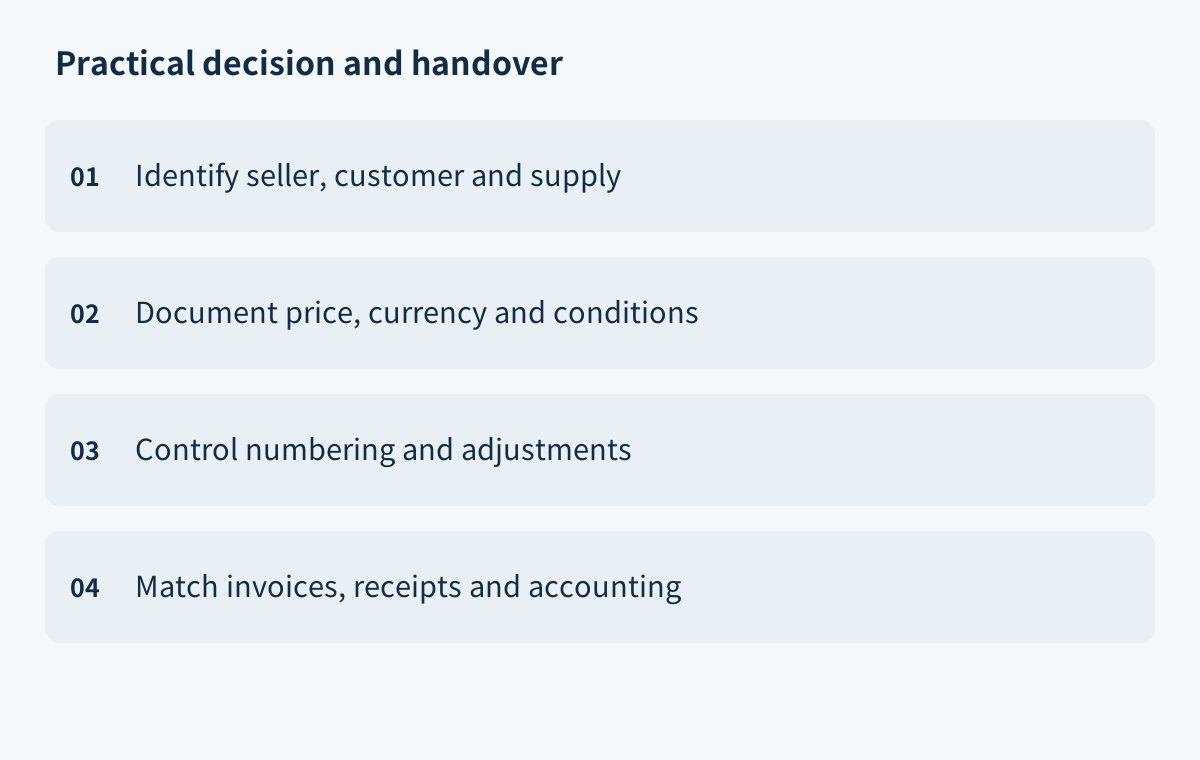
Give each transaction a searchable ID and link its contract or order, payment request, delivery evidence, receipt, and accounting entry. Check the names, descriptions, amounts, dates, and delivery status together. If they differ, note the discrepancy and who must resolve it; keep the original files instead of overwriting them. A handover index can list each file’s name, version, source, creation date, check status, and missing items. If a platform collects payment, establish whether it is only an intermediary or the contractual seller. For company names or registration numbers taken from customer documents, record the source and when it was checked.
Check Currency, Tax, and Payment Terms Separately
Before issuing a document, confirm the transaction currency, amount, due date, payment method, and who bears bank or platform fees. Use the contract, order, and agreed payment arrangements as the reference. If a customer pays in another currency, retain the original amount, conversion or deduction details, and amount actually deposited by the bank; keep exchange differences separate from platform fees.
Hong Kong’s tax position does not settle the rules in a customer’s market. HKTE’s overview of Hong Kong’s tax system states that Hong Kong does not impose sales tax or VAT. That does not mean cross-border sales into Taiwan, mainland China, Malaysia, or another market are free of VAT, GST, or electronic-invoicing requirements. The IRD’s BIR51 notes require amounts on the profits tax return to be shown in Hong Kong dollars, excluding cents. If financial statements are in a foreign currency, the amounts must be converted before completing the return, and the conversion rate stated in the tax computation. This filing requirement does not mean every commercial invoice must be issued in Hong Kong dollars.
Use a checklist for the original currency and amount, deadline, instalments or milestones, payment method, fee allocation, refund terms, platform settlement, and bank deposit. If a tax treatment is not confirmed, note the customer’s market and transaction type and assign the question for follow-up rather than entering an assumption as a conclusion. For related background on platform collections, see How Cross-Border E-Commerce Companies Use a Hong Kong Company for Collections and Invoicing. It is context for payment processes, not a decision on a particular contract or tax obligation. Retain the mapping between platform batch settlements and individual transactions, with the original currency, amount received, settlement date, and fees.
Manage Numbering, Credits, Refunds, and Versions
Before making a change, check whether the document is a draft, issued, paid, cancelled, or corrected, and whether the transaction includes partial payment, a credit, or a refund. Find the original document number and amount, the reason and date for the change, and the refund status. If a customer asks to change a name or amount, first clarify the underlying transaction and what both parties have agreed.
A numbering convention and version log are internal tracking practices, not Hong Kong statutory requirements for invoice numbering or credit-note format. Accounting software or a customer system may also limit available fields. Before exporting or reissuing a document, check how it will remain linked to the original transaction and retain the relevant correspondence and payment evidence.
Use consistent internal numbers and statuses, such as draft, issued, paid, pending correction, and refunded. For a correction, keep the original, save the revised version, and link both to the transaction. Record what changed, when and why, and who confirmed it. For a credit or refund, record the amount, processing date, payment status, related documents, and bank or platform transaction ID. For a partial refund, show how the original receipt relates to the amount returned so the refunded portion is not left as an outstanding receivable. If the document was sent to the customer, record when they were notified and confirmed the revision. If the original was reconciled or included in filing records, ask the person handling the books how to correct it and retain both before-and-after records.
Assess Tax Requirements in the Customer’s Market Separately
For an overseas customer, record the customer’s location and type, whether the transaction concerns goods or services, where fulfilment and delivery take place, the contract terms, the payment route, and who handles import, collection, or resale. These facts help identify which local authority or qualified professional to ask. A customer address or payment location alone does not establish the tax treatment.
The IRD explains that Hong Kong profits tax depends on whether a business is carried on in Hong Kong and whether profits arise in or derive from Hong Kong; these are questions of fact. See IRD Profits Tax. That Hong Kong tax context does not determine a customer market’s VAT, GST, electronic-invoicing, or other filing obligations. Applicable thresholds and deadlines depend on the market and transaction, so check the relevant authority or a qualified local professional before relying on a rule.
Create a checklist by market, covering the goods or services, customer type, fulfilment and delivery, payment route, contract terms, and questions to verify. For each open question, record the authority or professional to consult and who will follow up. If the transaction involves registration, an intermediary collecting payment, imports, platform sales, or a specialised service, verify the relevant facts and market first. Record which transaction, territory, and conditions the answer applies to so it is not reused for a different arrangement. A customer may act in a different capacity on another transaction or pay through an affiliate; review the contract, fulfilment, and movement of goods for each transaction, and date any updated conclusion.
Connect Documents to Reconciliation and Annual Filing
Before the annual handover, gather records that allow income, expenses, assets, and liabilities to be reconciled. Depending on the transaction, these may include contracts or orders, payment requests and corrections, delivery evidence, receipts, refunds, platform settlements, and bank deposits. A completed checklist does not itself mean an audit or filing is complete, or that a filing result is settled.
The IRD’s BIR51 notes on business records state that businesses in Hong Kong must keep sufficient records of income, expenditure, assets, and liabilities to establish assessable profits. The records should be retained for at least seven years after the transaction date, or until the corporation is dissolved if that happens sooner. This is the business-record requirement described in that tax guidance. Check any separate retention requirements that may apply under company law, a contract, or rules for a regulated activity.
Use the transaction ID to link each contract or order, payment request and correction, delivery record, receipt, refund, platform settlement, and bank deposit. Keep batch details and a transaction-level mapping when a platform settles multiple payments together. Flag unpaid amounts, duplicate entries, missing evidence, or unresolved market-tax questions, and assign each follow-up. The annual handover should include a document index, missing-items list, correction and refund history, exchange-rate source, and open questions. Preserve the original files and change history so the person handling the accounts can trace a balance back to its transaction. For broader background, see Hong Kong Company Accounting & Tax Filing: Complete Guide. Reconcile original amounts, changes, and remaining balances after a refund or correction, and retain year-end status and later receipts for unpaid items that cross into another year. For a case-specific question, use the contact details on the website homepage. This article is not legal or tax advice and does not promise an outcome.