Published · Updated

When a Hong Kong company is preparing to bring in an investor, arrange employee share ownership or change its shareholder structure, first establish whether the transaction is an allotment of new shares by the company or a transfer of existing shares by a shareholder. Both can change who holds shares, but they may differ in the source of the shares, the number of issued shares, filing documents and follow-up records. This article focuses on Hong Kong local companies and follows the practical sequence: checks before a decision, filing, record updates and handover.
Allotting New Shares Is Different from Transferring Existing Shares
Check who issues the shares and who receives the consideration
An allotment of new shares is when a company issues shares to a subscriber. A transfer of existing shares is when a current shareholder transfers shares they already hold to a transferee. Start by checking the agreement, payment arrangements, source of the shares, subscriber or transferee, number and class of shares, and relevant dates. Whether consideration is paid to the company or to the existing shareholder can help identify the transaction, but confirm its nature against the transaction documents and what the parties actually agreed to do.
| Check | Allotment of new shares | Transfer of existing shares |
|---|---|---|
| Source of shares | The company allots shares to a subscriber | An existing shareholder transfers shares already held |
| Recipient of consideration | Paid to the company under the subscription arrangements | Paid to the transferring shareholder under the transaction arrangements |
| Share count | Check issued shares and share capital details after allotment | Usually a change of holder; check whether the total number of shares remains the same |
| Filing direction | A return of allotment, Form NSC1, is generally required | Transfer details are included in the first NAR1 filed after the transfer |
Hong Kong 1823 explains that a company must submit Form NSC1 to the Companies Registry within one month after the first day of allotment. Share transfers are reported in the first annual return submitted after the transfer; enquiries about stamp duty should be directed to the Inland Revenue Department. 1823: Documents for an allotment or share transfer. For background on annual returns, see Hong Kong Company Annual Return (NAR1): 5 Steps. That related guide does not mean the two transactions have the same documents or deadlines.
Record an allotment and a transfer separately if one deal includes both
An investment agreement may cover both an allotment of new shares by the company and a sale of existing shares by a founder. Split these into two entries in your working schedule. For each, record the transaction type, date, share class, number of shares, consideration, payer, recipient and supporting document. Do not treat the two parts as one procedure merely because they appear in one agreement or involve one bank transfer. A clear breakdown makes it easier to compare the company decision, NSC1, register of members and payment records, and lets the next person trace where each figure came from.
Check the Articles and Existing Rights First
Review company documents alongside shareholder rights
Before allotment, gather the current articles of association, shareholders' agreement, investment documents, relevant previous resolutions, register of members before the allotment and details of each share class. Confirm that you have the current versions. Check who is authorised to make or approve the allotment, whether pre-emption arrangements or other shareholder consents apply, what rights attach to each class, and whether any terms affect the price, recipients or process. The answer depends on the company's documents. Do not assume that every company has the same approval process or restrictions.
Record the results in a table: document name and version, relevant clause, shareholders who may be affected, required consent or decision, open questions and the person responsible for following up. The articles and shareholders' agreement may contain different arrangements, so reading only one may not reveal all relevant rights. For more context on share capital and shareholders' agreements, see Hong Kong Share Capital Structure.
Flag conflicting documents for resolution
If a resolution, register of members and agreement show different share counts or classes, document the discrepancy first. Do not simply edit one ownership table and treat the process as complete. Note which shareholder or right is affected, who needs to provide a document or make a determination, and who will follow up. Until the discrepancy is resolved, keep unverified terms out of the final allotment information. If the issue concerns interpretation of the articles, legal effect or shareholder rights, seek appropriate professional advice for the circumstances.
Set Out the Subscription Terms and Allotment Decision
Put each subscriber's terms in one checklist
For each subscriber, record at least their name, the share class, number of shares, allotment date, consideration and currency, and the amount paid and unpaid per share. Also record the total number of shares in each class before and after the allotment, applicable conditions, responsible people and supporting documents. The decision document should clearly state the approved subscribers, shares and terms. Make sure the subscription agreement, resolution, filing information and post-allotment ownership table use consistent figures and class names.
The Companies Registry's NSC1 form asks for the allotment date, share details, subscriber information and a statement of share capital after allotment. If the company has more than one class of shares, it must also provide information about the rights attached to each class. Compare your schedule with the form fields before filing to catch differences in share counts, amounts paid or class names between the subscription agreement and company records. Companies Registry: NSC1 form and notes.
Check non-cash consideration and multiple share classes separately
If consideration includes services, property, a debt arrangement or another non-cash item, do not reduce it to a cash figure. NSC1 includes fields for non-cash consideration and, where applicable, requires supporting information or a schedule. 1823 also explains that where shares are allotted for wholly or partly non-cash consideration, relevant documents must accompany NSC1. Record the nature of the consideration, the supporting contract or arrangement, what has been delivered and the shares it relates to, then check the official form for required documents.
Different share classes may have different voting, dividend or capital distribution rights. State each class separately in the allotment decision and post-allotment share capital information. For an illustrative calculation, assume the company has 1,000 shares and A holds 600. If the company then allots 400 shares of the same class to a new subscriber, with no other changes, A's proportion falls from 600/1,000, or 60%, to 600/1,400, or about 42.86%. This calculation reflects the share count only. If the shares carry different rights, the number of shares alone does not establish an equivalent change in voting power or control.
Handle NSC1 and Statutory Deadlines Using Official Guidance
Calculate the filing period from the first day of allotment
1823 states that the company must submit NSC1 within one month after the first day of allotment. The period is expressed as one month; do not automatically convert it to 30 days. If the allotment information involves more than one date, confirm the actual allotment date and the period to be stated on the form, then arrange submission in accordance with official requirements. A timeline can record the first day of allotment, internal review date, planned submission date and receipt confirmation, with time set aside to resolve discrepancies.
Check the filing details and signature against the form
Before preparing the filing, check the company name, allotment date, share classes and counts, consideration, allottees and share capital immediately after the allotment. The Companies Registry's NSC1 download form is marked Version 1/2023 (December 2023). It includes fields for cash and non-cash allotments, allottee details, post-allotment share capital and rights attached to multiple share classes. Its signature section identifies a director or company secretary. At the time of filing, confirm the signature and attachment requirements against the form and applicable procedure. Keep the final submitted version, an attachment list and the Companies Registry's receipt or processing records for later reference.
Update the Register of Members, Share Certificates and SCR Assessment
Make the company records agree after allotment
After completion, compare the register of members, internal share capital information, post-allotment ownership table and any applicable share certificates. Check each holder, share class, number of shares, amounts paid and unpaid, and total shares in each class. If the company issues share certificates or other evidence, confirm that those records agree as well. The Companies Registry advises companies to update their own share capital information after each change to share capital and use their records to check later filings. Companies Registry: Share capital filing reminders.
Reassess the SCR against shareholdings and actual control
An allotment may affect the company's Significant Controllers Register (SCR) assessment, but the number of shares held by a new shareholder is not the only factor. The Companies Registry's guidance includes conditions such as directly or indirectly holding more than 25% of the issued shares, holding more than 25% of voting rights, having the right to appoint or remove a majority of the board, or having the right to exercise or actually exercising significant influence or control. Control arrangements involving a trust or a firm that is not a legal person may also need consideration. Since voting rights can differ between share classes, compare the share counts, ownership chain, class rights, voting rights and director appointment or removal arrangements before and after allotment. The Companies Registry's SCR guidelines, updated 23 May 2025, set out the relevant conditions. For background, see Hong Kong Significant Controllers Register (SCR).
Information enquiries, notices and updates for the SCR each have applicable procedures. Do not assume that every allotment changes the register, or that the allotment date is automatically the start of every relevant period.
Keep Payment Evidence and Completion Records Together
Match cash or non-cash consideration to the allotment terms
For a cash subscription, keep transfer or deposit evidence and record the payer, recipient, date, currency, amount and transaction reference. Compare these details with the subscription terms, company accounts and amounts recorded as paid. For cross-border payments, retain both remittance and receipt records and note a reference that identifies the payment. For property, services or another non-cash arrangement, keep the relevant contract, description of the consideration, and evidence of delivery or transfer of rights. These are practical filing suggestions to support checking and handover; they do not replace company documents or official filing attachments required for a particular case.
Use a completion checklist for handover
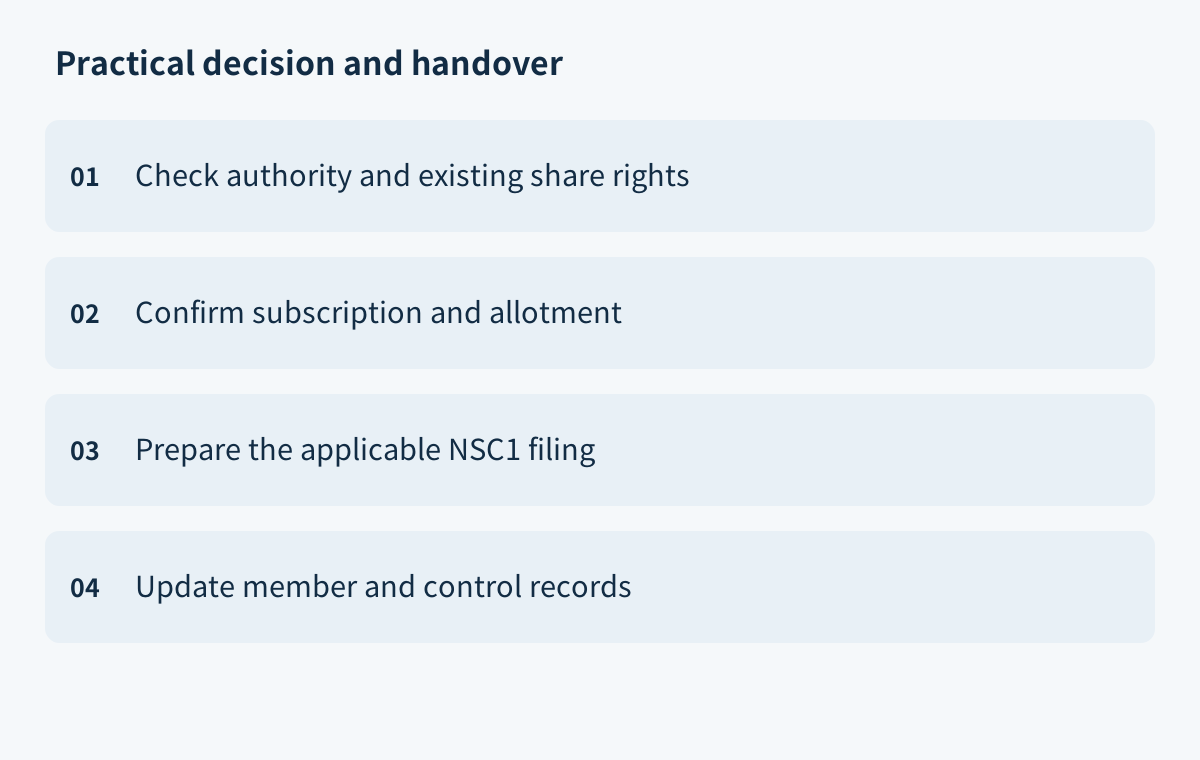
A completion folder can contain, in order: pre-allotment ownership information; applicable articles and agreements; subscription terms; the allotment decision; cash payment or non-cash consideration evidence; NSC1 and attachments; submission and receipt records; the updated register of members and share capital information; and the SCR review outcome. At handover, compare share counts, classes and consideration across the agreement, resolution, filing and company records. List any unfinished items with an owner and next step. Complete records help the company explain what changed and how, but do not replace an assessment of the transaction documents and applicable requirements.
For a case-specific assessment, you may submit a question through the contact details on the website. This article is not legal or tax advice and does not promise any outcome.