Published · Updated

If a company suddenly cannot transfer money, sees “dormant” in online banking, or has a platform mark a payment as sent before the bank credits it, separate three questions: the bank’s account status, the company’s legal status at the Companies Registry, and each payment’s current position. The steps below help directors verify facts, prepare records, contact the bank, trace funds and hand over open items. The bank and payment provider must confirm conditions for the specific account.
A Dormant Bank Account Is Not the Same as a Dormant Company
A bank’s dormant label is an account status under its terms and procedures; it does not establish that a company is legally dormant. The Companies Registry’s dormant company FAQ says a private company may declare dormancy by special resolution delivered for registration. It takes effect on delivery or a later date specified in the resolution. Check the Registry record, resolution and accounting records.
An accounting transaction ends dormancy. It means a transaction required under section 373 of the Companies Ordinance to be entered in the company’s accounting records, excluding a fee payable under an Ordinance. The Registry recommends independent professional advice on whether a transaction meets the definition. Compare dates in the ledger, bank statements and resolution. If activity may have occurred during dormancy, record its purpose and evidence, seek advice and do not rewrite historical records.
Keep separate records for bank status, restrictions and notices, and for resolutions, Registry details, accounting records and open questions. Note each item’s evidence file, date, owner and next action; list missing records for follow-up. See the Hong Kong company formation and secretary guide for background.
Does a dormant bank account automatically make the company legally dormant?
No. Check for a relevant registered resolution and activity that may qualify as an accounting transaction.
Check the Bank’s Definition and Account Restrictions
Find the bank notice, online message or latest correspondence. Record the account name, notice date, last few digits and case number. Ask what status applies, the criteria for this account, the last customer-initiated activity recognised, and whether bank-posted interest or fees affect the status. Do not assume a small transfer, online login or third-party payment meets the bank’s test.
Confirm whether incoming and outgoing payments, transfers, withdrawals, cheques, standing instructions, direct debits, online access, collection services and authorised-user actions remain available. For pending payments, ask whether they are unprocessed, rejected, under review or not yet traceable. Keep the bank’s written reply, department, date, next contact time and document requests.
The HKMA’s consumer information on dormant accounts says most banks may classify deposit accounts as dormant after a period without customer-initiated activity, generally six months or more; bank-initiated interest and charges are excluded. Some banks may charge fees or stop certain services. This is general consumer information, not a corporate-account standard or fee schedule. Ask the bank to confirm this account’s status and restrictions. For pre-opening background, see the Hong Kong bank account opening guide.
Is six months the standard for every corporate account?
No. The HKMA material does not replace account terms or the bank’s confirmation. Ask for this account’s relevant date, criteria and restrictions.
Prepare Identity, Business and Source-of-Funds Records
Ask the bank for the checklist for this review, including file format, validity period and secure submission channel. Gather company registration records and current identity and contact details for directors, beneficial owners and account signatories. Check names, roles and addresses against company records. Note outdated fields and acceptable proof; do not send sensitive files to an unverified address.
Prepare answers about the company’s business, customer and supplier markets, expected receipts and payments, and the contracts or services behind them. Evidence may include contracts, invoices, orders, logistics or platform settlement records, counterparty details, and source or use-of-funds explanations. Include only material relevant to the bank’s questions; this is an organising method, not one KYC checklist for every bank.
Index files by question, version, submission date, owner and unresolved point. Link invoices to contracts and payment references, confirm accepted languages and translation formats, and keep the bank’s receipt confirmation. The HKMA’s 7 March 2023 Smart Tips for Private Banking says measures in that setting should match assessed risk rather than apply identical checklists mechanically. It does not set requirements for ordinary corporate accounts. If evidence is missing, ask what question remains and what alternative proof is acceptable.
Is there one KYC checklist for all companies?
Do not assume so. Follow the bank’s requests for this account and business, and keep its checklist and supplementary-document replies.
Confirm Reactivation Steps and Fees with the Bank
Confirm the bank’s required channel, directors or signatories, mandate updates, accepted originals or certified copies, and any identity or business checks. Ask which functions, transaction limits and online permissions will be restored and what restrictions will remain. Procedures vary by bank and account type.
If an authorised person is outside Hong Kong, ask whether video verification, certified documents or another process is accepted. Verify the account details and receiving department before submission. Obtain a receipt and confirm the attachments are complete; successful delivery does not prove acceptance.
Ask the bank to confirm fees, expected processing time and any further review for this account. The HKMA’s general information says some banks may charge or stop services, but gives no common corporate reactivation fee or timetable and does not guarantee reactivation. Record the account, fee item, currency, estimate assumptions and contact person; mark provisional answers as unconfirmed.
Keep submitted versions, dates, receipt and case number. If reactivation is delayed or declined, ask what condition remains, the next step and whether escalation applies. Track items as prepared, awaiting submission, received or confirmed complete: submitting documents is not reactivation.
Is there a standard reactivation fee or processing time?
No universal amount or duration is stated here. The bank must confirm the fee, timing and restored functions for the specific account.
Handling Collections, Pending Funds and Alternatives
Track each payment by reference, amount and currency, payer, destination, initiation and expected settlement dates, platform status and bank findings. Ask the platform whether it was sent, is processing, returned or needs documents; ask the bank whether it received or held it. If answers differ, share the reference and payment proof with both parties and request the next step.
If a platform says “paid” but the bank has not credited the funds, trace the original reference before asking the payer to pay again. For another receiving account or payment service, confirm the bank, platform and payer can use it. Verify details through a trusted channel; update invoices, reconciliation records, payment instructions and customer notices. Record confirmations, the effective date and fee, timing or currency effects.
Clearing, business days and intermediary banks may affect timing; ask the platform for its payment instruction and tracking reference rather than assume the cause. For returned funds, confirm amount, currency, fees and return date before arranging another payment. For card disputes or formal platform notices, follow the named provider, card-network requirements and deadline. Stripe’s dispute guide covers its payment-service context, not general dormant-account or delay rules. Assign an owner and closure evidence; avoid duplicate payment while status is unclear.
Can the payer send the money again before the pending payment is traced?
First establish whether the original was not sent, is processing, was returned or was credited. Do not arrange a duplicate while its status is unclear.
Set Account Reviews and Access Controls After Reactivation
When the bank confirms reactivation, check account status, payment functions, limits, online users, signatories, contact details, two-factor authentication and collection services. Reconcile pending or returned payments, incomplete instructions and fees. Ask the scope, reason and release condition for remaining restrictions.
Remove former staff who no longer need access. Confirm primary and backup contacts, and record what each permission allows and who requests or reviews changes. Where supported, set layered authority or dual approval according to transaction risk. Do not share credentials or forward verification codes; each user should use individual bank-approved credentials.
At each review, compare statement balances with the ledger, check open or unusual payments and contact details, and track discrepancies to closure. Set frequency according to bank requirements, transaction changes and company risk. Update the bank when authorised people, markets or collection methods change. The HKMA Smart Tips discusses risk-based review in private banking; it does not set a fixed cycle for corporate accounts.
How often must an account be reviewed after reactivation?
There is no single interval for every corporate account. Set a schedule based on bank requirements and company risk, updating records when authority or business details change.
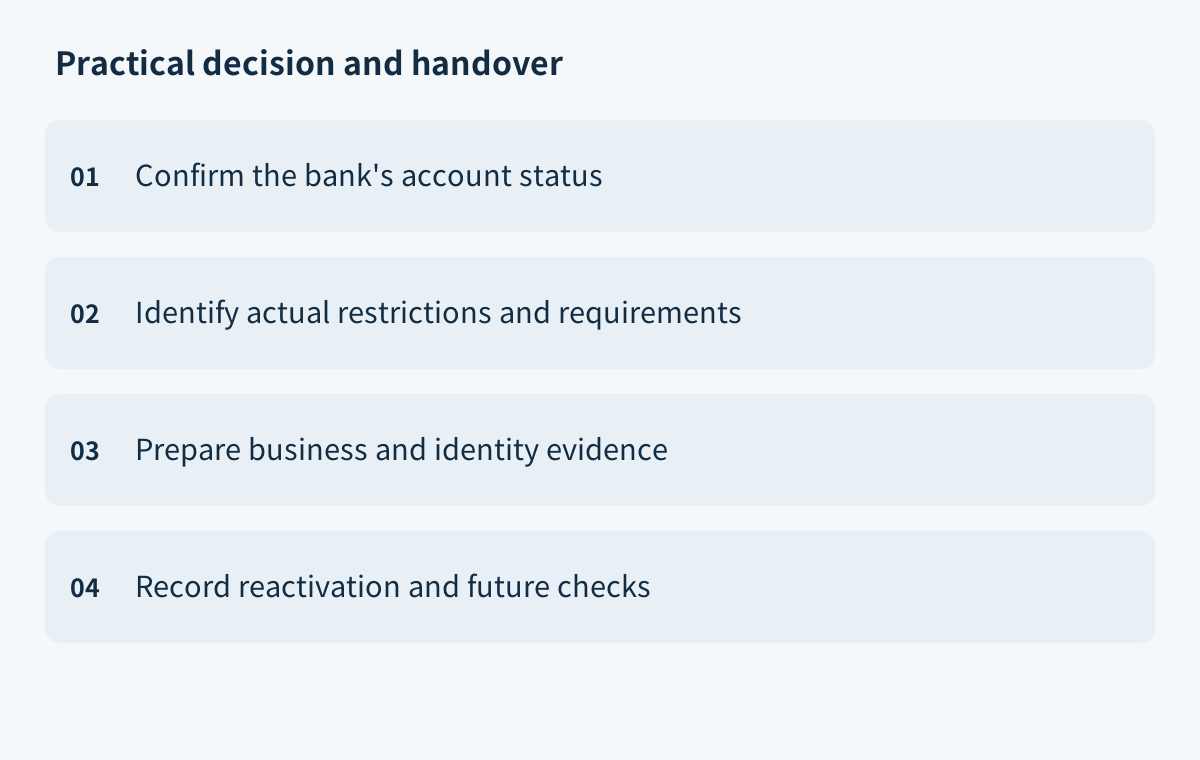
Close with a handover list covering legal status, the bank’s reply, restrictions, pending funds, documents, authorised users and the next review date. Give each open issue an owner and due date. For a case-specific assessment, use the website’s contact options. This article is not legal or tax advice and does not promise an outcome.