Published · Updated

For cross-border e-commerce through a Hong Kong company, reconciliation links orders, payment transactions, platform balance activity, payout batches, and bank deposits. A payout status may mean funds were sent to the bank but not yet posted. Neither status represents total sales or accounting revenue for the period. Business owners planning cross-border e-commerce through a Hong Kong company should align data sources, periods, and currencies, investigate each difference, and keep a reviewable handoff trail. This guide covers operational reconciliation; accounting recognition and Hong Kong profits tax depend on the facts of each case. For broader context on collections and invoicing, see How Cross-Border E-Commerce Companies Use a Hong Kong Company for Collections and Invoicing.
Platform Payouts Are Not Total Revenue
Start with four records: an order or sales export, payment-platform activity, payout details, and receiving-bank transactions. Confirm each file's dates, time zone, reporting currency, store, and payment channel. If the business uses several processors or marketplaces, separate their data first. A sales report may cover more orders than one processor's balance activity, so different totals do not by themselves show an error.
Do not treat net payout as revenue. Orders may include unpaid, cancelled, or pending transactions; payment activity covers a selected channel; payouts may combine transactions after fees or adjustments; and bank records show actual posting dates and currencies. These sources answer different questions and may cover different periods. Record each source, period, currency, time zone, and export time in the reconciliation sheet.
Shopify's activity report documentation says the Shopify Payments activity report shows balance movements, not accounting revenue, and excludes third-party processors and payment methods. Check other platforms' own definitions. Compare order, paid-order, and payment-activity counts using consistent filters. Put unmatched amounts on an exception list with a possible cause and next check; do not add them to sales to force agreement. If only summary data is available, note the limitation and mark the period partially reconciled.
Link Orders, Transactions, and Payouts with Identifiers
Check exports for platform/store, order ID, transaction or payment ID, type, original currency/amount, fees, net, payout ID, bank reference, and date/time. Reports may omit fields. Confirm whether IDs repeat and whether dates mean transaction or settlement.
One payout can combine transactions; one order can be paid in instalments; a refund may occur later. Keep separate rows for orders, transactions, payouts, and bank deposits, linked by identifiers. Match first on platform, store, transaction ID, or payout ID. When an ID is missing, use date, currency, and amount only as supporting evidence: different transactions can share the same values.
Mark rows reconciled, partially matched, or pending. Preserve raw unmatched values, the matching rule, and the reason for each difference. Shopify's payout troubleshooting guidance says a payout transaction CSV can include Amount, Fee, and Net columns. A bank reference may help trace a payment, but not every bank uses one; confirm other providers' fields separately. Test known IDs for leading zeros, case changes, or masking; standardize in a separate column while retaining raw values. Save unmatched and multiple-match lists, check for duplicate allocation, and keep original exports for handoff.
Separate Fees, Refunds, and Reserves
Check provider categories for charges, refunds, fees, disputes or chargebacks, adjustments, and reserves. Confirm whether the original fee is returned on a refund or listed separately; similar field names do not guarantee identical calculations.
List receipts, refund principal, processing fees, disputes and related fees, other adjustments, reserve deductions, and reserve releases separately. Use consistent signs and retain each source ID. Check whether Net already includes fees; if so, do not subtract them again. Track reserves separately; withheld funds are not bank deposits.
Shopify Payments' activity report separates refunds, disputes, adjustments, and Reserves & Holds; reserved or held funds remain in the account until released or paid out. Treat this as Shopify-specific reporting. Trace the platform net amount through its components to the payout and bank deposit. If a difference remains, record whether it may be a later-period refund, fee, adjustment, or reserve instead of hiding causes in an unexplained line.
For a later-period refund, use the platform activity date and link it to the order by refund or transaction ID; do not move it back to force monthly agreement. If fields permit, check opening balance plus activity, less payouts, equals closing balance. If a field is missing, mark the control incomplete rather than estimate. Keep original and converted amounts separate.
A Hypothetical Reconciliation of One Payout
This is a hypothetical, not a typical fee rate, real transaction, or provider quote. Assume one currency and payout batch, no opening balance, adjustment, or currency conversion: HK$10,000 in receipts, HK$1,000 refund principal, HK$300 processing fees, and HK$500 reserve deduction. Confirm each item appears in the batch detail.
Expected payout: HK$10,000 − HK$1,000 − HK$300 − HK$500 = HK$8,200. Compare it with platform payout detail, then the bank deposit. Keep each component's amount, currency, platform ID, and payout ID. If the platform shows HK$8,200 but the bank amount differs, check bank fees, deposit currency, and posting date. If the platform amount differs, check cross-period refunds, fees, disputes, adjustments, opening balances, and reserve releases.
Record expected and actual amounts, the difference, records checked, and open questions. Use worksheet rows for source-line ID, category, original-currency amount, direction, and payout ID so the calculation can be repeated. Confirm the same store, period, currency, and payout; if Net includes fees, do not subtract HK$300 again. Add actual adjustments as separate lines. If the bank has not posted the matching amount, mark it as awaiting posting with trace details; never overwrite a difference with the expected value.
Handling Currency, Timing, and Multiple Platforms
Confirm each report's transaction and settlement dates, time zone, payout currency, receiving account, and bank posting date. Transaction-date reports and bank posting dates can produce different monthly totals. Set period boundaries and check payouts and refunds around month-end before treating timing as an error.
For multiple platforms, reconcile by provider, payout currency, receiving account, and reporting period. Match transactions, payouts, and bank deposits in their original currencies first. After conversion, record the platform amount, actual bank deposit, actual exchange rate, and related fees. Use the rate on the transaction or bank record, not a reference rate from another date. Keep unmatched balances in different currencies separate until investigated so that offsets do not conceal a difference.
Shopify says its activity report can be viewed by payout currency; its guidance identifies date range, time zone, payout timing, third-party methods, and data delay as possible causes of differences. These notes apply to Shopify Payments, not another platform's update schedule or a bank's processing time. If a report provides transaction and settlement dates, retain both and state which one you used. Carry month-spanning items forward with platform status, next evidence to check, and last reconciliation date. Close after confirming the deposit or failure reason. Preserve original and converted timestamps when time zones differ.
Keep Transaction Evidence Ready for Your Accountant
Confirm whether Hong Kong record rules apply. Reconciliation and tax-record duties differ. The Inland Revenue Department says internet-business profits depend on case facts; incorporation, customer, or bank location alone does not determine taxability. Ask a professional about a specific filing, source-of-profits, or retention question.
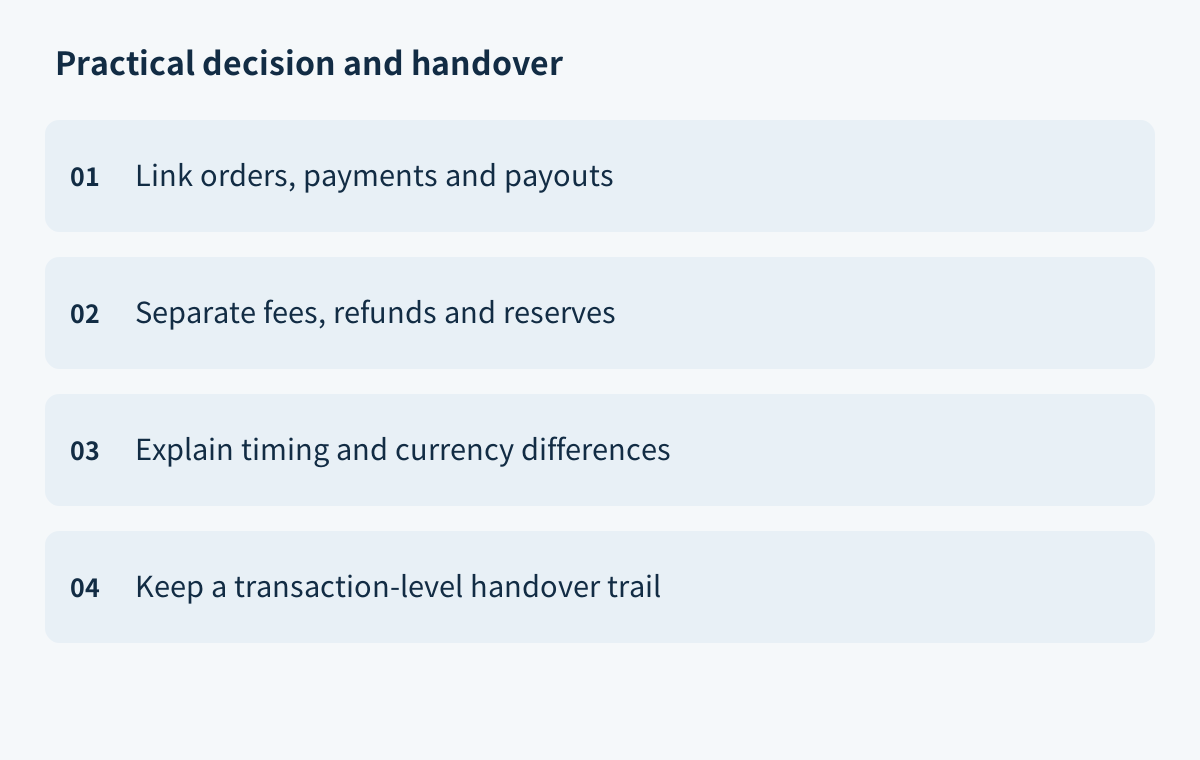
Keep raw order, platform transaction/payout, bank, refund/dispute, reserve, fee, and foreign-exchange records, plus an identifier map, reconciliation summary, and open-items list. Index company/store, period, currency/time zone, export time, fields, and matching rules. Link each working entry to its source file and line; name files by platform, store, period, and currency. Retain original exports and sheet versions, and record the handoff date and owner of open questions.
The IRD's FAQ on Internet Business says records in Chinese or English must be sufficient to ascertain assessable profits and kept at least seven years after related transactions are completed. Confirm how this applies. Its Profits Tax information says whether profits arise in or derive from Hong Kong is a question of fact. This is operational guidance, not legal or tax advice, and promises no outcome. For a case-specific assessment, send your question through the website's contact details.