Published · Updated

When a customer pays an invoice quoted in USD, a payment platform may deduct fees or convert the funds before sending them in a payout batch. The bank may then credit the account in HKD. A bank statement alone may not show which orders make up that credit, which fees were deducted, or where a difference arose. Effective multi-currency reconciliation preserves the amount, currency, date, and source at each step, then matches each link in sequence.
This guide follows an order or invoice through the payment platform, payout batch, bank credit, and accounting records. Available fields and reports vary by platform, bank, and account setup. If a report omits an exchange rate or fee, record it as an item to verify rather than filling it in with an estimate.
Distinguish the Quoted Transaction Currency from the Settlement Currency
For each transaction, identify the currency used for the quotation or order, the invoice, the customer's payment, the platform account's settlement, the payout, the bank credit, and the accounting records. These labels describe different steps. An order priced in USD does not mean the customer paid in USD or the bank credited USD. Keep each currency in its own column; do not add or subtract amounts in different currencies as though they were the same unit.
Before reconciling, confirm the platform and bank account used, where conversions occurred, whether payouts were made individually or in batches, and the report's period and time zone. Map the funds' route with the amount, currency, date, party that performed each conversion, and available evidence. If the report omits the rate or conversion time, ask the platform or bank for it. Do not substitute an online rate for actual settlement data. Bank information requests and periodic due diligence can depend on risk and circumstances; see the HKMA's smart tips for bank customers rather than assuming a universal bank fee or timeframe.
Stripe provides a platform-specific example. Its Balance summary report presents transactions in the settlement currency after required foreign-currency conversions, but does not match each payout to individual payment transactions. For automatic payouts, Stripe recommends its Payout reconciliation report to identify the transactions in each payout; a report can include transactions from before the selected period if they were paid out during that period. These are Stripe reporting rules, not universal rules for other providers. For market context on third-party collection options, see Choosing a Hong Kong Virtual Bank for Business Receipts: Airwallex, Wise, Statrys, and Traditional Banks Compared. That comparison does not mean the brand provides banking, payment, or reconciliation services.
To avoid confusing a transaction date with a credit date, trace one payment from its order number to the platform record, settlement batch, payout, and bank credit. Record the matching identifiers and any missing links. If settlement settings change, note the effective date so the old and new processes are not mixed together.
Keep Original-Currency Amounts and Conversion Data for Each Transaction
Make each transaction traceable from its source to the bank credit. A working reconciliation sheet can include the order or invoice number, transaction and payment dates, original currency and amount, platform transaction ID, gross amount, fees, and net amount, with a currency shown for every figure. If available, record the exchange rate, conversion time, and converted amount. Leave unavailable details blank and flag them; an estimate can obscure whether information is missing or an amount is genuinely different.
Also record the payout batch ID and date, bank credit date, bank reference, and source report name. Keep the original platform exports and bank statements. Use stable keys to link an order to a platform transaction, multiple transactions to a payout batch, and that batch to a bank reference. If a platform report does not link directly to an order, record the identifiers and basis used to match it. Do not treat equal amounts alone as proof that two entries belong to the same transaction.
Label each file with its reporting period, time zone, export date, and version. A transaction, platform settlement, and bank credit can fall on different days or in different months, so filtering only by statement date can make a cross-period payout look short. If a batch total does not match, check the period and time zone first, then compare transaction details and fees. For anything still unmatched, record the missing report or document, who will be asked for it, and the owner of the follow-up. Preserve the source values; if a correction is needed, keep the original, the change date, and the reason instead of overwriting the export.
Trace Fees and Foreign-Exchange Differences Separately
When a difference appears, break it into verifiable items rather than labeling the entire gap an exchange difference. Items to check may include platform fees, platform conversion, separate bank charges, refunds, disputes, reserves, payouts across reporting periods, and rounding. Link each item to a report line, transaction ID, or bank entry. If you have only a difference and no evidence of its source, do not assign it a fee name or accounting category yet.
Before comparing gross amount, fees, and net amount, confirm that the figures come from the same report, cover the same transaction or group, and use the same currency. Reconcile gross less the reported fees to net only when those conditions match. If conversion took place, first find the platform's converted amount and supporting data; do not subtract values in different currencies. If the platform net and bank credit differ, check the payout batch and any bank-side charge separately. The difference between two totals alone does not establish its cause.
For disputes, payment rules may depend on the provider and card network. Confirm the actual notice and applicable provider guidance; for example, Stripe's payment disputes guide applies to Stripe and is not a universal rule. Track each difference with the source filename and line, transaction ID, currencies, review status, and owner. Separate documented fees and bank deductions from unresolved rate data or unmatched amounts. A trace log organizes evidence for follow-up; it does not determine accounting treatment or prove that an exchange gain or loss has occurred.
Work Through a Hypothetical Multi-Currency Receipt
The following is a calculation example, not an actual platform rate or fee. Assume a transaction has a gross amount of USD 100, a reported platform fee of USD 3, and a net amount of USD 97. Assume that net amount is converted at HKD 7.80 per USD, with no other platform or bank fees, reserve, or second conversion. If any assumption differs from the actual transaction, the bank credit may differ too.
Match the USD 100 to the order or invoice, then find the same transaction ID in the platform detail and confirm the USD 3 fee and USD 97 net. Under the stated assumption, USD 100 minus USD 3 equals USD 97, and USD 97 multiplied by 7.80 equals HKD 756.60. This calculation does not prove the actual transaction rate; use the platform or bank's conversion records for that.
For a second hypothetical transaction, assume a gross amount of USD 50 and a fee of USD 1.50 at the same assumed rate. The net is USD 48.50, or HKD 378.30. Together, the assumed gross total is USD 150, fees are USD 4.50, and net is USD 145.50, equivalent to HKD 1,134.90 at 7.80. Reconcile each transaction's gross, fee, and net before checking the batch total. Do not force a single bank credit to match one order if the payout contains several transactions.
Then connect the platform settlement record to the payout batch and check the bank credit against the batch. Keep the corresponding entries from the platform report, payout details, and bank statement. If actual rates, fees, dates, or amounts differ, retain the actual figures and list the variance for follow-up. This example does not establish an accounting entry.
Leave Functional Currency and Accounting Treatment to Professional Judgment
An account's currency and an entity's functional currency are different concepts. The IFRS Foundation describes functional currency under IAS 21 as the currency of the primary economic environment in which an entity operates, where it primarily generates and expends cash. IAS 21 also addresses foreign-currency transactions, translation of foreign operations' financial statements, and translation into a different presentation currency. See the IFRS Foundation's IAS 21 overview. Do not decide functional currency solely from the place of incorporation, account currency, or revenue currency. First confirm the reporting standards that apply, then ask a qualified professional to assess the entity's operations. IAS 21 should not be assumed to apply to every Hong Kong company.
For that handoff, organize the currencies of the entity's main income and expenses, customer and supplier locations, payment methods, how working capital is usually held and used, foreign-currency transaction frequency, and the reporting standards in use. Attach relevant orders, contracts, platform reports, bank records, or existing financial statements. If a summary lacks source documents, mark what is unknown rather than presenting an assumption as company policy.
Questions for an accounting professional may include which rate to use when recording a transaction, how to treat foreign-currency items at period end, how to record differences caused by different rates, and what documents support a refund or dispute. Send those questions with the source records so the reviewer can trace the facts. Separate known facts, with their sources and periods, from questions about standards, functional-currency evidence, rate sources, and period-end treatment. Ask the professional to state the assumptions and period covered by their conclusion, and whether a change in operations or payment flows calls for reassessment. This article gives record-organizing guidance; it does not select an accounting policy or determine tax treatment or financial-statement conclusions.
Build a Month-End Evidence Pack and Exception List
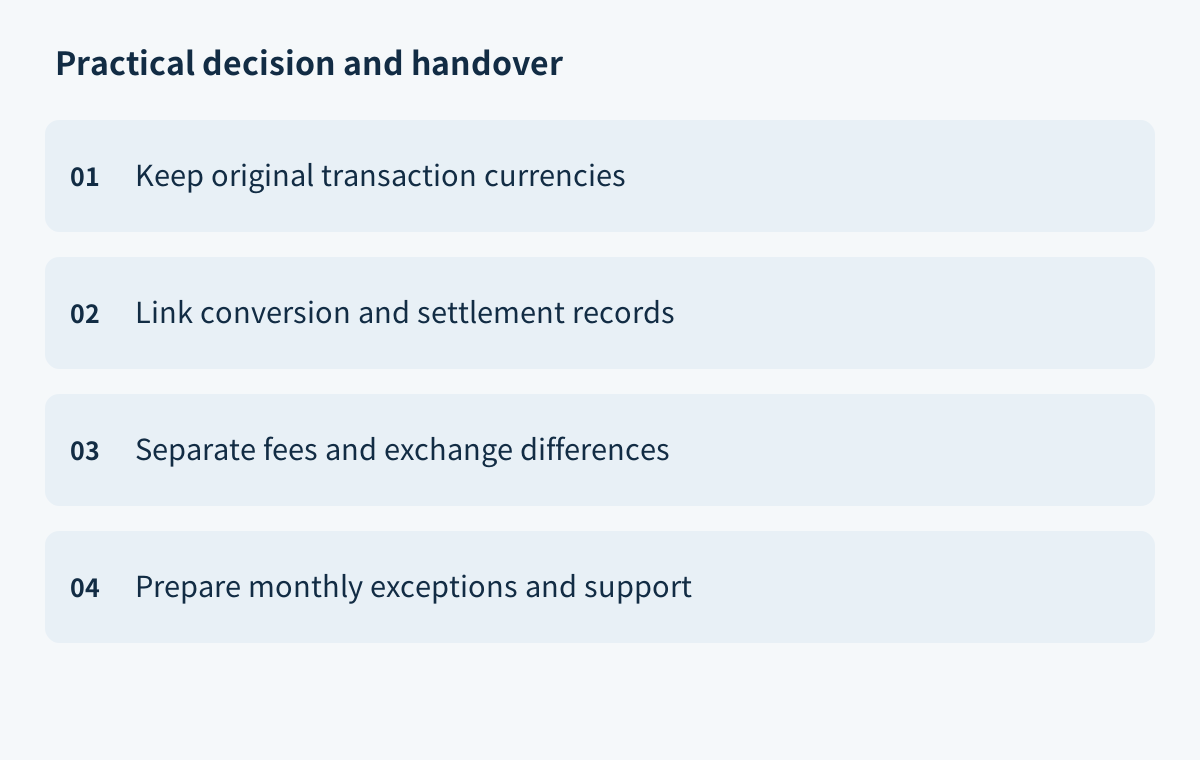
Organize a monthly evidence pack by transaction ID or payout batch. It can contain contracts or invoices, platform transaction details, fees and conversion data, payout or settlement reports, bank statements, original exports, the reconciliation sheet, and unmatched items. Label every file with its period, report time zone, export time, and version. Keep each source figure linked to the reconciliation result so the next person can trace how the month-end total was assembled.
The Hong Kong Inland Revenue Department's Record Keeping guidance says that people carrying on a trade, profession, or business in Hong Kong must keep records in Chinese or English that are sufficient to ascertain assessable profits, for at least seven years. Its examples include books, vouchers, bank statements, invoices, and receipts. Confirm how the requirements apply to the particular business. This Hong Kong record-keeping rule should not be presented as a tax conclusion for readers in Taiwan.
For each exception, record the transaction or batch, difference type, original currency and amount, documents available and missing, current owner, follow-up contact, next action, and evidence required to close it. Track refunds, disputes, reserves, cross-period credits, missing exchange rates, and unidentified fees separately. At handoff, list unresolved items and why they remain open. When an item is resolved, attach the report or explanation received and retain the change history.
Before closing, check that each sale links to a receipt, each payout links to a platform batch, and each bank credit links to settlement or remittance evidence. Every unmatched difference should have an owner and a next step. If source evidence is missing, leave the item open and state what is needed instead of burying the gap in an unidentified balance. For a case-specific question, contact us through the website. This article is not legal or tax advice and does not promise an outcome.