Published · Updated

A loss in a Hong Kong company's financial statements is not automatically the amount it can carry forward for tax. Identify the taxpayer and basis period, reconcile its accounts to the adjusted tax loss under the Inland Revenue Ordinance (IRO), and check how prior losses were assessed and used. Cross-border transactions, a changed year-end or a shareholding reorganisation can alter which facts need review. This guide sets out six checks and the records to keep for handover.
Accounting Losses and Tax Losses Are Different
Identify the taxpayer corporation, year of assessment and basis period. Gather the trial balance, general ledger, financial statements, bank records, key invoices and contracts, plus prior returns, tax computations and notices of assessment. Note the year-end and any start, cessation or accounting-date change; special basis-period rules can apply, so the period may not be a calendar year.
A book loss is an accounting result. An adjusted loss for profits tax is calculated under the IRO and assessed in relation to profits arising in or derived from Hong Kong. Profits from the sale of capital assets are excluded. Expenses incurred in producing assessable profits may qualify; private, non-business and capital expenses are generally not deductible. Reconcile each item to evidence and current IRD profits tax guidance.
Example: if the accounts show a loss of HKD 200,000, including a HKD 30,000 private expense, and there are no other tax adjustments, the illustrative adjusted loss is HKD 170,000 (200,000 − 30,000). This is arithmetic, not a filing conclusion. List each adjustment with its account, reason, amount and supporting document. Mark unclear items pending and avoid duplicate adjustments; a reviewer should be able to trace the entries and reproduce the total.
Classify the Income Source and Adjust Deductions First
Profits tax generally applies to profits from a trade, profession or business carried on in Hong Kong that arise in or derive from Hong Kong. Whether a business is carried on here and where its profits arise are questions of fact. Hong Kong incorporation, overseas customers or receipt into an overseas account do not alone determine source. See the IRD's territorial source and profits-tax guidance.
For each revenue stream, record who negotiated and signed contracts, where goods were sourced and delivered, where services were performed, and what employees or agents did. Link contracts, orders, logistics or delivery evidence, service records and payment proof. If invoicing, receipt, incorporation and performance locations differ, list them separately and keep discrepancies open until checked.
Classify expenses by actual business purpose: check the service, business benefited, period and payment, since an invoice alone does not prove deductibility. Split private or capital elements and document the basis. Foreign-sourced interest, dividends, intellectual-property income or disposal gains may require a separate FSIE review, with its own income and taxpayer conditions. This is additional to source analysis. Read the FSIE overview for background, not as a case conclusion.
Loss Carryforwards Depend on the Entity and Business
The IRD allows a year's business loss to be carried forward against later profits of that trade. A corporation with multiple trades may offset one trade's loss against another's profits. Concessionary rates require special adjustments. Before carrying an amount forward, confirm the computation, taxpayer and business, and reconcile amounts already used. See the IRD's treatment of losses.
A company cannot simply set off another group company's loss because they share owners, directors or accounting systems; the IRD's BIR51 notes exclude another person's losses included in the company's accounts. Consolidated statements do not replace each taxpayer's own return, computation or assessment notice. Partnerships, special tax arrangements and different tax rates may require a separate check of the applicable set-off rules.
Maintain a loss schedule by legal entity, year of assessment and business. Show opening losses, current-year additions, amounts set off, IRD assessments or adjustments, closing balance and linked returns and assessment notices. At year-end, reconcile the balance to the tax computation and IRD correspondence before carrying it forward. Record discrepancies and open questions instead of silently reusing an old figure. If the accounting date changed or business stopped, check the basis-period dates and year of assessment stated in the notices.
Review Ownership Changes, Groups and Anti-Avoidance Rules Separately
If shares were sold, an investor joined or the group was reorganised, chart ownership, activities, income sources, customers and assets before and after the change, and compare them with records from the loss period. Keep the commercial rationale, agreements, financing records and board minutes; date any later explanatory note and identify its source. A transfer date alone does not establish purpose or explain how the loss arose.
The IRD describes section 61 as addressing artificial or fictitious transactions, section 61A as applying to transactions with the sole or dominant purpose of obtaining a tax benefit, and section 61B as restricting loss set-off after a shareholding change in specified circumstances. A change alone does not establish that losses are unusable, and a stated commercial purpose alone does not settle the risk. The complete facts matter. Review the IRD's anti-avoidance provisions.
Prepare a before-and-after table for control, activities, assets, income, loss balance and commercial rationale, with traceable support. Separate facts, inferences and open questions, especially about transaction purpose and expected set-off. IRD's DIPN No. 8 (Revised) is dated September 2009 and reflects the law as it stood at publication; use it as historical guidance and check the current Ordinance and company records.
Tax Returns Must Be Addressed Even When There Is No Income
When a return arrives, record the year of assessment, form type, issue date and deadline. Confirm the requested income, expenses, supplementary forms and evidence. No income, suspended trading or a pre-revenue stage does not mean a return already received can be ignored. Save the notice in that year's file and record the responsible person, response date, items submitted and proof of receipt.
The IRD may issue an I.R.C. 1812 letter temporarily excusing a corporation from annual Profits Tax returns, but it does not remove statutory duties to prepare audited accounts. A private company can become dormant only by delivering the required special resolution and satisfying the Companies Ordinance's no-accounting-transaction condition; dormant status may exempt it from preparing audited statements during that period. See the IRD return FAQ, Companies Registry dormant-company guidance and its accounts and audit FAQ.
For BIR51 or BIR52 returns issued on or after 1 April 2026, the FAQ says to complete every item and enter “0” where there is no amount. If the prior-year loss statement is missing, use the loss in the prior-year tax computation; if unavailable, enter “0”. Check the form's required figures, attachments and signatures, then retain the filed copy and receipt. For general filing context, see the Hong Kong company tax-return guide; the actual return and notices govern the company's obligations.
Keep Loss Computations and Historical Assessments
The IRD requires a Hong Kong business to keep sufficient records to establish assessable profits and retain them for at least seven years. Examples include account books, vouchers, bank statements, invoices, receipts, asset and liability records, and details of goods or services that verify transactions. For loss tracking, also retain tax computations, adjustment schedules, filed returns, assessment notices and documents supporting source, expense purpose and ownership changes. See the IRD record-keeping requirements.
Create a file index by legal entity and year of assessment; filenames can include the year, document type and assessment reference. For each revised computation, preserve the revision date, reason, previous version and supporting basis rather than overwriting the earlier file. Note the source and receipt date of records received from others, along with any missing originals. Keep the filed return, working papers and proof of receipt traceable to one another.
An annual handover summary can list the taxpayer, year, opening loss, current-year loss, amount used, closing balance, IRD adjustments and missing documents. Link each figure to a computation or assessment notice. The next person should be able to recalculate the balance and compare it with the next return; if figures differ, preserve the prior record and explain the difference.
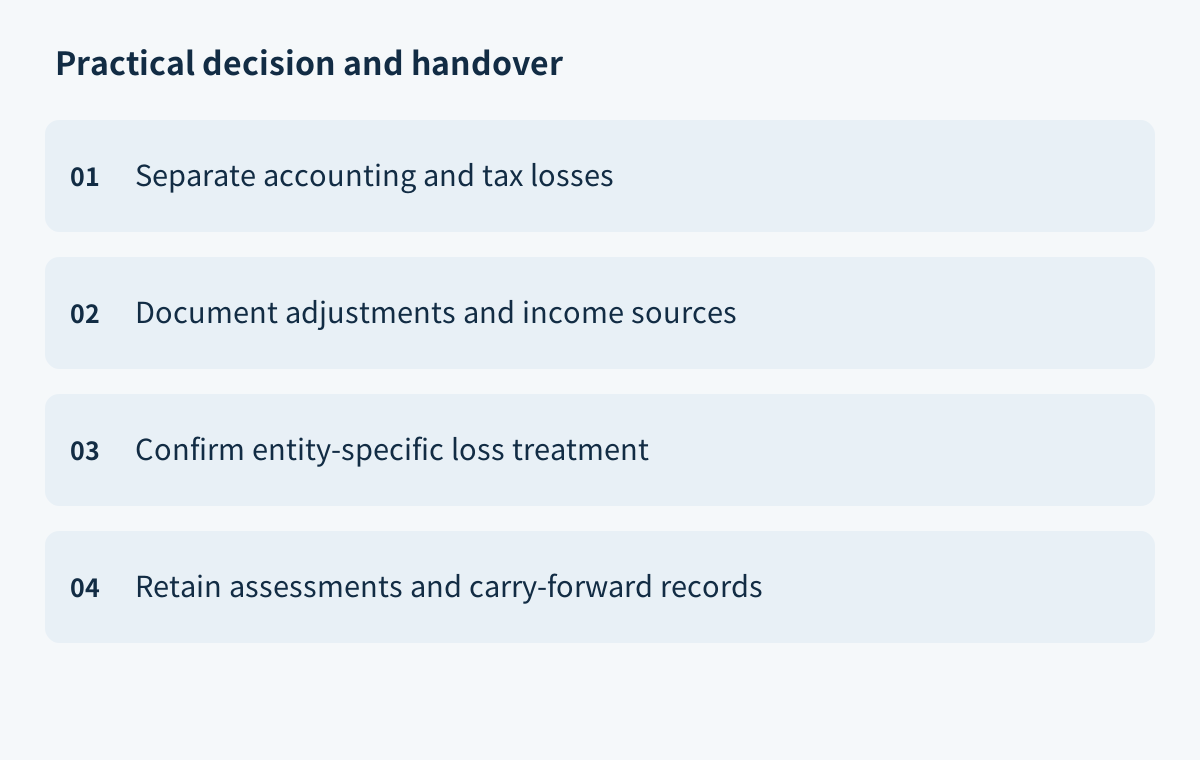
Compute the tax loss, check source and deduction adjustments, track it by taxpayer, respond to each return and keep records that support recalculation. For case-specific questions, use the website contact details to enquire. This article is not legal or tax advice and promises no outcome.