Published · Updated

After receiving a Hong Kong Profits Tax assessment, check whether the information is correct, whether the issue is an error in the filed return or disagreement with the assessment, and when objection and payment deadlines fall. Correction, objection and appeal are separate procedures; an objection does not automatically suspend payment. This guide summarises general official steps for Chinese, Taiwanese, Malaysian and other Chinese-speaking business owners planning to expand through a Hong Kong company. Follow the notice and case facts.
Correcting Information, Objecting to an Assessment and Appealing Are Separate Procedures
First identify the problem. Before an assessment is issued, write to the Assessor about a filed return error or omission, quote the Profits Tax file reference and attach relevant information. After issue, lodge written objection grounds; a supplementary letter is not necessarily a formal objection. IRD: Rectification of Errors or Omissions in a Profits Tax Return
If tax charged is excessive because of errors or omissions in a filed return, you may apply for revision within six years after the relevant year of assessment ends or within six months after the assessment notice was served, whichever is later. Detail the error and provide evidence. This corrects return information; it does not replace the one-month objection deadline. Record both requests and deadlines separately if both routes may apply.
If the Commissioner rejects an objection in a written determination, you may appeal to the Board of Review. Submit written notice with a copy of the determination and grounds within one month after it is transmitted; check the Board’s requirements. Board of Review: Functions and Procedures Confirm the document and year of assessment. For handover, record the issue, chosen route, deadline basis and owner, and retain filing copies. For general context, see Hong Kong Tax Filing: 3 Alternatives, 1 Hard Rule; it does not determine an individual case.
Check the Assessment Notice and Statutory Deadlines First
For each notice, record the year, issue date, service date if known, Profits Tax file reference or Charge No., Assessor’s notes, amount and instalment dates. Distinguish final assessments from provisional tax demands. Compare the assessment and computation with the filed return and mark differences.
The IRD says a written objection must reach it within one month after the assessment notice’s issue date and state the grounds. To correct return errors or omissions, the deadline is within six years after the year of assessment ends or six months after the relevant notice is served, whichever is later. These periods start from different events. Do not substitute an email arrival, portal login or agent’s forwarding date; one month is not always a fixed 30 days. IRD: Profits Tax Return Errors or Omissions FAQ
Maintain one tracker for dates, deadlines, filings, missing documents and owners. For a potentially late objection, the IRD’s Business Tax Portal guide asks for reasons. Prepare a timeline and evidence, and ask an external tax professional to check next steps. An enquiry or missing document does not stop a deadline, and a late objection is not automatically accepted. Log each notice separately; a later notice does not extend an earlier deadline.
Set Out Specific Grounds and Supporting Evidence
Tie each ground to an item in the assessment notice. Compare the notice, filed return, accounts and computation. Explain which fact, classification or calculation is disputed and how the difference arose. For an income or expense, identify its return field, the notice’s treatment, the amount claimed and the company’s calculation basis.
Gather relevant records such as ledgers, working papers, contracts, invoices, payment and delivery records, or correspondence. These are examples, not a fixed checklist. Index each item, amount, ground, calculation, document, fact supported and missing material. Match attachment names to index numbers and record dates, sources and versions.
For example, suppose an HK$80,000 expense was adjusted. This illustrates file organisation only; it does not establish deductibility or success. Match the return field and assessment note to the ledger, calculation, contract, invoice and payment record, noting what each supports. Mark a missing delivery record outstanding and assign an owner. For foreign-currency accounts, retain the original amount, conversion date, exchange-rate basis and working paper to recalculate the Hong Kong dollar figure. Preserve formulas and source data for estimates or allocations, identify items included in combined totals, and flag unsupported inferences for review.
Submit the Request and Keep Proof of Receipt
The IRD’s online Profits Tax guide separates objections, provisional-tax holdover requests and assessment-amendment requests. Its Business Tax Portal (BTP) and Tax Representative Portal (TRP) procedures do not apply to sole proprietorship businesses. Before choosing a request, a company or authorised representative should confirm account access, authority and company selection. The guide lists the year of assessment, notice issue date, Charge No., grounds and evidence; follow live portal requirements. IRD: Guide to Objection to Assessment, Holdover of Provisional Tax and Request to Amend Assessment (Profits Tax)
Before submitting, check the year, issue date, Charge No., request type, grounds and attachment versions. Do not confuse a holdover request with an objection, or an amendment request with an objection filed on time. If separate requests are needed, do not assume one covers the other. If the online route is unavailable for your business type or notice, confirm the method with the IRD; ordinary email is not automatically valid.
After filing, save the acknowledgement, request copy, attachment list, submission date and time, and any reference. Check uploaded files against retained versions; record the expected reply, follow-up date and owner for further documents. Clicking Submit or saving a draft does not prove receipt. If an acknowledgement omits files, keep the pre-submission list and confirm receipt through the published channel. For paper filing, retain posting and tracking proof, and check the official address and deadline.
An Objection Does Not Automatically Suspend Tax Payment
The IRD says tax remains payable by the assessment notice’s due date despite an objection or appeal, unless the Commissioner orders all or part of it held over while the matter is pending. A receipt, enquiry reference or pending professional advice is not a holdover order. Track payment dates with the dispute. For possible surcharges and recovery measures, see GovHK: Consequences of Not Paying Tax on Time. IRD: Payment of Tax in Dispute and Interest on Tax Held Over
Determine whether the matter concerns an assessment already made or provisional Profits Tax; these are separate requests. Check conditions, amounts and timing against the notice and case facts. An order may require security, such as tax reserve certificates or a banker’s undertaking. Applying does not guarantee approval. Interest may be payable on held-over tax ultimately found due, so confirm the order’s scope and later liability.
Track total tax, disputed and undisputed portions, due dates, payments, holdover status and any formal order. Until a written order arrives, follow the original due date; if only part is held over, manage the balance under the notice. If cash flow is tight, ask an external tax professional and follow the IRD’s process. An objection letter is not a payment arrangement. If a revised assessment or holdover order arrives after payment, retain the receipt and official reply, then check whether the amount was refunded, set off or remains outstanding.
Ask a Tax Professional to Check the Next Steps
For disputes involving cross-border transactions, income source, accounting classification, related parties, missing evidence, delay reasons or appeal, consult an appropriate Hong Kong tax, accounting or legal professional. Specify what to check: the deadline, whether to amend or object, whether the grounds match the calculation, missing evidence, and who will follow up on holdover or payment. Confirm who will check facts, prepare documents, file as representative and handle later IRD correspondence; qualifications and scopes vary.
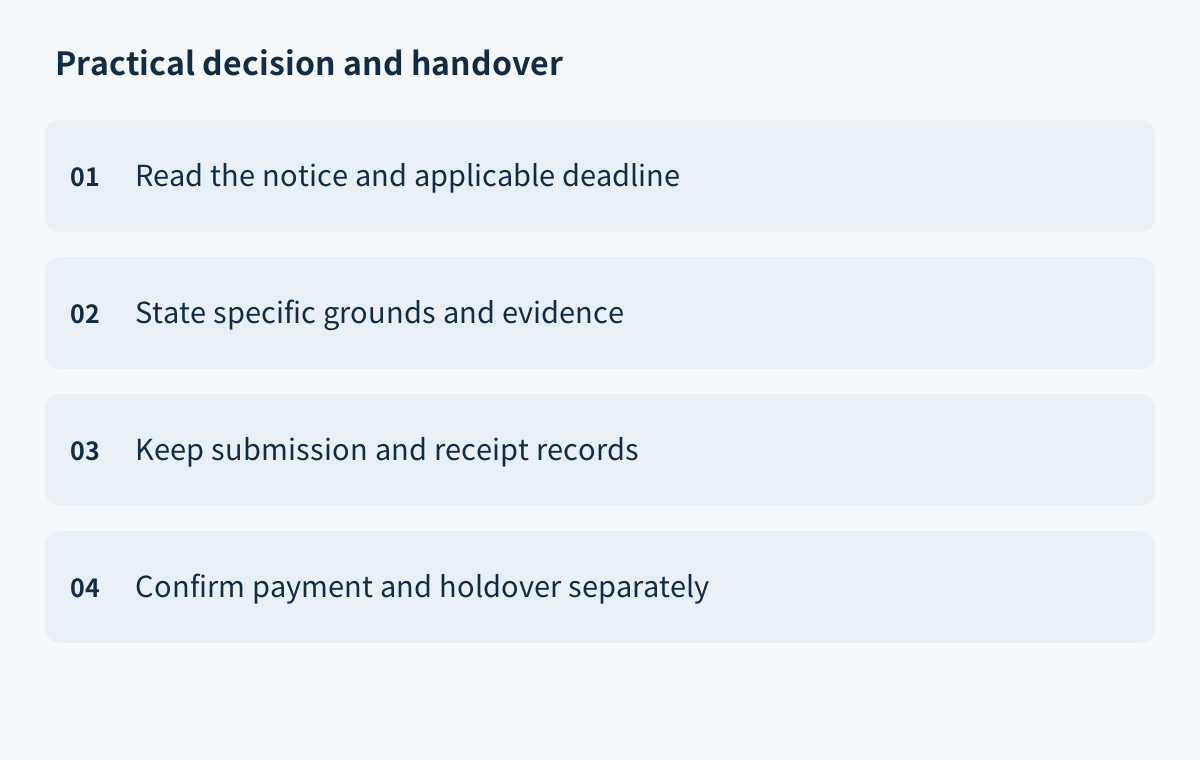
Prepare a handover pack with the notice and deadline tracker, filed return and accounts, disputed items and calculations, grounds summary, evidence index and missing items, filing copies and receipts, payments and any holdover order. Add questions and a response date. For an appeal, include the Commissioner’s written determination and prior correspondence, and check the Board’s requirements and deadline. Identify who holds original records and monitors deadlines.
For related background on cross-border profit sourcing or offshore income, see HK Offshore Profits Tax Claim: Steps, Costs and Evidence. It does not determine an objection’s outcome. Do not apply a general webpage, another company’s case or one document automatically to your assessment. If a professional will organise documents but not file as representative, record that scope and assign an internal owner to track deadlines and replies. Ask for written recommendations listing assumptions to verify, the next deadline and the responsible person. Resolve conflicts with the notice or accounts before filing.
For an assessment-specific question, use the contact details on the website to raise it. This article is general information, not legal or tax advice, and does not promise an outcome.